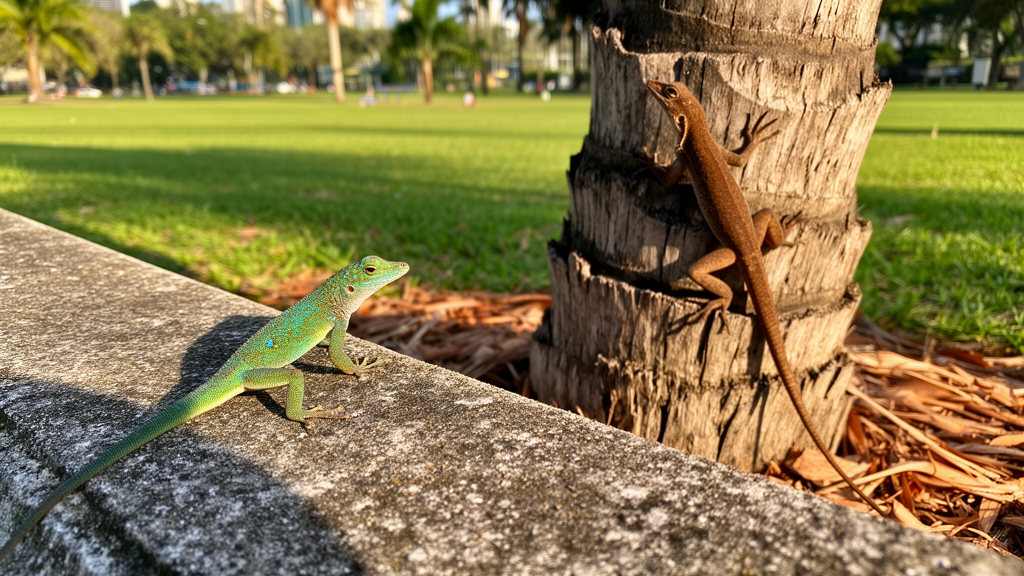
A meta-regression analysis of published morphometric records has revealed that urbanization and interspecific competition drive distinct, context-dependent body size changes in Caribbean anole lizards. Conducting a quantitative synthesis published in Frontiers in Ecology and Evolution, researchers Joseph H. Medina of Loyola University New Orleans and Sonny S. Bleicher of Western Colorado University examined how anthropized habitats and invasive congeners reshape the physical dimensions of native and non-native reptiles. Focusing on snout–vent length data from Green Anoles, native to the southeastern United States, and invasive Cuban Brown Anoles, the authors found that morphological changes do not follow a uniform trajectory. Instead, bodily shifts depend on sex, habitat type, and the duration of contact between competing species. While urban lizards generally measured larger than forest counterparts across baseline comparisons, prolonged coexistence triggered unexpected morphological contractions, demonstrating that adaptive trajectories in human-modified landscapes are deeply shaped by local ecological contexts.
The investigation evaluates how human-altered landscapes and biological invasions generate novel evolutionary pressures that accelerate physical divergence in terrestrial organisms. Anthropogenic environments impose multifaceted challenges, including artificial built surfaces, fragmented canopy cover, accumulated chemical pollutants, elevated thermal profiles, and disturbed biotic communities. These selective forces frequently drive shifts in behavioral repertoires, physiological tolerances, and anatomical structures across vertebrate species. Invasive species often exploit these human-disturbed habitats through life-history characteristics such as high reproductive rates, opportunistic foraging diets, and elevated tolerance of environmental turnover. Caribbean anoles represent an exemplary system for evaluating these pressures due to their well-documented history of adaptive radiation and microhabitat specialization across island and mainland settings. Male anoles rely extensively on competitive territorial displays, mate guarding, and agonistic encounters to secure resources and achieve reproductive success. When invasive Cuban Brown Anoles colonize territories inhabited by native Green Anoles, direct resource competition interacts with anthropogenic disturbance to reshape selective advantages tied to physical body size.
To measure morphological variation consistently across published studies, the researchers focused on snout–vent length, defined as the distance from the snout tip to the cloacal opening. Tail length was deliberately excluded because many lizards break and regenerate caudal structures, introducing substantial measurement error into comparative morphological datasets. Snout–vent length offers an established, standardized benchmark for assessing somatic growth, developmental stages, sexual dimorphism, and social rank in squamate reptiles. In anoles, larger dimensions correlate with physical performance traits, territory dimensions, and competitive dominance during social interactions. The authors evaluated two ecologically distinct congeners: the native Green Anole, an arboreal insectivore favoring dense canopy foliage, and the Cuban Brown Anole, a ground-dwelling competitor adapted to open, disturbed substrates. Both species exhibit significant sexual size dimorphism, with males measuring larger than females. They share an eighteen-month average wild lifespan and insectivorous diets consisting primarily of small arthropods, providing comparable developmental baselines across natural and built habitats.
Compiling the empirical dataset involved systematic literature mining across Elsevier ScienceDirect, JSTOR, and Google Scholar between February and May 2025, with re-evaluation completed in September 2026. The search combined species names, habitat keywords contrasting urban and forest environments, and the target morphometric measurement. To overcome institutional access constraints, the authors screened bibliographies from relevant publications and investigated studies produced by prominent herpetological research groups. The literature selection yielded twenty eligible publications, encompassing peer-reviewed papers as well as master’s and doctoral theses that reported mean snout–vent length, sample size, and dispersion metrics. From these works, the researchers harvested 126 sex-specific population samples representing distinct geographic locations and habitat classifications. Urban habitats were defined as built and anthropogenically modified environments, whereas forest habitats comprised natural vegetated landscapes. When specific collection years were missing, sampling dates were imputed as three years prior to publication based on the empirical dataset median, while island land areas and decadal invasion timelines were cataloged.
Statistical modeling was conducted in R using the metafor package, implementing a restricted maximum likelihood meta-regression framework designed to test morphometric variation across taxa, ranges, habitats, and time scales. Random effects included a study identifier to minimize inter-study methodological variance, an invasion time factor capturing shared variation across invasion intervals, and a continuous autoregressive correlation structure addressing within-study temporal autocorrelation. To identify the most effective temporal scale, the authors compared models using exact sampling years, ten-year decadal intervals, and five-year bins. Although the decadal aggregation yielded the lowest small-sample Akaike Information Criterion value of 2969, the researchers selected the five-year interval model, which achieved a comparable criterion of 3038 while outperforming the exact year model. The five-year scale maintained statistical power and sample diversity while providing adequate temporal resolution to detect microevolutionary adjustments across short generation times. Incorporating normalized island land area as a covariate, the final model evaluated twenty-six fixed-effect parameters across environmental, temporal, and taxonomic variables.
The meta-regression fixed effects demonstrated clear baseline morphological divergence across sexes, habitat structures, taxonomic groups, and insular environments. Male lizards were substantially larger than females, exceeding female snout–vent length by an average of 12.34 millimeters across baseline comparisons. Lizards inhabiting urban environments measured 3.89 millimeters larger overall than forest-dwelling conspecifics, supporting initial expectations regarding enhanced competitive performance and thermal regulation in warmer urban microclimates. Across taxonomic groups, invasive Cuban Brown Anoles were 7.81 millimeters larger than native counterparts from their home range, while native Green Anoles were 8.7 millimeters larger than native Cuban Brown Anoles. Island versus continental status alone did not yield a significant primary effect, but within island systems, land area exerted a significant negative influence, decreasing lizard size by 0.223 millimeters per unit increase in log-transformed area. However, post-hoc weighted regressions revealed that this negative scaling with island area occurred exclusively among native populations, whereas invasive island lizards exhibited high variance without significant correlation.
Interaction analyses revealed complex morphology across sex and habitat categories that contradicted simplistic assumptions of universal urban gigantism. For native Green Anoles, males were 4.18 millimeters smaller than the combined multi-taxon mean, while urban females measured 4.6 millimeters below the general female baseline. Urban invasive Cuban Brown Anoles also exhibited notable size reductions relative to their respective sex baselines, with urban females measuring 10.95 millimeters smaller and urban males measuring 8.11 millimeters smaller than average. Post-hoc pairwise comparisons using Bonferroni-Holm corrections documented significant morphological separations between species across specific habitats. In forest environments, female Green Anoles were 8.7 millimeters larger than native female Cuban Brown Anoles. In urban habitats, invasive Cuban Brown Anoles of both sexes were significantly smaller than co-occurring Green Anoles, with females measuring 7.25 millimeters smaller and males measuring 7.01 millimeters smaller. These findings demonstrate that urban selective pressures operate in a highly context-dependent manner across species, sexes, and localized environments.
The investigation identified striking contradictions between two separate temporal metrics evaluated within the data. When assessing sampling dates grouped into five-year bins, forest-dwelling male invasive Cuban Brown Anoles appeared to decrease in size over time, while native Green Anoles showed modest morphological gains. However, when evaluating the estimated duration of invasive presence measured in decades, post-hoc weighted regressions revealed contrasting biological patterns. In forest habitats where both species coexisted, invasive male Cuban Brown Anoles increased in snout–vent length by 0.54 millimeters per decade of invasion. In contrast, coexisting Green Anole females decreased by 0.81 millimeters per decade, and males showed a downward trend of 0.35 millimeters per decade. In urban environments, both native and invasive populations showed consistent downward trends in size over decades of invasion. The authors concluded that collection date trends primarily reflect historical publication and sampling biases, whereas decadal invasion metrics capture actual morphological adjustments driven by sustained interspecific competition.
These divergent morphological trajectories align with theoretical models of ecological niche displacement and density-dependent behavioral adaptation. In forest ecosystems where invasive Cuban Brown Anoles remain relatively uncommon, competitive and predatory pressures maintain strong selection for large, robust males capable of colonizing new habitats. Conversely, native Green Anoles displaced toward higher arboreal perches experience restricted spatial resources, favoring smaller body sizes that reduce energetic maintenance requirements. In urban settings, high lizard densities alter social dynamics and mating behaviors. Dense populations diminish the effectiveness of territorial defense and mate guarding, favoring alternative mating strategies such as opportunistic copulation. Because smaller body sizes facilitate agility and demand fewer energetic resources, selective pressures favor smaller individuals as invaded urban communities reach demographic saturation. Consequently, the large, aggressive phenotypes characteristic of initial colonization fronts are gradually replaced by smaller phenotypes adapted to intense local competition, illustrating how competitive pressures and habitat constraints interact over time to reshape optimal organismal size.
The authors highlighted several critical methodological caveats and data limitations that restrict the broader interpretation of historical morphological patterns. Published studies exhibit significant geographic clustering and a strong historical reporting bias toward male-only samples, leaving female populations comparatively underrepresented across both native and invaded ranges. Furthermore, an absence of historical records between four and eleven decades post-invasion limits continuous observation of long-term developmental trajectories. Classifying diverse environments into broad urban and forest categories necessarily simplifies structural variations across distinct geographical locations and historical eras. Reporting norms have also evolved over time, with modern studies generally featuring larger sample sizes, enhanced statistical controls, and greater focus on urban ecosystems than older historical literature. These gaps underscore the pressing need for standardized morphometric protocols, expanded sampling of female cohorts, and sustained multi-decade monitoring of native and introduced populations. While acknowledging these constraints, the study demonstrates the value of meta-regression in detecting rapid, context-dependent morphological adjustments unfolding across the Anthropocene.
Subject of Research: Morphological adaptation of Anolis lizards under urbanization and invasive species competition
Article Title: Changing in the face of invasion and urbanization: meta-analytical support for context-dependent morphological adaptation in Anolis lizards
Article References: Medina, J. H., & Bleicher, S. S. (2026). Changing in the face of invasion and urbanization: meta-analytical support for context-dependent morphological adaptation in Anolis lizards. Frontiers in Ecology and Evolution, 14, Article 1926907. https://doi.org/10.3389/fevo.2026.1926907
Image Credits: AI Generated
DOI: 10.3389/fevo.2026.1926907
Keywords: Anolis lizards, urban ecology, invasive species, morphological adaptation, meta-regression, Green Anole, Cuban Brown Anole, snout-vent length, Changing, face, invasion, urbanization
News Source: Gavin Prescott. (November 9, 2026). Urbanization and Invasive Competition Reshape Lizard Body Sizes Across Decades. Scienmag.