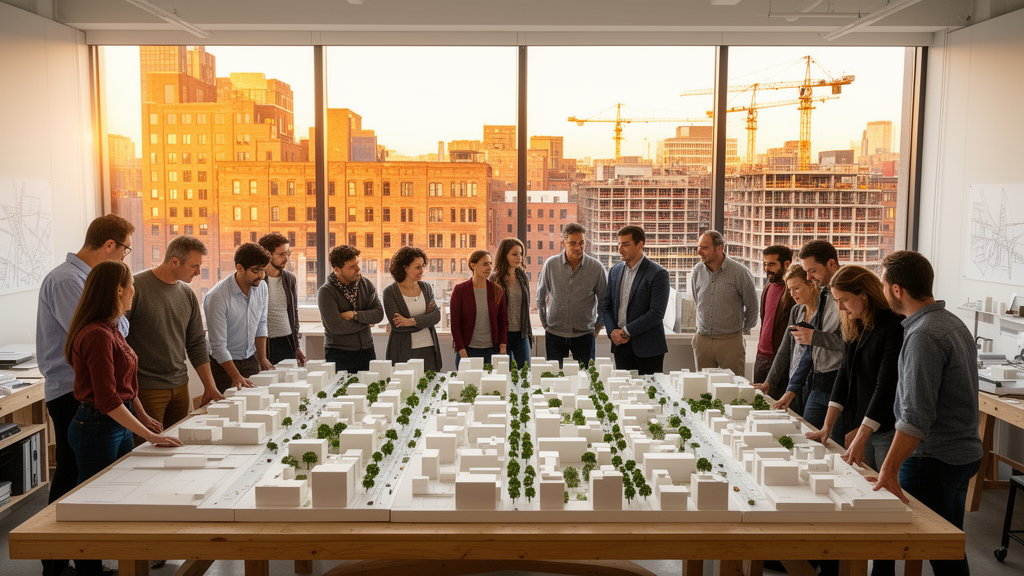
Gentrification has long been treated as a dirty word in urban policy, a shorthand for displacement, exclusion and the hollowing out of working-class neighbourhoods. Now a transnational roundtable convened under the Humboldt Cities Network, bringing together scholars and practitioners from Europe and China, argues that the concept deserves a more careful, context-dependent reading. Writing in the journal Frontiers of Urban and Rural Planning, the contributors reframe gentrification not as a uniform outcome of urban change but as a multi-dimensional process whose mechanisms vary sharply across land regimes, state capacities and development trajectories.
The roundtable’s starting point is a shared analytical definition. Gentrification, in the formulation most contributors converge on, involves two interrelated mechanisms: the profit-oriented reinvestment of capital in previously underinvested urban areas, and the replacement of lower-income groups by more affluent populations during that reinvestment. Crucially, this means processes in which existing residents upgrade their living conditions without being replaced fall outside the concept altogether. The contributors also draw on Marcuse’s typology of displacement, distinguishing physical displacement, economic displacement, displacement pressure and exclusionary displacement through price barriers, with exclusionary displacement identified as central to understanding long-term shifts in neighbourhood composition.
The European contributions trace how the field itself has changed. In Germany, early debates about pioneer cultures and alternative lifestyles have given way to politically charged discussions driven by housing crises and social mobilization. Yet as political attention has intensified, the research landscape has become fragmented, with many studies fixating on micro-level phenomena at the expense of the comprehensive political-economic analysis the field requires. One panellist highlights the dual nature of state intervention: public space improvements and infrastructure investments often elevate land values and intensify social replacement, while regulatory instruments such as value-protection mechanisms attempt to mitigate those effects. The interaction between market expansion and social regulation manifests differently across federal systems, centralized administrative traditions and state-entrepreneurial systems.
A structural relationship that urban policy has consistently underestimated, another contributor argues, is the link between public investment in urban quality and the gentrification dynamics it sets in motion. When cities invest in parks, environmental upgrades or public space improvements, surrounding land values rise, higher-income groups are attracted, and neighbourhood social composition shifts. What enables this dynamic is the public sector’s inability to recapture the land-value uplift generated by its own investments; the financial gains flow disproportionately to private landowners and investors rather than back into public resources. Regeneration pursued in the name of urban quality may thus simultaneously intensify the socio-spatial divisions it nominally seeks to address.
The Chinese contributions complicate the picture further. In many Western cities, gentrification followed a recognizable sequence: prolonged suburbanization, urban decline, then re-centralization driven by middle-class cultural and lifestyle preferences. In China, suburbanization and inner-city redevelopment proceed simultaneously under strong state regulation of land, altering both the spatial logic and the social dynamics of the process. Cases from Guangdong, Shanghai and Nanjing show overlapping interests involving heritage conservation, tourism, state-owned assets and commercial redevelopment producing uneven and sometimes internally contradictory trajectories. Regional variation within China is substantial enough that the contributors caution against positing a unified Chinese model of gentrification.
The state’s role is perhaps the sharpest point of contrast. Whereas much of the gentrification literature assumes market dynamics take the lead and the state functions as a regulator, in China the relationship is effectively reversed: the state is, in many instances, the principal driver of gentrification. The Xintiandi project in Shanghai is cited as emblematic, with government agencies centrally involved in land acquisition, resident relocation, development coordination and the distribution of land-lease revenues. China’s fiscal system gives local governments a direct material stake in land-lease income, meaning regeneration serves simultaneously as urban policy and fiscal strategy. More recently, approaches have shifted toward the principle of keeping the old structure first, modifying second and demolishing third, with small-scale incremental regeneration gaining wider adoption, though the structural pressures of land finance remain in place.
Shanghai’s transformation models illustrate the multi-modal character of the process. Three primary models are identified: comprehensive demolition and redevelopment, exemplified by Xintiandi, where complete relocation enables rapid restructuring; gradual functional substitution, as in Tianzifang, where commercial expansion and rising rents contribute to resident outmigration; and micro-regeneration, which maintains the residential base while introducing creative industries and small-scale commercial uses. Emerging rural gentrification, driven by tourism and consumption upgrades, is also noted. Yet some local conditions resist the conventional narrative: in certain historic houses of the former French Concession, rental levels remain lower than commonly assumed, enabling international students to reside there on grounds of affordability as well as lifestyle.
Not all cases fit the negative template. In Changsha, residents affected by demolition received equivalent housing in the same location rather than being relocated to the periphery, and public spaces were deliberately designed to sustain existing local practices such as playing cards, mahjong and socializing over tea. The result, according to the roundtable, was a regenerated environment that enhanced livability while maintaining cultural continuity and proved popular with visitors without producing social displacement. In Shanghai, some residents supported redevelopment because of compensation arrangements, asset appreciation or anticipated improvements in living environments, and some projects subsequently stimulated stronger community governance and resident engagement. The contributors stress this does not mean gentrification necessarily leads to desirable outcomes, but that more dialectical, differentiated analysis is warranted.
The concept’s boundaries are also being tested by new drivers. Several contributors point to the transition to carbon neutrality as the next frontier: meeting that target requires substantial investment in green infrastructure, energy retrofits and building renovation at a scale public budgets cannot sustain, and private capital’s involvement is likely to drive up housing costs and generate new displacement pressures alongside environmental gains. Past experience offers limited reassurance, since public-sector measures have shown some capacity to moderate gentrification in the short term but sustaining effective regulation over longer periods proves politically and institutionally difficult. Touristification, studentification and financialization in European cities compound the pressure, and one panellist argues that in contexts such as Austria, housing shortages stem not from too little construction but from housing built for investor interests rather than residential needs.
The roundtable’s conclusion is deliberately double-edged. Gentrification is neither exclusively negative nor uniformly harmful: alongside displacement and socio-spatial polarization, regeneration has in some contexts produced tangible improvements in infrastructure, public amenities and environmental quality. The critical question is not whether change occurs, but how its benefits and burdens are distributed and whether existing residents retain meaningful access to the neighbourhoods being transformed. Gentrification is best understood as a long-term, multi-phase process whose full consequences may only become visible over years or decades, with European cases showing incremental displacement accumulating through market dynamics and Chinese cases showing state-facilitated redevelopment compressing the same trajectory into shorter, more intense episodes. Whether a neighbourhood can absorb investment without wholesale social replacement depends substantially on its territorial capital, the historically embedded networks, institutional protections and community resources that shape local resilience. As the concept increasingly intersects with heritage conservation, tourism, rural transformation and ecological transition, the contributors warn of a real risk of conceptually overstretching the term while losing sight of its core concern with long-term changes in social accessibility and urban inequality.
Subject of Research: Gentrification and urban regeneration compared across European and Chinese contexts
Article Title: Roundtable discussion on rethinking gentrification through urban regeneration
Article References: Wei, R., Huang, H., Yan, J., Bernt, M., Elisei, P., Fan, L., Gan, J., Gruber, E., Jiang, X., Krupski von Mansberg, A., Kunzmann, K., Walter, J., Wu, J., Yi, X., Yin, C., & Yin, J. (2026). Roundtable discussion on rethinking gentrification through urban regeneration. Frontiers of Urban and Rural Planning, 4(1), Article 14. https://doi.org/10.1007/s44243-026-00085-6
Image Credits: AI Generated
DOI: 10.1007/s44243-026-00085-6
Keywords: gentrification, urban regeneration, displacement, urban planning, China, Europe, land finance, territorial capital, carbon neutrality, housing policy, state-led redevelopment, Humboldt Cities Network
News Source: Denise Maddox. (October 29, 2026). Urban Regeneration Experts Rethink Gentrification Across Europe and China. Scienmag.