The discovery, reported in the journal Nature, opens door for reimagining the energy grid, technology, society
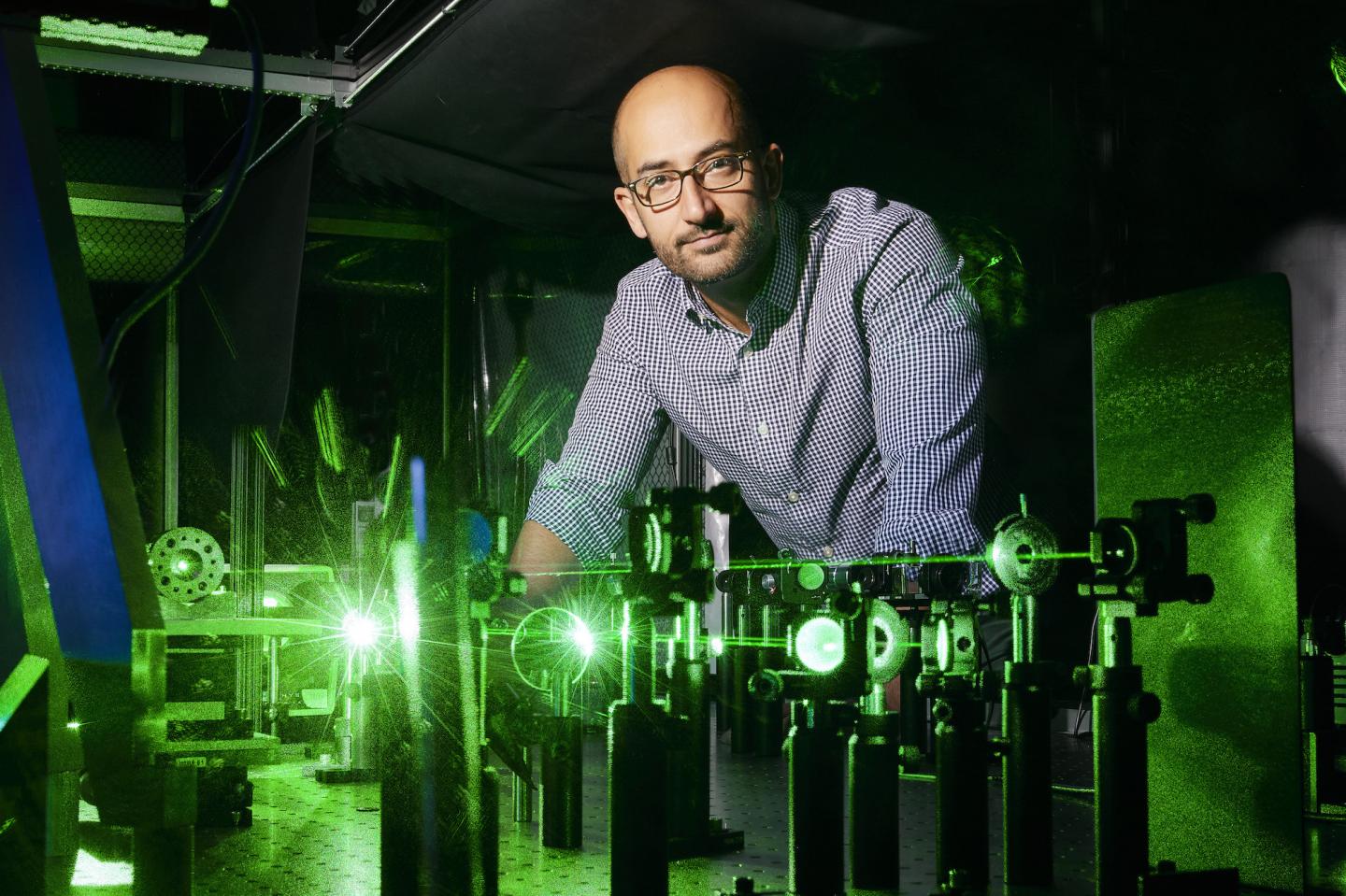
Credit: Josh Hawkins/UNLV Photo Services
Physicists from the University of Nevada, Las Vegas and the University of Rochester have made a breakthrough in the long sought-after quest for a room-temperature superconductor, what they call the “holy grail” of energy efficiency.
The research team led by University of Rochester physicist Ranga Dias in collaboration with Ashkan Salamat, assistant professor of physics and astronomy at UNLV, established room temperature superconductivity in a diamond anvil cell – a small, handheld, and commonly used research device that enables the compression of tiny materials to extreme pressures – pressures that you’d only find at the center of the Earth.
Though the phenomena observed by the research team and reported today as the cover story in the journal Nature was at an early stage, or fundamental level, the discovery has implications for how energy is stored and transmitted. It could also one day change how everyday technological devices – from laptops to MRI machines – are powered, how people and goods are transported, and how the whole of society could operate years into the future.
“It’s a revolutionary game changer,” said Salamat, who leads the Nevada Extreme Conditions Lab at UNLV, a newly formed, multidisciplinary group that explores fundamental experimental, computational, and engineering problems of materials under high pressure. “The discovery is new, and the technology is in its infancy and a vision of tomorrow, but the possibilities are endless. This could revolutionize the energy grid, and change every device that’s electronically driven.”
Superconductivity is a remarkable quantum phenomena as its hallmark properties include the expulsion of magnetic fields and zero resistance electrical flow, meaning that the energy current passing through a circuit is conducted infinitely and perfectly, with no loss of power.
Since its first observation in 1911, scientists have observed superconductivity only at very low temperatures — temperatures within a few degrees of absolute zero, (minus 273 degrees Celsius), which would make widespread and practical application unattainable. In 1968, however, scientists predicted that metallic hydrogen – accessed at very high pressures – could be the key ingredient to discovering superconductivity at or above room temperature.
“Because of the limits of low temperature, materials with such extraordinary properties have not quite transformed the world in the way that many might have imagined. However, our discovery will break down these barriers and open the door to many potential applications,” Dias said in a University of Rochester release.
In Dias’ lab at the University of Rochester, the research team worked to chemically synthesize hydrogen in an effort to solve the century-old problem. Like a materials search engine, Salamat and Dias used the diamond anvil cell to scan through temperature and pressure space to find the right combination that would drive carbon sulfur hydrogen first into a metallic state, and then even further into a room-temperature superconducting state.
The U.S. energy grid, Salamat notes, which is made up of metallic cables loses about $20 billion a year to dissipating current. Though a metal like copper exhibits the least resistance of nearly all metals, it’s still resistant. Running current through copper and other metals generates heat, and as a consequence energy is lost (think of the heat exiting the bottom of your laptop).
Room-temperature superconductivity would allow current to flow through a closed loop forever, meaning that no energy would be lost. In the long distant future, such a state could enable a solar farm in the Southwest U.S. to transport energy to the East Coast with no loss, or MRI machines – which currently need liquid helium to operate – to be deployed to war zones. It could change how electronics are designed and built, and could revolutionize the transportation system.
The discovery of the room-temperature superconductor, Salamat said, was not what you would call a “eureka” moment, but rather, a methodical, targeted effort by he and Dias. Their next step is to develop a protocol that releases the pressure for these materials while also retaining their superconducting properties.
To support their continued work on the problem, Dias and Salamat have started a new company, Unearthly Materials, to find a path to room temperature superconductors that can be produced at scale at ambient pressure.
“We live in a semiconductor society,” Salamat said. “With this kind of technology, you can take society from a semi-conducting society into a superconducting society.”
###
Media Contact
Natalie Bruzda
[email protected]
Original Source
https:/
Related Journal Article
http://dx.