Perovskite solar cells (PSCs) are highly regarded for their exceptional performance and straightforward fabrication. However, traditional hole transport layers (HTLs) like Poly (triarylamine) (PTAA), Nickel Oxide (NiOx), and poly (3,4-ethylenedioxythiophene)-poly (styrenesulfonate) (PEDOT) have inherent limitations that impede efficiency and stability. These materials often suffer from issues such as hydrophobicity, high reactivity, and acidity, which negatively affect the overall performance of PSCs. Due to these challenges, there is a pressing need to explore and develop novel HTLs that can overcome these limitations and further enhance the capabilities of PSCs.
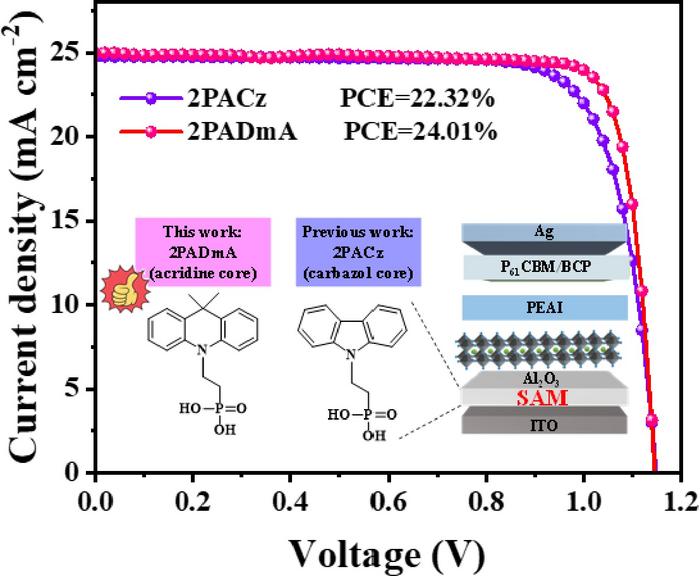
Credit: Energy Materials and Devices, Tsinghua University Press
Perovskite solar cells (PSCs) are highly regarded for their exceptional performance and straightforward fabrication. However, traditional hole transport layers (HTLs) like Poly (triarylamine) (PTAA), Nickel Oxide (NiOx), and poly (3,4-ethylenedioxythiophene)-poly (styrenesulfonate) (PEDOT) have inherent limitations that impede efficiency and stability. These materials often suffer from issues such as hydrophobicity, high reactivity, and acidity, which negatively affect the overall performance of PSCs. Due to these challenges, there is a pressing need to explore and develop novel HTLs that can overcome these limitations and further enhance the capabilities of PSCs.
A team of researchers from Yunnan University and the University of Science and Technology of China has designed and synthesized a new dimethyl acridine-based self-assembled monolayer (SAM), [2-(9,10-dihydro-9,9-dimethylacridine-10-yl)ethyl] phosphonic acid (2PADmA), for use as a hole transport layer in inverted PSCs. The study (DOI: 10.26599/EMD.2024.9370038) was published in Energy Materials and Devices on June 25, 2024.
The research team synthesized a novel dimethyl acridine-based SAM, 2PADmA, and employed it as a hole-transporting layer in inverted PSCs. This SAM modulates perovskite crystallization, enhances carrier transport, passivates defects, and reduces nonradiative recombination. The 2PADmA-based devices achieved a power conversion efficiency (PCE) of 24.01%, significantly higher than the 22.32% PCE of devices using the commonly employed 2PACz SAM. The increased performance is primarily due to an improved fill factor (FF) of 83.92% compared to 78.42% for the 2PACz-based devices. Additionally, the 2PADmA-based devices showed enhanced stability, retaining about 98% of their initial PCE after 1080 hours of dark storage and 87% after 400 hours of heating at 85°C, demonstrating superior performance and durability.
Dr. Bing Cai, the lead researcher from Yunnan University, stated, “The development of the 2PADmA SAM represents a significant advancement in the field of PSCs. This novel SAM not only improves the efficiency and stability of PSCs but also offers a new approach to designing advanced HTLs for future solar cell technologies.”
The innovative 2PADmA SAM opens up new possibilities for improving the efficiency and stability of PSCs, making them more viable for commercial applications. This advancement could lead to the development of more efficient and durable solar energy systems, contributing to the global transition to renewable energy sources and supporting efforts to combat climate change.
This work is granted by National Natural Science Foundation of China (Grant Nos.51925206, 52302052), the Strategic Priority Research Program of the Chinese Academy of Sciences (Grant No. XDB0450301), Yunnan Provincial Science and Technology Project at Southwest United Graduate School (Grant No. 202302AO370013) and Huacai Solar Co., Ltd.
About Energy Materials and Devices
Energy Materials and Devices is launched by Tsinghua University, published quarterly by Tsinghua University Press, exclusively available via SciOpen, aiming at being an international, single-blind peer-reviewed, open-access and interdisciplinary journal in the cutting-edge field of energy materials and devices. It focuses on the innovation research of the whole chain of basic research, technological innovation, achievement transformation and industrialization in the field of energy materials and devices, and publishes original, leading and forward-looking research results, including but not limited to the materials design, synthesis, integration, assembly and characterization of devices for energy storage and conversion etc.
About SciOpen
SciOpen is an open access resource of scientific and technical content published by Tsinghua University Press and its publishing partners. SciOpen provides end-to-end services across manuscript submission, peer review, content hosting, analytics, identity management, and expert advice to ensure each journal’s development. By digitalizing the publishing process, SciOpen widens the reach, deepens the impact, and accelerates the exchange of ideas.
Journal
Energy Materials and Devices
DOI
10.26599/EMD.2024.9370038
Article Title
Dimethyl acridine-based self-assembled monolayer as a hole transport layer for highly efficient inverted perovskite solar cells
Article Publication Date
25-Jun-2024