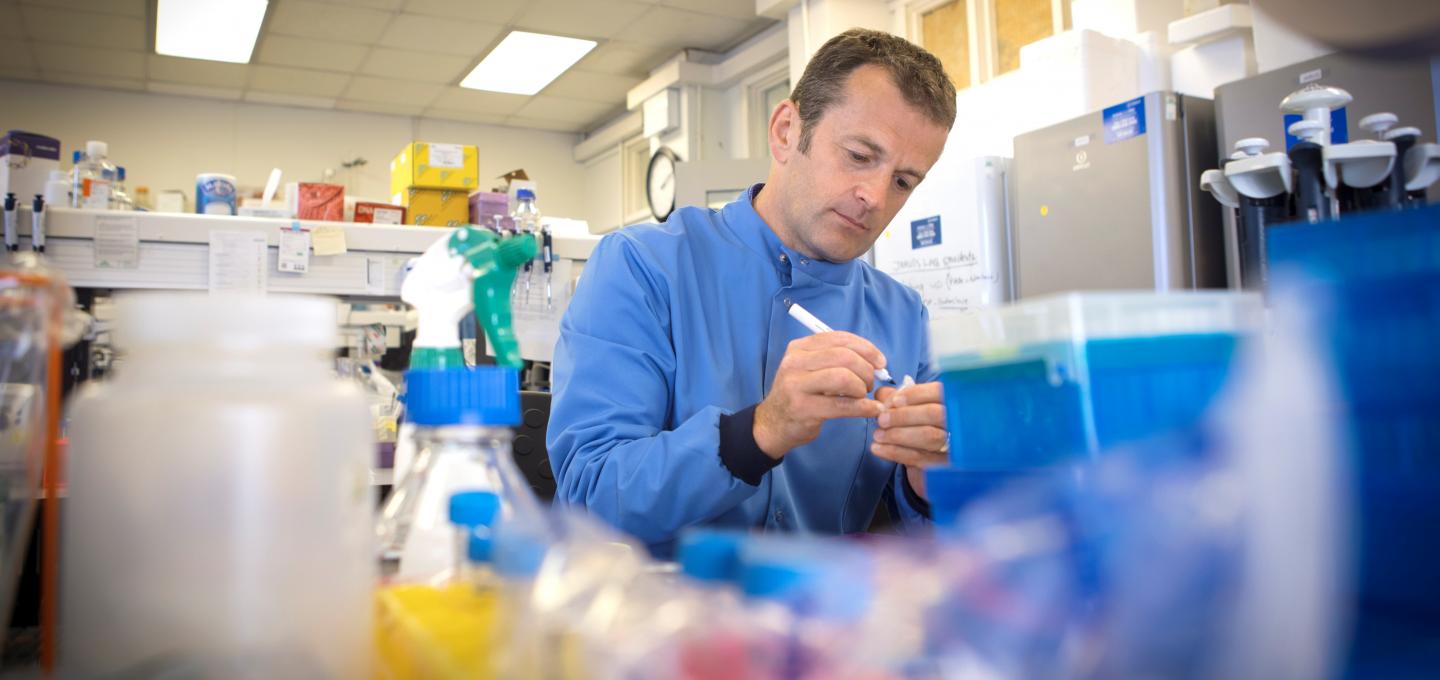
Credit: University of Plymouth
Amprologix Limited, a University of Plymouth spinout company, has won a £1.2 million contract from the Department for Health and Social Care to accelerate development and scale up its lead antibiotic candidate to tackle antimicrobial resistant MRSA and related superbugs.
Amprologix was established in 2018 to commercialise the work of Mathew Upton, Professor of Medical Microbiology in the University’s Institute of Translational and Stratified Medicine (ITSMed).
The company has now been awarded funding by the Small Business Research Initiative (SBRI), part of Innovate UK, to make its epidermicin NI01 antibiotic ready for the first phase of human clinical trials during early 2021.
Amprologix’s first product is expected to be a nasal cream containing epidermicin NI01 to prevent MRSA infections.
Epidermicin is derived from bacteria found on human skin, and work conducted to date shows a single dose to be as effective as six doses of the current gold standard treatment in a relevant model of MRSA infection.
Antimicrobial-resistant bacteria kill more than 25,000 people a year in Europe. The drug resistant ‘superbug’ MRSA was named last year as a “high priority” target for antibiotic research by the World Health Organisation and it is a leading cause of healthcare associated infection (HCAI).
Professor Upton, chief scientific officer at Amprologix, initially developed the patented technology while at the University of Manchester, which owns an equity share in the company through UMI3 Ltd, its commercialisation arm. Frontier IP, the University’s commercialisation partner, holds a 10 per cent stake in return for providing a range of commercialisation services.
Professor Upton said: “I feel very strongly that epidermicin has excellent potential for use in nasal decolonisation to prevent skin and wound infections, like those caused by MRSA. Development of NI01 could have immense benefits for patients, so I’m genuinely excited about this work and generating the data needed to enter phase 1 trials.”
Dr Gordon Barker, chief executive officer of Amprologix, added: “Despite the urgent need for new antibiotics and new approaches to treatment, it remains extremely difficult to fund new drug discovery ventures in this space. The government-backed SBRI programme is a world-leading scheme to address this market failure and we’re really grateful for their support, which will accelerate the development of next generation life-saving medicines like NI01.”
Amprologix has already secured industry involvement in its work through a strategic partnership with Ingenza Limited. Ingenza, a leader in industrial biotechnology and synthetic biology, is also a shareholder in Amprologix and has been developing a bespoke recombinant process for production of epidermicin.
For the SBRI-funded project, Professor Upton will optimise the formulation of epidermicin and conduct a pre-clinical toxicology evaluation. Amprologix will license optimised microbial based production technology from Ingenza’s biologics manufacturing platform to produce the new antibiotics at scale.
Professor Upton is also working separately with Ingenza, IBM and the National Physical Laboratory, using Artificial Intelligence to create a portfolio of novel, adaptable antibiotic candidates for future exploitation.
Dr Ian Fotheringham, managing director of Ingenza, said: “We are developing advanced biologics manufacturing technologies to address exactly this kind of critical unmet therapeutic need. Our platform will underpin the future success of this exciting new family of potent and selective antimicrobials.”
Neil Crabb, chief executive officer of Frontier IP, said: “We’re delighted the SBRI is backing this programme, which validates the best approach to IP commercialisation. Through Amprologix and Professor Upton’s ground-breaking science, there is huge potential to prove the efficacy of epidermicin and identify further new antibiotics that can be manufactured at scale.”
###
Media Contact
Alan Williams
[email protected]
44-175-258-8004
Original Source
https:/