

• HOME
  • NEWS
  • EXPLORE
    • CAREER
      • Companies
      • Jobs
    • EVENTS
    • iGEM
      • News
      • Team
    • PHOTOS
    • VIDEO
    • WIKI
  • BLOG
  • COMMUNITY
    • FACEBOOK
    • INSTAGRAM
    • TWITTER
Monday, September 7, 2026
BIOENGINEER.ORG
No Result
View All Result
  • Login
  • HOME
  • NEWS
  • EXPLORE
    • CAREER
      • Companies
      • Jobs
        • Lecturer
        • PhD Studentship
        • Postdoc
        • Research Assistant
    • EVENTS
    • iGEM
      • News
      • Team
    • PHOTOS
    • VIDEO
    • WIKI
  • BLOG
  • COMMUNITY
    • FACEBOOK
    • INSTAGRAM
    • TWITTER
  • HOME
  • NEWS
  • EXPLORE
    • CAREER
      • Companies
      • Jobs
        • Lecturer
        • PhD Studentship
        • Postdoc
        • Research Assistant
    • EVENTS
    • iGEM
      • News
      • Team
    • PHOTOS
    • VIDEO
    • WIKI
  • BLOG
  • COMMUNITY
    • FACEBOOK
    • INSTAGRAM
    • TWITTER
No Result
View All Result
Bioengineer.org
No Result
View All Result
Home NEWS Science News Biology

University researchers discover new species of venomous snake

Bioengineer by Bioengineer
July 25, 2018
in Biology
Reading Time: 2 mins read
0
Share on FacebookShare on TwitterShare on LinkedinShare on RedditShare on Telegram
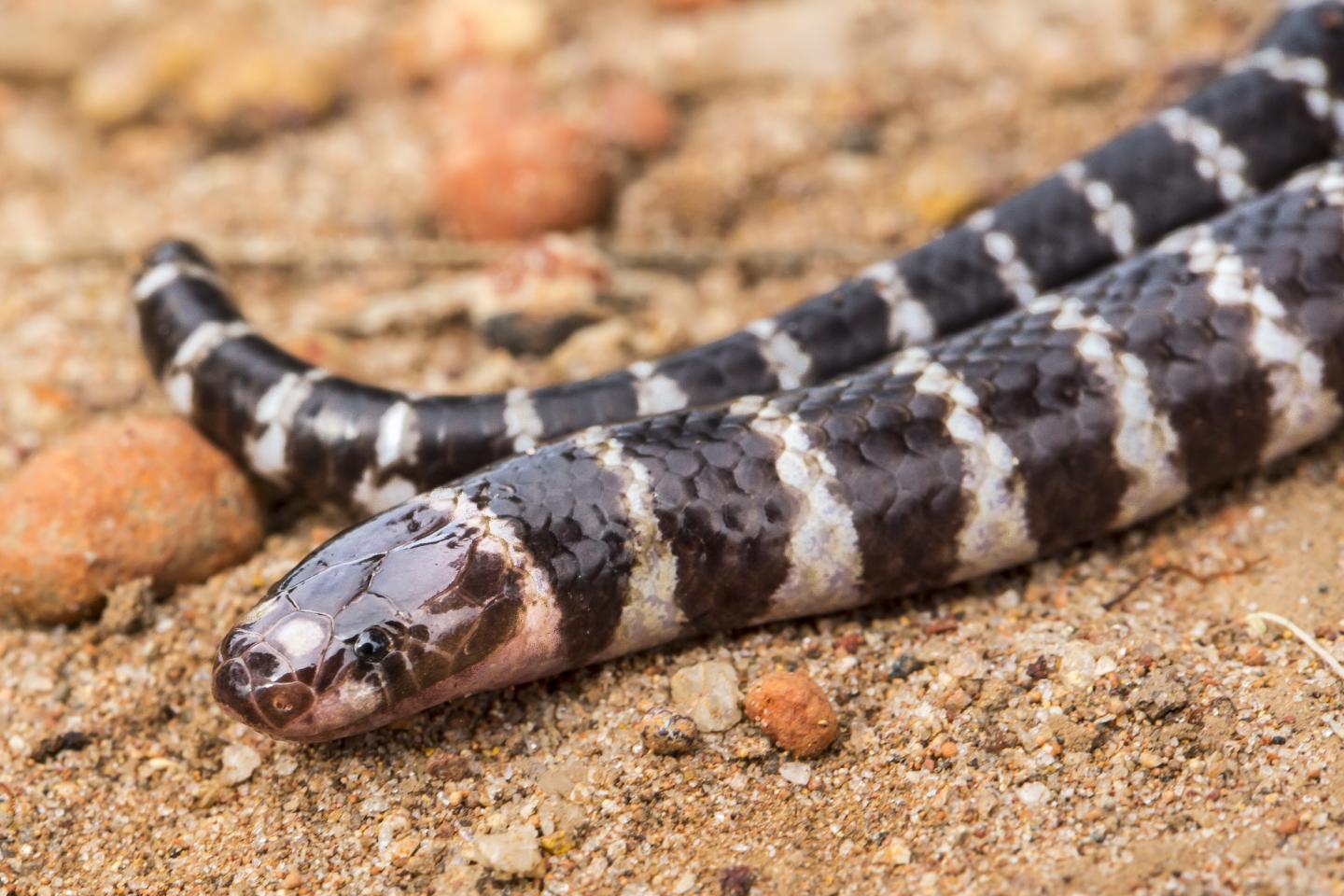
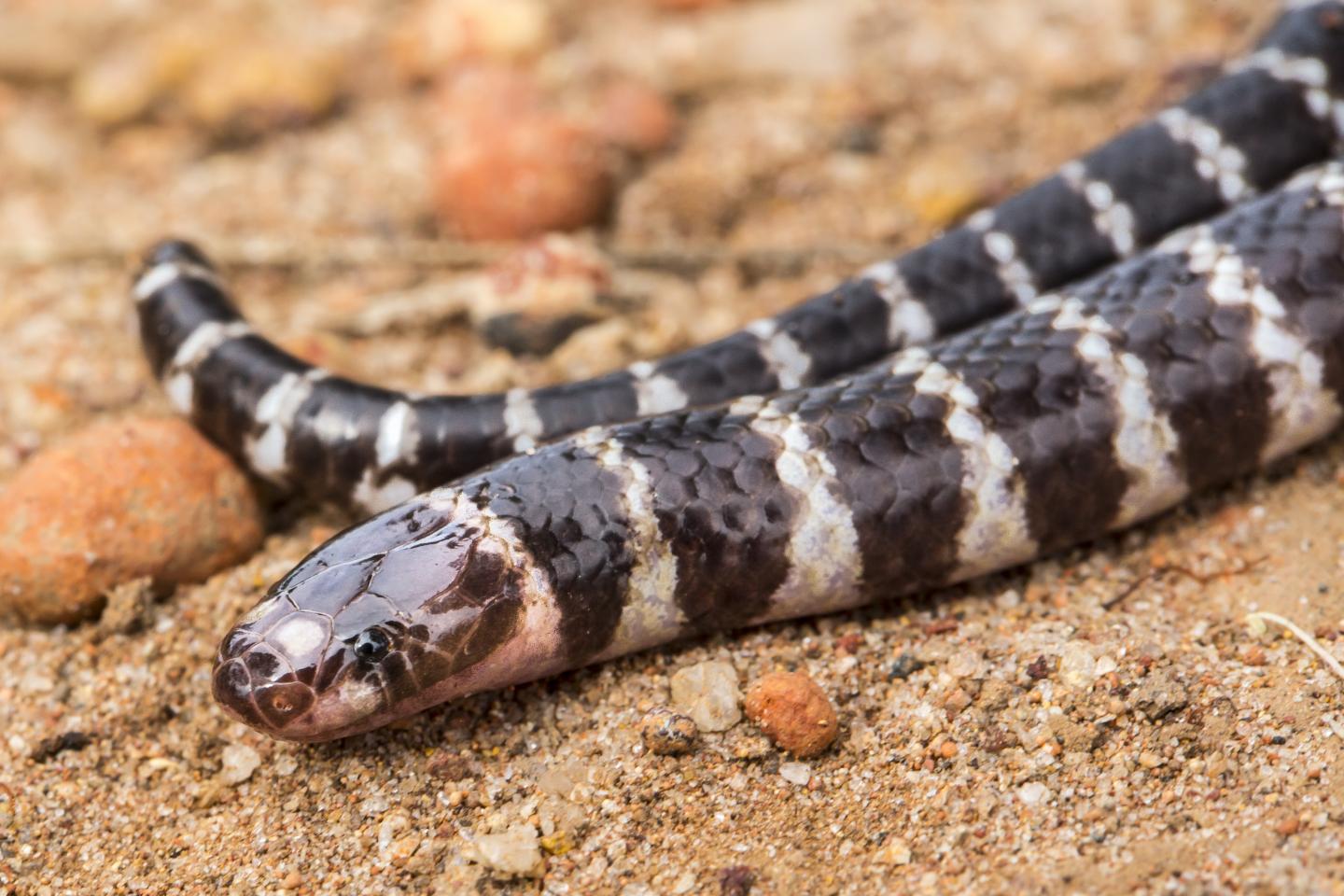
IMAGE

Credit: Dr. Freek Vonk

Researchers at Swansea University's College of Science are part of an international team that has discovered a new species of venomous snake in Australia.

The Vermicella parscauda (Weipa bandy-bandy) is a small (50-100cm) black and white banded snake found only in Australia. It belongs to a group of venomous snakes known as burrowing elapids. But despite being part of a highly venomous family including cobras and the infamous Australian taipans, bandy-bandys pose no risk to humans and their venom could actually contain medicinal properties.

Dr Kevin Arbuckle is leading the molecular data analysis part of the research at Swansea. He said: "We are extremely excited to have identified this new species. After conducting the analyses of molecular data, we found that we had indeed found a distinctly different species than the bandy-bandys known previously."

It could be said that the last thing Australia needs is another venomous snake but as Dr Arbuckle points out, this new species could have distinct benefits. "Due to their secretive habitats, small size, and venom that is not highly toxic to humans, the Weipa bandy-bandy is of no threat to us. In fact, once the venom of this new species is investigated, its complex mixture of biologically active chemicals has the potential to lead to future drug developments that could help humans."

The Weipa bandy-bandy was discovered by Dr Bryan Fry (University of Queensland) and Dr Freek Vonk (Naturalis Biodiversity Centre) in 2014, during a field trip to the Cape York Peninsula. Dr Vonk and Dr Fry suspected that the specimen was different to other bandy-bandy species. During a later trip in 2016, another team member from Dr Fry's lab came across another of the snakes – a sign that the first wasn't simply an unusual individual but might represent a new species. New genetic samples and morphological data were collected for these individuals and compared with all other bandy-bandy species. It was then up to Dr Arbuckle to use the genetic data and test whether the new specimens represented a new, evolutionarily distinct species and to compare this to previously known species.

The Weipa bandy-bandy might pose no threat to humans, but as Dr Arbuckle says, the opposite is unfortunately not true: "Despite only just being discovered the new species already faces significant threat through potential habitat disruption due to mining activities and will likely be classified as endangered or even critically endangered once formally evaluated.

Identifying the species is the first step towards making efforts to conserve it and provides a strong argument to avoid greatly extending the current mining enterprises that threaten its habitat."

###

The paper detailing the discovery of the Weipa bandy-bandy has been published in the journal Zootaxa: https://biotaxa.org/Zootaxa/issue/view/zootaxa.4446.

Media Contact

Mari Hooson
[email protected]
01-792-513-455
@swanseauni

http://www.swansea.ac.uk/

Original Source

http://www.swansea.ac.uk/press-office/latest-research/universityresearchersdiscovernewspeciesofvenomoussnake.php http://dx.doi.org/10.11646/zootaxa.4446.1


Share14Tweet8Share2ShareShareShare2

Related Posts

Degranulated eosinophilia offers unexpected diagnostic clue for ectopic paragonimiasis

Degranulated eosinophilia offers unexpected diagnostic clue for ectopic paragonimiasis

September 6, 2026
Garlic compound blocks key signal, triggering gastric cancer cell death

Garlic compound blocks key signal, triggering gastric cancer cell death

September 6, 2026

Metabolomics reveals how tubuloside A inhibits Streptococcus suis biofilms

September 6, 2026

Thar Desert flora: botanical treasures spanning medicine, tradition, and conservation

September 6, 2026
Please login to join discussion

POPULAR NEWS

  • Risk factors for multicentric lower genital tract intraepithelial neoplasia revealed

    29 shares
    Share 12 Tweet 7
  • Nikkei 225 firms face flood risks across industries and regions

    29 shares
    Share 12 Tweet 7
  • Wireless smart microneedle device enables connected personalized pain management

    29 shares
    Share 12 Tweet 7
  • Floods and droughts linked to child malnutrition in low-income countries

    29 shares
    Share 12 Tweet 7

About

We bring you the latest biotechnology news from best research centers and universities around the world. Check our website.

Follow us

Recent News

Risk factors for multicentric lower genital tract intraepithelial neoplasia revealed

Nikkei 225 firms face flood risks across industries and regions

Wireless smart microneedle device enables connected personalized pain management

Subscribe to Blog via Email

Enter your email address to subscribe to this blog and receive notifications of new posts by email.

Join 85 other subscribers
  • Contact Us

Bioengineer.org © Copyright 2023 All Rights Reserved.

Welcome Back!

Login to your account below

Forgotten Password?

Retrieve your password

Please enter your username or email address to reset your password.

Log In
No Result
View All Result
  • Homepages
    • Home Page 1
    • Home Page 2
  • News
  • National
  • Business
  • Health
  • Lifestyle
  • Science

Bioengineer.org © Copyright 2023 All Rights Reserved.