The University of Oldenburg in north-west Germany is poised to become a global leader in animal navigation research with the upcoming construction of the state-of-the-art NaviGate research facility. Recently endorsed by the German Council of Science and Humanities (WR) as “outstanding,” this innovative building will house pioneering research infrastructure designed to unravel the complex sensory mechanisms that enable animals to navigate with exceptional accuracy across vast distances. Spearheaded by Prof. Dr Henrik Mouritsen, a renowned biologist specializing in animal navigation and the spokesperson for the NaviSense cluster of excellence, the facility promises to push the boundaries of our understanding in sensory biology, neurosensorics, and ecology.
The NaviGate research center represents a unique confluence of multidisciplinary expertise. It is set to bring together biologists, physicists, chemists, computer scientists, and social scientists under one roof to collaborate in deciphering the intricate navigation systems of vertebrates and other migratory species. The building’s design reflects this integrated approach, offering shared laboratory spaces and cutting-edge equipment that promote synergistic research efforts. Such collaboration is expected to generate profound insights into how animals combine multiple sensory cues—magnetic, visual, olfactory, and auditory—to achieve their astonishing navigational feats.
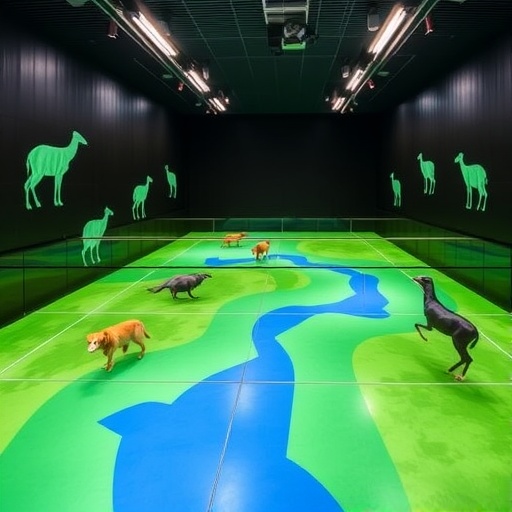
At the heart of the NaviGate facility will be an extraordinary 18-meter diameter dome known as the Non-Magnetic Multisensory Virtual Reality Dome (NMVR Dome). This specialized chamber enables near-natural experimental conditions where the navigation behavior of birds, insects, fish, and even microorganisms can be studied in unprecedented detail. The dome’s construction employs non-magnetic materials and is shielded from electromagnetic pollution, ensuring that magnetic stimuli can be precisely controlled and manipulated. This is crucial for studying magnetoreception, an elusive sensory ability that allows animals to perceive Earth’s magnetic field for orientation.
Within the NMVR Dome, researchers can simulate a wide array of environmental variables that affect animal navigation. Utilizing laser-based planetarium projectors, the dome can recreate realistic starry skies, detailed landscapes, and specific visual stimuli to mimic natural or altered celestial cues. Moreover, the system can superimpose electromagnetic disturbances, such as those caused by human-made electromagnetic pollution, or simulate artificial light pollution, both increasingly relevant in today’s anthropogenically impacted environments. This capability to integrate multisensory inputs offers a revolutionary virtual reality platform to explore how animals respond and adapt to changing environmental conditions.
Beyond visual cues, the facility’s infrastructure also allows for precise control and analysis of auditory and olfactory stimuli, thus enabling comprehensive studies of multisensory navigation processes. This integrative sensory approach is particularly significant as recent research has revealed that animals do not rely on a single navigational cue but instead synthesize multiple inputs to navigate effectively. Until now, inadequate research infrastructure has limited scientists’ ability to systematically study how these cues interact in real time. NaviGate will remove these barriers, offering a global platform for breakthroughs in understanding the neurobiological underpinnings of navigation.
Importantly, the knowledge generated at NaviGate will extend beyond academic interest, bearing essential implications for conservation biology. Many migratory species are threatened by increasing anthropogenic stressors such as electromagnetic pollution, habitat fragmentation, and climate change. By dissecting how these factors interfere with or disrupt natural navigation systems, researchers hope to inform targeted conservation strategies. This could involve mitigation measures to reduce electromagnetic interference or urban lighting that disorients nocturnal migrants, thereby supporting biodiversity preservation and ecosystem health.
The facility’s budget, capped at approximately 99 million euros, reflects the German Council of Science and Humanities’ recognition of the building’s critical national and international importance. This funding enables the integration of advanced technologies and the recruitment of multiple early-career research groups, fostering both scientific innovation and talent development. By providing laboratory spaces for up to four new research teams, NaviGate will nurture a dynamic academic environment that accelerates knowledge transfer and interdisciplinary dialogue on the fundamentals of animal navigation.
The potential societal impact of discoveries made at NaviGate is far-reaching. Beyond conservation, insights into sensory processing and navigation may inspire new technologies, including advanced navigation systems for autonomous vehicles or drones, as well as novel sensory devices modeled on biological principles. Understanding nature’s solutions to complex orientation tasks could guide the design of sustainable and efficient technological systems in a broader context, demonstrating the symbiosis between fundamental research and applied innovation.
Prof. Dr Henrik Mouritsen emphasized the visionary scope of the project, stating that NaviGate will secure the University of Oldenburg’s position at the forefront of animal navigation research for decades. This foresight promises to catalyze a global research network and stimulate new academic and technological developments that resonate well beyond the traditional boundaries of sensory biology. It also strengthens Oldenburg’s institutional capacity to contribute substantially to pressing ecological and evolutionary challenges.
The German Council of Science and Humanities plays a pivotal role in recognizing and supporting research facility projects that exhibit exceptional scientific merit and societal relevance. Through its recommendation process, the council directs federal and state government resources towards initiatives like NaviGate that demonstrate transformative potential. The final funding decision rests with the Joint Science Conference (GWK), which is expected to follow the council’s endorsement given the project’s significant benefits.
With its uniquely equipped NMVR Dome and commitment to multidisciplinary collaboration, the NaviGate research building heralds a paradigm shift in how we study animal navigation under controlled yet ecologically realistic conditions. By meticulously recreating and manipulating multisensory environments, scientists will probe fundamental questions about cognitive mapping, sensory integration, and behavioral adaptation. These efforts promise to unravel one of nature’s most extraordinary puzzles: how migratory species find their way across continents and oceans with unerring precision.
The innovation embodied in NaviGate extends beyond its facilities to encompass an ambitious vision for talent cultivation and knowledge dissemination. By hosting emerging research groups and integrating diverse scientific disciplines, the center plans to generate a sustained flow of breakthrough discoveries and trained experts. This ecosystem aligns with broader goals of advancing biodiversity conservation, ecological awareness, and the translation of basic science into impactful technologies.
Ultimately, the NaviGate research building stands as a testament to the transformative power of visionary investment in scientific infrastructure. Its realization will empower researchers worldwide to unlock the secrets of animal navigation, enhancing our understanding of nature’s ingenuity while addressing critical environmental challenges. For the University of Oldenburg, NaviGate marks a defining milestone, cementing its status as an intellectual beacon for sensory and navigation science in the coming era.
Subject of Research: Animal navigation, sensory biology, neurosensorics, magnetoreception, multisensory integration, ecological impact of anthropogenic stressors
Article Title: University of Oldenburg to Construct Groundbreaking NaviGate Research Facility for Animal Navigation Science
News Publication Date: Information not provided
Web References: Not specified
References: None provided
Image Credits: HTP Hidde Architekten
Keywords: Animal navigation, magnetoreception, multisensory virtual reality, ecological stressors, neurosensorics, migratory behavior, electromagnetic pollution, sensory integration, virtual reality dome, biodiversity conservation
Tags: animal navigation research facilityanimal navigation sensory integrationcollaborative animal navigation researchcutting-edge animal navigation technologymagnetic sensory navigation in animalsmigratory species navigation mechanismsmultidisciplinary animal navigation studiesNaviSense cluster of excellenceneurosensorics and animal movementsensory biology in animal navigationUniversity of Oldenburg research centervisual and olfactory cues in navigation