Cryo-electron microscopy has revealed an entirely new amyloid-β filament fold in the brains of individuals carrying one of the rarest known genetic causes of Alzheimer’s disease, offering a structural explanation for why this particular mutation produces devastating brain hemorrhages alongside dementia. In a study published in Nature Structural & Molecular Biology, researchers extracted amyloid filaments from the postmortem parietal lobes of two members of the only two Flemish pedigrees known to exist worldwide, and found that the mutation sculpts amyloid-β into a three-dimensional architecture unlike any previously described. The newly characterized arrangement, which the team has named the “Flemish fold,” is defined by a unique hydrophobic interface between protein filaments and appears to be directly linked to the variant’s striking tendency to damage blood vessels rather than brain tissue alone.
The Flemish mutation is an A692G substitution in the gene encoding the amyloid precursor protein, or APP. When APP is processed, the change corresponds to an A21G substitution within amyloid-β, the short peptide that aggregates into the plaques characteristic of Alzheimer’s disease. Carriers of this mutation develop a rare, early-onset form of the disease with two unusual pathological hallmarks: pronounced cerebral amyloid angiopathy, in which amyloid accumulates in the walls of cerebral blood vessels, and senile plaque cores that are unusually large. Affected individuals suffer from both progressive dementia and cerebral hemorrhages, a combination that distinguishes the Flemish variant from more common presentations of familial Alzheimer’s disease. Until now, the molecular reason for this vascular tropism remained obscure.
To understand the structural consequences of the mutation, the team turned to cryo-electron microscopy, a technique that images flash-frozen biological molecules at near-atomic resolution and has in recent years transformed the study of amyloid diseases. Filaments were extracted from parietal lobe tissue of the two affected individuals and their structures determined. Although tau paired helical filaments, the tangles that accompany most forms of Alzheimer’s disease, were present in the samples, the predominant filaments were built not from tau but from the amyloid-β peptide itself, specifically the Aβ40 species carrying the A21G substitution. The Flemish fold, it turned out, is written directly into the peptide sequence.
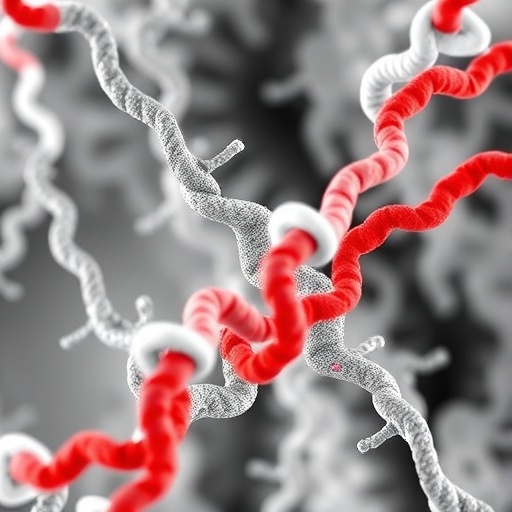
Structurally, the filaments are composed of two identical protofilaments, each spanning residues D1 through V40 of the amyloid-β peptide, packed together with two-start helical symmetry. This means that two protofilaments run in parallel along the length of the filament, twisting around each other in a helical arrangement. Comparative analysis revealed a striking continuity with previously known amyloid structures: the region of the peptide preceding the mutation site, residues Y10 through F19, adopts essentially the same substructure in both the Flemish fold and in wild-type Aβ42 filaments. The mutation’s effect is therefore not a wholesale remodeling of the peptide but a subtle yet consequential local change. The glycine substitution removes a single methyl group from residue 21, and the loss of that small hydrophobic moiety is enough to redirect the packing of the entire filament.
What emerges downstream of residue 21 is a completely different arrangement from all previously characterized Aβ folds. Since the first amyloid structures were determined, structural biologists have catalogued a growing repertoire of filament folds in Alzheimer’s disease and related disorders, each associated with different clinical presentations. The Flemish fold now joins this catalogue as a distinct entry, defined by its own hydrophobic interface, the interdigitating surface through which the two protofilaments and successive peptide layers stabilize one another. That an alteration of a single methyl group can generate a fold with no known counterpart underscores the exquisite sensitivity of amyloid assembly to sequence chemistry, and suggests that the growing library of familial APP mutations may each encode their own structural signatures.
The structural work alone could not explain why the Flemish fold associates with blood vessels. To address that question, the researchers employed a cell-based assay, and their results provide the study’s most intriguing mechanistic clue. The distinctive Flemish fold was found to be associated with the vascular tropism characteristic of this variant. In other words, the particular architecture of the filament, dictated by the A21G substitution, correlates with the propensity of amyloid to deposit in vessel walls rather than, or in addition to, the brain parenchyma. Cerebral amyloid angiopathy arises when amyloid-β, particularly the Aβ40 species, accumulates within the smooth muscle and basement membrane of leptomeningeal and cortical arteries, weakening them until they rupture. The Flemish findings now provide a structural vocabulary for that process: a fold that appears optimized, in some sense, for the vascular environment.
The implications extend beyond a single family. Dominantly inherited mutations in APP and in the presenilin genes have long served as guideposts for understanding Alzheimer’s disease more broadly, on the logic that if a mutation is sufficient to cause the disease, the pathway it disrupts must be central to the illness. The identification of a mutation-specific filament fold strengthens an increasingly influential idea in the field: that amyloid polymorphism, the existence of distinct filament structures, may correspond to distinct disease phenotypes. Previous cryo-EM studies have shown that different folds correlate with different dementias, including variants of Alzheimer’s disease and cerebral amyloid angiopathy with differing clinical courses. The Flemish fold, being tied to a specific pedigree and a specific clinical syndrome, offers one of the cleanest demonstrations yet that structure and phenotype are mechanistically linked.
The rarity of the Flemish pedigrees makes the achievement particularly notable. Only two such families are known worldwide, and obtaining postmortem brain tissue from affected members is exceptionally difficult. The fact that filaments from two independent individuals yielded consistent structures, with Aβ40-A21G as the predominant component, provides confidence that the Flemish fold is a reproducible biological entity rather than an artifact of a single brain. The presence of tau paired helical filaments alongside the amyloid filaments also confirms that the Flemish variant produces a bona fide Alzheimer-type pathology, complete with both plaques and tangles, even as its vascular features set it apart.
For the molecular understanding of Flemish-type dementia and cerebral hemorrhage, the study delivers what its authors describe as the definition of a familial Alzheimer-disease-associated amyloid fold. This framing matters because it establishes the Flemish fold as a structural unit of analysis in its own right. Future work can now ask mechanistic questions at atomic resolution: how the hydrophobic interface of the Flemish fold interacts with vascular basement membranes, whether the fold nucleates more readily on vascular surfaces, whether the faster clearance of Aβ40 from brain tissue funnels the peptide into vessels, and whether small molecules could be designed to destabilize the Flemish fold specifically. The loss of a single methyl group at residue 21, and the filament architecture it produces, has gone from a genetic curiosity to a defined structural target.
More broadly, the work exemplifies the maturing relationship between cryo-EM and neurodegenerative disease research. In the space of a decade, amyloid structures have progressed from generic models to fold-specific structures that distinguish diseases, mutations, and even individual patients. Each new fold added to the catalogue is a potential biomarker, a phenotypic explanation, and a drug-discovery template all at once. The Flemish fold demonstrates that even in a disease as intensively studied as Alzheimer’s, the structural landscape remains incompletely mapped, and that rare families, however small in number, can illuminate molecular mechanisms invisible in the common sporadic form of the illness. For the members of the two Flemish pedigrees and for the broader effort to understand cerebral hemorrhage in Alzheimer’s disease, the structure now provides a foundation on which diagnostic, mechanistic, and therapeutic advances can be built, one methyl group at a time.
Subject of Research: Cryo-electron microscopy structures of a distinct amyloid-β filament fold, termed the “Flemish fold,” in individuals with the APP Flemish mutation, and its link to cerebral amyloid angiopathy and hemorrhage
Subject of Research: Biology
Article Title: Distinct amyloid-β filament fold in individuals with APP Flemish mutation
Article References: Khaki, P. S. S., Guillen-Poza, P. A., Wong, C., Kan, C., Sharma, R., Sugimura, R., Robinson, A. C., Valbuena, A., NG, R. C.-L., Yang, Y., & Hervas, R. (2026). Distinct amyloid-β filament fold in individuals with APP Flemish mutation. Nature Structural & Molecular Biology, 33(8), 1194-1203. https://doi.org/10.1038/s41594-026-01855-y
Image Credits: AI Generated
DOI: 10.1038/s41594-026-01855-y
Keywords: amyloid-β, APP Flemish mutation, A692G, A21G, cryo-electron microscopy, Flemish fold, familial Alzheimer’s disease, cerebral amyloid angiopathy, Aβ40 filaments, hydrophobic interface, tau paired helical filaments, cerebral hemorrhage
Cite Scienmag News
APA
MLA
Chicago
Cassandra Pierce. (September 6, 2026). Unique amyloid-β filament structure found in APP Flemish mutation carriers. Scienmag. https://scienmag.com/unique-amyloid-%ce%b2-filament-structure-found-in-app-flemish-mutation-carriers/
Cassandra Pierce. “Unique amyloid-β filament structure found in APP Flemish mutation carriers.” Scienmag, 6 September 2026, https://scienmag.com/unique-amyloid-%ce%b2-filament-structure-found-in-app-flemish-mutation-carriers/. Accessed 6 September 2026.
Cassandra Pierce. “Unique amyloid-β filament structure found in APP Flemish mutation carriers.” Scienmag. September 6, 2026. https://scienmag.com/unique-amyloid-%ce%b2-filament-structure-found-in-app-flemish-mutation-carriers/
Copy citation
Download RIS
Tags: Alzheimer’s diseaseAmyloid precursor proteinamyloid precursor protein mutationamyloid-β aggregation in dementiaamyloid-β filament structureAPP Flemish mutationAPP gene mutationblood vessel damage in Alzheimer’sBrain hemorrhagesCerebral amyloid angiopathycryo-electron microscopycryo-electron microscopy of amyloid filamentsFlemish fold amyloid structureFlemish mutationgenetic causes of early-onset Alzheimer’sneurodegenerative disease mechanismsNovel amyloid foldnovel amyloid-β filament foldProtein aggregationstructural biology of Alzheimer’s diseaseStructural biology of amyloid filamentsunique amyloid filament architecture