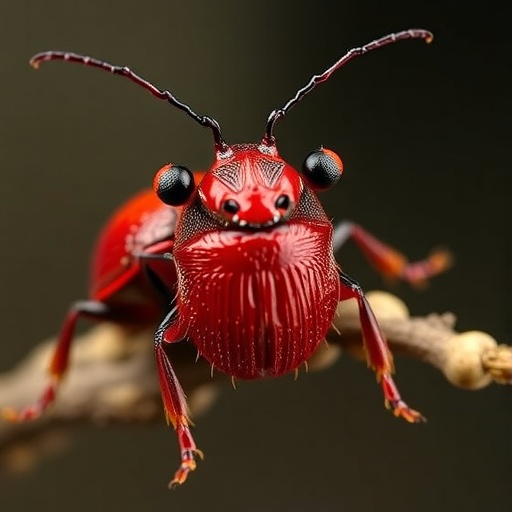
Tiny genes have long been dismissed as genomic noise, too short to matter and too difficult to detect to bother with. A new study of the red flour beetle, Tribolium castaneum, challenges that assumption in striking fashion. Writing in BMC Biology, a team of Brazilian researchers reports the identification and characterization of 454 putative small open reading frames, or small ORFs, in the beetle’s genome, and shows that many of these compact genetic elements are not only actively expressed but deeply conserved across hundreds of millions of years of evolution, reaching back to ancestors shared with bacteria.
Small open reading frames are DNA sequences capable of encoding proteins or peptides shorter than roughly 100 amino acids. Because of their diminutive size, they have historically slipped through the nets of standard gene-annotation pipelines, which were designed to flag longer protein-coding sequences and to avoid false positives among short, seemingly random stretches of DNA. The conventional wisdom held that such short sequences would rarely, if ever, be conserved across distant species, since random chance alone could produce short open reading frames in abundance. The new study directly confronts that view with a comprehensive, multi-omics approach that integrates genomic, transcriptomic, and proteomic data.
Led by Diego Guerra-Almeida, of the University of Campinas and the Federal University of Rio de Janeiro, together with Jonathan Javier Mucherino-Muñoz, Evenilton Pessoa Costa, Mariana Freitas Nery, Diogo Antonio Tschoeke, and senior author Rodrigo Nunes-da-Fonseca, the team began with a de novo search of the beetle’s genome for short coding-capable sequences. Their initial screen yielded 14,878 candidate small ORFs, which they then subjected to rigorous comparative genomic filtering. By clustering sequences at an 80 percent identity threshold to remove redundancy, they narrowed the set to 13,657 non-redundant candidates, and ultimately to a final curated set of 454 small ORFs with credible evidence of conservation or biological activity.
The conservation results form the scientific heart of the paper. The researchers searched for matching sequences across the tree of life, from other beetles and insects to arthropods, eukaryotes more broadly, and even bacteria. They found 230 potential orthologs within the order Coleoptera, the beetles; 167 within insects as a whole; 85 across arthropods; 39 across eukaryotes; and, remarkably, six with matches in bacteria. If confirmed, conservation between insect genes and bacterial sequences hints at either extraordinarily ancient origins predating the divergence of major branches of life, or, intriguingly, horizontal gene transfer, the movement of genetic material between unrelated organisms. The authors note that horizontal gene transfer is a known contributor to gene innovation, and the bacterial-conserved sequences also displayed an unusual biochemical signature: guanine-cytosine, or GC, content exceeding 50 percent, well above the roughly 44.87 percent average observed across conserved small ORFs generally. GC content is a useful evolutionary tracer because organisms and lineages differ characteristically in their genomic base composition, and sequences that deviate sharply from their host’s norm often flag genes acquired from elsewhere.
Functional predictions added further weight to the idea that these small ORFs are more than genomic punctuation. Gene Ontology enrichment analysis revealed dozens of small ORFs associated with catalytic activity, transporter function, structural roles, and regulatory processes, classes of function that imply genuine biochemical activity rather than random noise. The team also scanned the predicted peptide sequences for interaction motifs, finding that 254 of the 454 small ORFs possess protein-protein interaction potential, suggesting they could plug into existing cellular networks as modulators, scaffolds, or competitors of larger proteins. Among the annotated matches were domains and proteins of known importance, including elements resembling components of the COMPASS and SAGA chromatin-modifying complexes, which regulate gene expression by altering histone proteins, and sequences related to vacuolar-type ATPase and mitochondrial outer membrane translocase components, implicating some microproteins in cellular energy handling and mitochondrial import.
Expression data provided another crucial layer of evidence. Drawing on 14 RNA-seq libraries spanning multiple developmental stages of the beetle, the researchers quantified transcript levels for each candidate. In total, 40.1 percent of the small ORFs were expressed at a threshold of more than one transcript per million in at least one sample, and 16.5 percent were expressed across five or more libraries, indicating broad and persistent activity rather than one-off transcriptional accidents. The expression patterns themselves told an evolutionary story. Conserved small ORFs tended to show wide, stable expression across tissues and stages, consistent with genes performing essential housekeeping or developmental functions. In contrast, lineage-specific small ORFs displayed restricted expression patterns, concentrated largely in the gonads and embryos. That distribution is evolutionarily suggestive: reproductive tissues are arenas of intense evolutionary competition and rapid innovation, and genes expressed there can be shaped by sexual selection or early-development-specific demands before spreading into broader roles.
The classification of small ORFs by genomic location also proved informative. The team distinguished between small coding DNA sequences, canonical short genes in their own right, and alternative ORFs such as upstream ORFs and downstream ORFs, which sit within the transcribed regions of larger genes and have traditionally been regarded as translational regulators of the main protein rather than independent protein-coding elements. Isoformic ORFs and small CDSs emerged as the most widely expressed classes, with small CDSs in particular dominating the ranks of highly expressed candidates. Strikingly, 29 small ORFs showed both transcriptional support and translational evidence from curated Swiss-Prot protein records or ribosome profiling, or Ribo-seq, data, which maps exactly where ribosomes traverse messenger RNA molecules. Of these 29 doubly supported candidates, 28 were small CDSs, providing some of the strongest evidence yet that the beetle actively translates these miniature genes into real proteins.
Paralogy analysis revealed yet another dimension of the small ORF landscape. The researchers identified 390 small ORFs with potential paralogs, duplicated copies within the beetle genome itself, and some of these duplicated sequences showed homology to previously described proteins. Gene duplication is a classic engine of evolutionary innovation, allowing one copy to maintain an ancestral function while the other is free to diverge. The prevalence of paralogs among the small ORFs suggests that these diminutive genes are not frozen relics but participants in the ongoing churn of genome evolution, with the potential to seed new functions.
The choice of Tribolium castaneum as the study organism is itself significant. The red flour beetle is one of the premier model organisms of evolutionary and developmental biology, prized for its fully sequenced genome, ease of laboratory rearing, and its position within the extraordinarily species-rich order Coleoptera. Unlike the fruit fly Drosophila melanogaster, which is a derived and somewhat atypical insect, Tribolium preserves many ancestral insect traits, making it a useful reference point for reconstructing the evolutionary history of genes across insects and their relatives. Applying a systematic small ORF discovery pipeline in such a well-annotated genome offers a template that other laboratories can adapt for their own organisms of interest.
The broader implications reach into what researchers have come to call the dark proteome: the vast, poorly characterized space of short proteins and peptides whose existence is suspected but whose functions remain unknown. Over the past decade, ribosome profiling and peptidomics studies in animals, plants, and fungi have steadily uncovered functional microproteins, from muscle-development regulators in fruit flies to mitochondrial peptides in mammals. The Tribolium study adds a crucial evolutionary perspective, demonstrating that at least a subset of these tiny genes is not a recent, ephemeral phenomenon but a deeply conserved layer of genome architecture. The finding that some small ORFs may trace back to bacterial ancestors, or even arrive via horizontal gene transfer, raises provocative questions about how novel genes are born and how the earliest protein-coding sequences may have looked.
The authors are careful to frame their results as a framework rather than a finished atlas. They emphasize the need for experimental validation, through gene knockout, RNA interference, CRISPR editing, or direct peptide detection, to determine which of the 454 candidates perform essential functions and which are passengers in the genome. The full dataset, including genomic coordinates, conservation metrics, Gene Ontology annotations, protein binding predictions, translation evidence, and expression values across all 14 RNA-seq libraries, is released openly as supplementary material, along with the exact bioinformatics scripts and command lines used in the analysis. That transparency invites the wider community to test, refine, and extend the catalog, and positions the humble beetle as a new frontier in the hunt for biology’s smallest genes. For a field long accustomed to overlooking anything under 100 codons, the message from Tribolium is clear: small does not mean insignificant.
Subject of Research: Identification, conservation, and expression of small open reading frames (smORFs) in the model beetle Tribolium castaneum
Subject of Research: Biology
Article Title: Deeply conserved and expressed small ORFs in the model beetle Tribolium castaneum
Article References: Guerra-Almeida, D., Mucherino-Muñoz, J. J., Costa, E. P., Nery, M. F., Tschoeke, D. A., & Nunes-da-Fonseca, R. (2026). Deeply conserved and expressed small ORFs in the model beetle Tribolium castaneum. BMC Biology. https://doi.org/10.1186/s12915-026-02686-5
Image Credits: AI Generated
DOI: 10.1186/s12915-026-02686-5
Keywords: small ORFs, Tribolium castaneum, dark proteome, microproteins, gene conservation, horizontal gene transfer, Ribo-seq, orphan genes, ORFeome, ncORFs, gene expression, Coleoptera
Cite Scienmag News
APA MLA Chicago
Juliet Wilcox. (September 6, 2026). Tiny conserved proteins discovered in the red flour beetle genome. Scienmag. https://scienmag.com/tiny-conserved-proteins-discovered-in-the-red-flour-beetle-genome/
Juliet Wilcox. “Tiny conserved proteins discovered in the red flour beetle genome.” Scienmag, 6 September 2026, https://scienmag.com/tiny-conserved-proteins-discovered-in-the-red-flour-beetle-genome/. Accessed 6 September 2026.
Juliet Wilcox. “Tiny conserved proteins discovered in the red flour beetle genome.” Scienmag. September 6, 2026. https://scienmag.com/tiny-conserved-proteins-discovered-in-the-red-flour-beetle-genome/
Copy citation Download RIS
Tags: ancient genetic elements shared with bacteriachallenges in gene annotation pipelinesconserved tiny genes across evolutionconserved tiny genes in Tribolium castaneumdetection of small proteins in beetle genomeevolutionary conservation of small ORFsevolutionary history of small open reading framesfunctional significance of small peptidesfunctional significance of tiny proteinsgenomic annotation challenges for tiny genesgenomic discovery in Tribolium castaneumimplications for genome annotation pipelinesimplications for genome annotation techniquesmulti-omics analysis of short DNA sequencesmulti-omics analysis of short genetic elementsproteomic evidence of small protein expressionsmall gene expression in insectssmall open reading frames in beetle genomesmall open reading frames in insect genomessmall peptides encoded by tiny genestiny gene discovery in model insectstiny genes in insect genomes