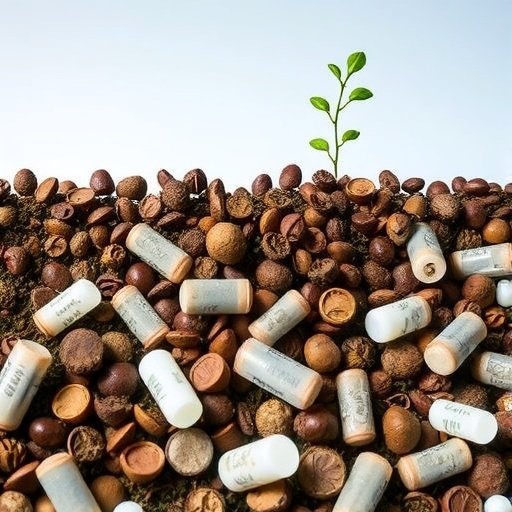
Microplastics have become one of the most ubiquitous contaminants on Earth, and a new study suggests that in the world’s salt-stressed soils, these tiny particles may be quietly rewiring the microbial machinery that governs one of the planet’s most important carbon reservoirs. Writing in the journal Microbial Ecology, a research team led by Jiali Sun and Yan Jiao of Inner Mongolia Normal University reports that conventional polyethylene microplastics and biodegradable polylactic acid microplastics exert strikingly different effects on soil organic carbon dynamics, with the biodegradable polymer emerging as a surprisingly powerful promoter of microbial carbon fixation in saline-alkali soils.
Soils store more carbon than the atmosphere and all vegetation combined, and saline-alkali soils—degraded lands where salt accumulation suppresses plant growth and microbial activity—represent a vast and expanding category under pressure from irrigation practices, climate change, and intensifying agriculture. At the same time, plastic fragments have infiltrated agricultural soils worldwide through mulching films, irrigation with contaminated water, sewage sludge application, and the slow breakdown of larger plastic debris. Because microorganisms carry out nearly all of the chemical transformations that determine whether soil carbon remains locked away or escapes into the atmosphere as carbon dioxide, any pollutant that reshapes microbial communities has the potential to alter the global carbon balance. What has remained murky is how different types of microplastics interact with salinity—a stress factor that itself profoundly constrains microbial metabolism.
To disentangle these effects, the team combined carefully controlled laboratory incubation experiments with metagenomic sequencing, a technique that reads the collective genetic blueprint of entire soil microbial communities without the need to culture individual species in the laboratory. Soils were exposed to two microplastic types: polyethylene, the durable conventional plastic that fragments into particles persisting for decades or centuries, and polylactic acid, a biodegradable polymer derived from plant starch that microorganisms can enzymatically hydrolyze and ultimately metabolize. Each plastic was added at four concentrations—0, 0.5, 1, and 14 percent by weight—spanning the range from environmentally realistic contamination levels to high-dose experimental conditions. Critically, the researchers crossed these treatments with three salinity levels, expressed as electrical conductivity values of 4.75, 20, and 40 mS/cm, creating a matrix of conditions that allowed them to separate the influence of plastic type, dose, and salt stress.
The first major finding concerned microbial diversity. Across the board, the addition of microplastics increased microbial richness in the soils, indicating that plastic particles—even inert polyethylene—provide new niches or substrates that allow more microbial species to coexist. But the deeper story emerged when the researchers measured carbon pools directly. Polylactic acid significantly increased soil organic carbon by between 0.96 and 118.71 percent compared with polyethylene, and boosted soil microbial biomass carbon—an indicator of living microbial mass—by 9.18 to 362.46 percent. These are enormous effects by soil science standards, and they point to a fundamental asymmetry: not all microplastics disturb soil carbon cycling in the same way, and biodegradable plastics may actively stimulate the biological processes that build carbon stocks rather than degrade them.
The metagenomic data revealed exactly how this stimulation occurs. Genes associated with carbon fixation—the processes by which microorganisms convert inorganic carbon dioxide into organic biomass—responded differently to the two plastics. Polylactic acid enhanced carbon fixation primarily through two of the most celebrated biochemical pathways in biology: the Calvin–Benson–Bassham cycle, the same route that plants use in photosynthesis, whose key gene Prk increased in relative abundance by 3.31 to 98.43 percent, and the Wood–Ljungdahl pathway, an ancient carbon-fixation route used by anaerobic bacteria and archaea, whose acsABCDE genes rose by 0.035 to 0.44 percent. Polyethylene, by contrast, stimulated the 3-Hydroxypropionate cycle, with the mcr gene increasing by 17.3 to 163.06 percent—a pathway typically associated with certain autotrophic microbes that thrive in specialized environments.
Energy metabolism shifted as well. Polyethylene addition increased the metabolic activity of the tricarboxylic acid cycle, the central energy-generating hub of cellular respiration, by 0.8 to 26.67 percent, suggesting that the conventional plastic pushes microbial communities toward greater oxidative breakdown of organic matter—processes that can ultimately release carbon dioxide. Meanwhile, both plastic types promoted the relative abundance of genes involved in ethanol fermentation, including adh, mdh, and ald, hinting that microplastic exposure drives microbes toward fermentative metabolism, a less efficient mode of energy production that flourishes when environments become chemically stressful or oxygen-limited.
Salinity proved to be a decisive modifier of all these effects. The relative abundance of several carbon fixation genes was higher under low-to-medium electrical conductivity conditions than at the highest salinity level, where the enhanced fermentation pathways suggested a more complex and potentially less efficient carbon cycle. In other words, salt stress appears to push microbial communities away from carbon sequestration and toward metabolic coping strategies. This interaction matters because saline-alkali soils are already metabolically constrained environments; the study suggests that microplastic contamination in these lands cannot be evaluated in isolation from the salt regime.
Broader functional predictions based on the Kyoto Encyclopedia of Genes and Genomes pathway database added a further layer of nuance. Polylactic acid treatments exhibited greater changes in functional pathway abundance in response to varying salinity than polyethylene treatments, indicating that the biodegradable plastic’s effects are more sensitive to—and potentially more responsive to—environmental context. Polyethylene addition increased the abundance of general metabolic pathways but decreased the abundance of pathways devoted to translation, replication, and DNA repair, the fundamental maintenance operations of cells. That suppression is a biochemical red flag: it suggests that polyethylene exposure may impair microbial growth and genomic integrity even as it superficially stimulates metabolism. Polylactic acid, in contrast, showed a stronger capacity to promote cellular processes, consistent with a polymer that microbes can actively consume as a carbon source rather than merely endure.
The implications ripple outward in several directions. First, the work complicates the popular assumption that biodegradable plastics are automatically benign—or automatically harmful—in soil environments. Here, polylactic acid fragments appear to feed microbial communities, enrich carbon-fixing pathways, and build microbial biomass, potentially supporting carbon storage in soils that are otherwise carbon-poor. But the study also raises questions: if biodegradable plastics accelerate microbial activity, they may equally accelerate the decomposition of existing organic matter under some conditions, and long-term field studies will be needed to confirm whether the laboratory carbon gains persist. Second, the findings underscore that polyethylene, even when it does not serve as food for microbes, exerts selective pressure that can suppress genetic maintenance functions across communities—a subtle form of physiological stress that could erode the resilience of soil ecosystems over time.
There is also a geographic urgency to the work. Inner Mongolia, where the research team is based, sits at the heart of China’s vast saline-alkali belt, where decades of irrigation, land conversion, and climate pressure have degraded millions of hectares. These same regions rely heavily on plastic mulch films to conserve soil moisture and boost crop yields, creating an intimate overlap between plastic contamination and soil salinization. Understanding how these two stressors interact is therefore not an academic curiosity but a practical necessity for land managers weighing the trade-offs of agricultural plastic use on marginal lands.
The methodological approach itself represents a growing trend in environmental microbiology. Rather than measuring bulk carbon changes alone, the team interrogated the functional genes of entire communities, allowing them to pinpoint which biochemical pathways—Calvin cycle, Wood–Ljungdahl, 3-hydroxypropionate, TCA cycle, fermentation—shifted under each treatment. This gene-level resolution transforms what could have been a simple pollution study into a mechanistic account of how polymer chemistry propagates through microbial metabolisms to alter ecosystem-scale carbon fluxes.
As microplastic production continues its relentless rise and soil salinization expands across arid and semi-arid regions worldwide, the intersection of these two global challenges will only grow more consequential. This study provides a template—and a warning: the carbon future of degraded soils may depend not just on how much plastic enters the ground, but on what kind, and how salty the ground beneath it has become.
Subject of Research: Effects of polyethylene and biodegradable polylactic acid microplastics on soil organic carbon dynamics and microbial carbon-fixation genes in saline-alkali soils
Subject of Research: Biology
Article Title: Metagenomic Insights into the Microbial Regulation of Soil Organic Carbon Dynamics Under Microplastic Exposure in Saline-Alkali Soils
Article References: Sun, J., Yang, W., Lyu, P., Ma, X., Wang, Y., & Jiao, Y. (2026). Metagenomic Insights into the Microbial Regulation of Soil Organic Carbon Dynamics Under Microplastic Exposure in Saline-Alkali Soils. Microbial Ecology. https://doi.org/10.1007/s00248-026-02876-2
Image Credits: AI Generated
DOI: 10.1007/s00248-026-02876-2
Keywords: biodegradable microplastic, polyethylene, polylactic acid, soil organic carbon, carbon fixation genes, saline-alkali soils, microbial community, metagenomics, Calvin–Benson–Bassham cycle, Wood–Ljungdahl pathway, salinity stress, carbon cycling
Cite Scienmag News
APA MLA Chicago
Morgan Morrow. (September 6, 2026). Microplastics reshape microbial control of soil carbon in saline-alkali soils. Scienmag. https://scienmag.com/microplastics-reshape-microbial-control-of-soil-carbon-in-saline-alkali-soils/
Morgan Morrow. “Microplastics reshape microbial control of soil carbon in saline-alkali soils.” Scienmag, 6 September 2026, https://scienmag.com/microplastics-reshape-microbial-control-of-soil-carbon-in-saline-alkali-soils/. Accessed 6 September 2026.
Morgan Morrow. “Microplastics reshape microbial control of soil carbon in saline-alkali soils.” Scienmag. September 6, 2026. https://scienmag.com/microplastics-reshape-microbial-control-of-soil-carbon-in-saline-alkali-soils/
Copy citation Download RIS
Tags: andbiodegradable microplastics effects on soil microbesbiodegradable microplastics in soilsclimate changeclimate change and soil microplastic interactionscontamination of saline soils by microplasticseffects of microplastics on soil microbial ecologymicrobial ecology of contaminated soilsmicroplastic contamination in agricultural soilsmicroplastics and microbial-driven soil carbon sequestrationmicroplastics impact on soil microbial communitiesmicroplastics influence on microbial carbon fixationmicroplastics influence on soil organic carbonplastic debris infiltration in soilsplastic pollution and soil carbon storageplastic pollution and soil microbial functionplastic pollution in degraded saline soilspolyethylene microplastics environmental effectspolyethylene microplastics in agricultural soilssaline-alkali soil carbon cyclingsaline-alkali soil degradationsoil microbial carbon fixationsoil organic carbon dynamics and microplastics