An unexpected duo, salamanders and algae, may offer a key to unlock medical solutions. New research led by Bigelow Laboratory for Ocean Sciences will examine how a peculiar relationship between this unusual pair could lead to innovative drugs that regulate human immune systems and tissue repair.
Credit: Roger Hangarter, Indiana University Department of Biology
An unexpected duo, salamanders and algae, may offer a key to unlock medical solutions. New research led by Bigelow Laboratory for Ocean Sciences will examine how a peculiar relationship between this unusual pair could lead to innovative drugs that regulate human immune systems and tissue repair.
The work, led by Senior Research Scientist John Burns, is funded by a new, three-year $150,000 grant from the William Procter Scientific Innovation Fund. The multidisciplinary research team includes biologists and natural product chemists at the University of North Carolina Wilmington and Gettysburg College.
“We are hopeful that the connections between salamanders and algae could lead to exciting and unforeseen discoveries in medicine,” said Burns. “And we are grateful to the William Procter Fund for the chance to explore this unique relationship.”
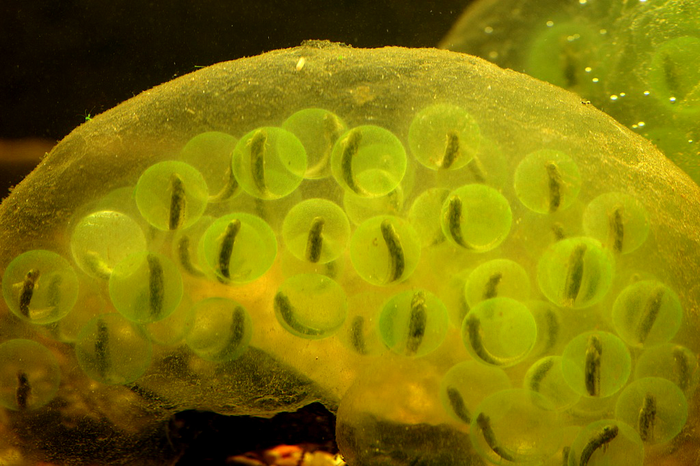
The alga colonizes the salamander eggs soon after they are laid and enters into salamander tissues and cells. The alga gets a suitable environment in which to thrive, and the unharmed salamander gains oxygen – and possibly other benefits – from the algal cells. It is the only known example of an alga living inside a vertebrate in nature.
“These two organisms are coexisting and benefiting one another,” Burns said. “We are trying to find out how the salamander and algae interact, and whether the molecules they are using can be used to regulate immunity in humans.”
Chemical interactions in nature have long been a source of innovation and medical solutions. However, progress in finding new medicines slowed over the twentieth century as researchers exhausted the capabilities of existing research technologies. As molecular tools emerged, scientists gained powerful new ways to explore biological interactions, and a renewed focus on biological drug discovery.
One frontier of this research is in symbioses, intimate relationships between organisms that provide mutual benefit. Symbiosis research represents a shift toward exploring the subtle dialog between these partners. The work seeks to understand the forces driving the interactions between organisms, the effects they have on one another, and the chemical exchange between them.
“When we look to the natural world for drugs, we are usually looking at antagonisms. We’re looking for the kind of thing that stops bacteria from growing in order to find something we might be able to use in our own bodies,” Burns said. “Studying these organisms in a symbiotic relationship is completely new, and that’s why we think it’s an interesting place to look for new types of drugs.”
Previous research connected the algae inside salamander cells with the activation of genes that are known to regulate immune distress signals. The alga may also evade immune detection by inhibiting or making itself invisible to other major immune system sensors. If researchers can find molecules that regulate immune systems in ways that are not harmful to the host, they could be used in patients with conditions like autoimmune diseases.
The researchers also believe that there may be a potential application for regenerative medicine. Salamanders can regrow their limbs and tails, and the team will investigate the role algal molecules may play in that process – a foundational step to exploring how the algae might be used in treatments to repair human tissue.
Burns said the research would take considerable time to lead to a drug, but the potential is there.
“We are taking this natural interaction and trying to figure out how it works to better understand how the two organisms communicate and benefit,” Burns said. “This relationship has existed for a long time, so there may be a lot of chemical nuance and possibility to be discovered.”
###
Bigelow Laboratory for Ocean Sciences is an independent, nonprofit research institute located in East Boothbay, Maine. From the Arctic to the Antarctic, Bigelow Laboratory scientists use innovative approaches to study the foundation of global ocean health and unlock its potential to improve the future for all life on the planet. Learn more at bigelow.org, and join the conversation on Facebook, Instagram, and Twitter.