Glioblastoma is one of the most treatment-resistant cancers, with those diagnosed surviving for less than two years.
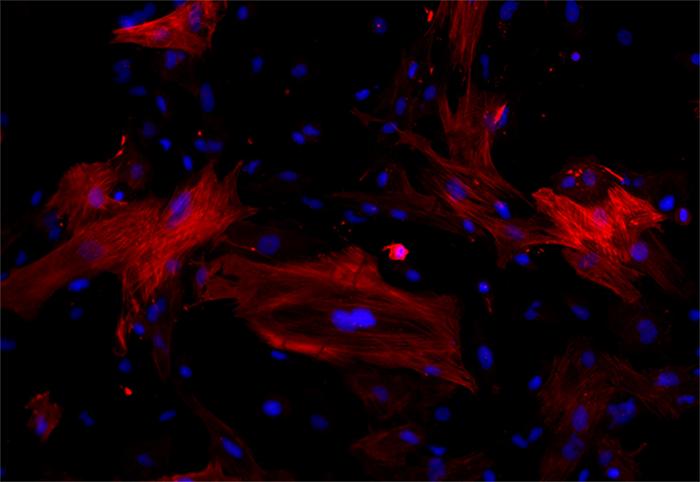
Credit: Provided by Meenal Datta and TIME Lab at the University of Notre Dame
Glioblastoma is one of the most treatment-resistant cancers, with those diagnosed surviving for less than two years.
In a new study in NPJ Genomic Medicine, researchers at the University of Notre Dame have found that a largely understudied cell could offer new insight into how the aggressive, primary brain cancer is able to resist immunotherapy.
“A decade ago, we didn’t even know perivascular fibroblasts existed within the brain, and not just in the lining of the skull,” said Meenal Datta, assistant professor of aerospace and mechanical engineering at Notre Dame and senior author on the study. “My lab’s expertise is examining tumors from an engineering and systems-based approach and looking at the novel mechanical features in rare cancers that may have been understudied or overlooked.”
Using standard bioinformatics and newer AI-based approaches, Datta’s TIME Lab began analyzing different genes expressed in the tumor microenvironment related to the extracellular matrix — or the scaffolding cells create to support future cell adhesion, migration, proliferation and differentiation — and other various cell types. What they found was a surprising, fairly new cell type: perivascular fibroblasts. These fibroblasts are typically found in the blood vessels of a healthy brain and deposit collagen to maintain the structural integrity and functionality of brain vessels.
“It was a serendipitous discovery,” said Maksym Zarodniuk, graduate student in the TIME Lab and the bioengineering doctorate program, and first author on the study. “We started in a completely different direction and stumbled upon this population of cells by using a combination of both bulk and single-cell RNA sequencing analyses of patient tumors.”
In their data, researchers were able to identify two groups of patients: those with a higher proportion of perivascular fibroblasts and those with significantly less. They found that brain cancer patients with more perivascular fibroblasts in their tumors were more likely to respond poorly to immunotherapies and have poor survival outcomes.
When exploring how this is possible, the researchers found that perivascular fibroblasts support the creation of an immunosuppressive tumor microenvironment, allowing the cancer to better evade the immune system. The fibroblasts may also help the cancer resist therapies — such as chemotherapy that targets dividing cells — by promoting stem-like cancer cells that rarely divide, which are believed to be a major source of tumor relapse and metastasis.
“Moving forward, we want to do new experiments to confirm what we found in this paper and provide some good ground to start thinking about how to improve response to immunotherapy,” Zarodniuk said.
Because perivascular fibroblasts are a part of a healthy brain’s vasculature, Datta believes that these cells are breaking off and getting close to or infiltrating the glioblastoma tumor. However, instead of supporting healthy brain function, these fibroblasts are getting reprogrammed and helping the tumor instead.
“Most people think about the brain as being very soft, with soft cells and a soft matrix. But by putting down these fibroblasts and making these very fibrous proteins, it gives us an entirely different perspective on the structure of the brain and how it can be taken advantage of by cancer cells originating in the same organ,” Datta said.
In addition to Datta and Zarodniuk, other Notre Dame collaborators include Jun Li, professor of applied and computational mathematics and statistics, who developed deep learning algorithms in support of this work; Xin Lu, the John M. and Mary Jo Boler Collegiate Associate Professor of Biological Sciences at Notre Dame; and Xander Steele, undergraduate student in the TIME Lab and a Grand Challenges Scholar.
Datta is an affiliated member of Notre Dame’s Berthiaume Institute for Precision Health, Eck Institute for Global Health, Harper Cancer Research Institute, Lucy Family Institute for Data and Society, NDnano and Warren Center for Drug Discovery. Datta is an assistant professor in the following doctorate programs: aerospace and mechancial engineering, bioengineering and materials science and engineering.
This work was funded by the National Cancer Institute.
Contact: Brandi Wampler, associate director of media relations, 574-631-2632, [email protected]
Journal
npj Genomic Medicine
DOI
10.1038/s41525-023-00381-w
Article Title
CNS tumor stroma transcriptomics identify perivascular fibroblasts as predictors of immunotherapy resistance in glioblastoma patients
Article Publication Date
26-Oct-2023