• HOME
  • NEWS
  • EXPLORE
    • CAREER
      • Companies
      • Jobs
    • EVENTS
    • iGEM
      • News
      • Team
    • PHOTOS
    • VIDEO
    • WIKI
  • BLOG
  • COMMUNITY
    • FACEBOOK
    • INSTAGRAM
    • TWITTER
Tuesday, May 12, 2026
BIOENGINEER.ORG
No Result
View All Result
  • Login
  • HOME
  • NEWS
  • EXPLORE
    • CAREER
      • Companies
      • Jobs
        • Lecturer
        • PhD Studentship
        • Postdoc
        • Research Assistant
    • EVENTS
    • iGEM
      • News
      • Team
    • PHOTOS
    • VIDEO
    • WIKI
  • BLOG
  • COMMUNITY
    • FACEBOOK
    • INSTAGRAM
    • TWITTER
  • HOME
  • NEWS
  • EXPLORE
    • CAREER
      • Companies
      • Jobs
        • Lecturer
        • PhD Studentship
        • Postdoc
        • Research Assistant
    • EVENTS
    • iGEM
      • News
      • Team
    • PHOTOS
    • VIDEO
    • WIKI
  • BLOG
  • COMMUNITY
    • FACEBOOK
    • INSTAGRAM
    • TWITTER
No Result
View All Result
Bioengineer.org
No Result
View All Result
Home NEWS Science News

Understanding the effect of wildfires on air quality: a NASA initiative

Bioengineer by Bioengineer
September 7, 2022
in Science News
Reading Time: 3 mins read
0
(a) The distribution of ΔO3/ΔCO ratio along the longitude within the wildfire plume and (b) the estimated longitudinal CO plume age distribution based on the NAST-I measurements. Credit: The Authors doi 10.1117/1.JRS.16.034522
Share on FacebookShare on TwitterShare on LinkedinShare on RedditShare on Telegram

Wildfires, characterized by unplanned, uncontrolled, and unpredictable fires erupting in areas such as forests, grasslands, and prairies, have recently grown in frequency and intensity. Likely resulting from climate change effects, wildfires are increasingly impacting ecosystems and human lives. While wildfires are considered ecologically beneficial, there have been rising concerns over the negative effects, namely degradation of air quality from the smoke and pollutants released.
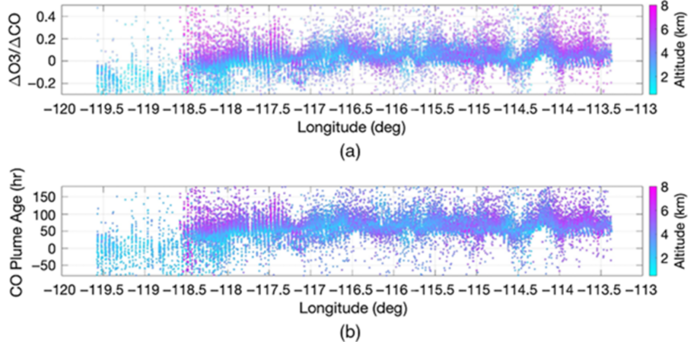
(a) The distribution of ΔO3/ΔCO ratio along the longitude within the wildfire plume and (b) the estimated longitudinal CO plume age distribution based on the NAST-I measurements. Credit: The Authors doi 10.1117/1.JRS.16.034522

Credit: The Authors, doi 10.1117/1.JRS.16.034522.

Wildfires, characterized by unplanned, uncontrolled, and unpredictable fires erupting in areas such as forests, grasslands, and prairies, have recently grown in frequency and intensity. Likely resulting from climate change effects, wildfires are increasingly impacting ecosystems and human lives. While wildfires are considered ecologically beneficial, there have been rising concerns over the negative effects, namely degradation of air quality from the smoke and pollutants released.

In particular, carbon monoxide (CO) and ozone (O3) are major contributors to wildfire-induced air pollution. However, unlike CO, O3 is not directly generated during wildfires. Instead, it is produced from O3 precursors emitted during wildfires and depends on several factors for its production. This, in turn, complicates the O3 production process. Moreover, its presence within wildfire plumes determines the wildfire plume age. Assessing its concentrations is, therefore, necessary to better understand how wildfires affect the air quality, weather, and climate.

In a recent study published in SPIE’s Journal of Applied Remote Sensing, scientists at NASA Langley Research Center, in collaboration with the National Oceanic and Atmospheric Administration (NOAA), reported their findings on this front in the Fire Influence on Regional to Global Environments and Air Quality (FIREX-AQ) field campaigns in 2019. The measurements of atmospheric CO and O3 levels were performed across the continental USA using a remote sensor called “National Airborne Sounder Testbed-Interferometer” (NAST-I), which provided both high spatial and spectral resolution.

“The NAST-I, onboard NASA ER-2 aircraft, covers a space large enough to monitor the wildfire plume from its origination, evolution and transport, and provides 3D distributions of the O3 and CO concentrations at a higher spatial resolution compared to that of satellite infrared-ultraspectral sensors,” said Dr. Daniel K. Zhou, the principal investigator of NAST-I and the lead author of the study.

Based on these measurements, the team estimated the plume age by observing the differential concentration ratios of O3 and CO, i.e., ΔO3/ΔCO and performing a linear fit with previous observations of wildfire ΔO3/ΔCO ratios. “Our results showed enhanced levels of CO in the evolving plume as it was transported away from the site of the fire. The plume age was associated with the plume distance in both vertical and horizontal directions,” Zhou said.

Overall, this study provides important insights that could prove crucial to a deeper understanding of the effects of wildfires on the atmosphere and the steps needed to mitigate them.

Read the Gold Open Access article by Daniel K. Zhou et al., “Estimation of fire-induced CO plume age from NAST–I during the FIREX-AQ field campaign”, J. of Applied Remote Sensing 16(3), 034522 (2022) doi 10.1117/1.JRS.16.034522.


Journal

Journal of Applied Remote Sensing

DOI

10.1117/1.JRS.16.034522

Article Title

Estimation of fire-induced CO plume age from NAST–I during the FIREX-AQ field campaign

Article Publication Date

22-Aug-2022

Share12Tweet8Share2ShareShareShare2

Related Posts

Humans and Zebra Finches Share Similar Speech Learning Techniques #ASA190 — Chemistry

Humans and Zebra Finches Share Similar Speech Learning Techniques #ASA190

May 11, 2026
New Study Uncovers How Fungal Parasites Attack Strawberries and Raspberries — Agriculture

New Study Uncovers How Fungal Parasites Attack Strawberries and Raspberries

May 11, 2026

City of Hope Researchers to Present Groundbreaking Immunotherapy and Precision Medicine Advances Across Multiple Cancer Types at ASCO 2026

May 11, 2026

Medicaid Expansion Reduces Mortality in Young Adults with Kidney Failure

May 11, 2026

POPULAR NEWS

  • Research Indicates Potential Connection Between Prenatal Medication Exposure and Elevated Autism Risk

    841 shares
    Share 336 Tweet 210
  • New Study Reveals Plants Can Detect the Sound of Rain

    728 shares
    Share 290 Tweet 182
  • Salmonella Haem Blocks Macrophages, Boosts Infection

    62 shares
    Share 25 Tweet 16
  • Breastmilk Balances E. coli and Beneficial Bacteria in Infant Gut Microbiomes

    57 shares
    Share 23 Tweet 14

About

We bring you the latest biotechnology news from best research centers and universities around the world. Check our website.

Follow us

Recent News

Humans and Zebra Finches Share Similar Speech Learning Techniques #ASA190

New Study Uncovers How Fungal Parasites Attack Strawberries and Raspberries

City of Hope Researchers to Present Groundbreaking Immunotherapy and Precision Medicine Advances Across Multiple Cancer Types at ASCO 2026

Subscribe to Blog via Email

Enter your email address to subscribe to this blog and receive notifications of new posts by email.

Join 82 other subscribers
  • Contact Us

Bioengineer.org © Copyright 2023 All Rights Reserved.

Welcome Back!

Login to your account below

Forgotten Password?

Retrieve your password

Please enter your username or email address to reset your password.

Log In
No Result
View All Result
  • Homepages
    • Home Page 1
    • Home Page 2
  • News
  • National
  • Business
  • Health
  • Lifestyle
  • Science

Bioengineer.org © Copyright 2023 All Rights Reserved.