• HOME
  • NEWS
  • EXPLORE
    • CAREER
      • Companies
      • Jobs
    • EVENTS
    • iGEM
      • News
      • Team
    • PHOTOS
    • VIDEO
    • WIKI
  • BLOG
  • COMMUNITY
    • FACEBOOK
    • INSTAGRAM
    • TWITTER
Sunday, May 24, 2026
BIOENGINEER.ORG
No Result
View All Result
  • Login
  • HOME
  • NEWS
  • EXPLORE
    • CAREER
      • Companies
      • Jobs
        • Lecturer
        • PhD Studentship
        • Postdoc
        • Research Assistant
    • EVENTS
    • iGEM
      • News
      • Team
    • PHOTOS
    • VIDEO
    • WIKI
  • BLOG
  • COMMUNITY
    • FACEBOOK
    • INSTAGRAM
    • TWITTER
  • HOME
  • NEWS
  • EXPLORE
    • CAREER
      • Companies
      • Jobs
        • Lecturer
        • PhD Studentship
        • Postdoc
        • Research Assistant
    • EVENTS
    • iGEM
      • News
      • Team
    • PHOTOS
    • VIDEO
    • WIKI
  • BLOG
  • COMMUNITY
    • FACEBOOK
    • INSTAGRAM
    • TWITTER
No Result
View All Result
Bioengineer.org
No Result
View All Result
Home NEWS Science News Biology

Understanding of early life ecosystems highlighted in new publication

by
September 6, 2025
in Biology
Reading Time: 2 mins read
0
Matthew Brown
Share on FacebookShare on TwitterShare on LinkedinShare on RedditShare on Telegram

STARKVILLE, Miss.—With a new understanding of past life on the planet through fossils, a Mississippi State biological sciences faculty member is helping researchers better predict Earth’s future.

STARKVILLE, Miss.—With a new understanding of past life on the planet through fossils, a Mississippi State biological sciences faculty member is helping researchers better predict Earth’s future.

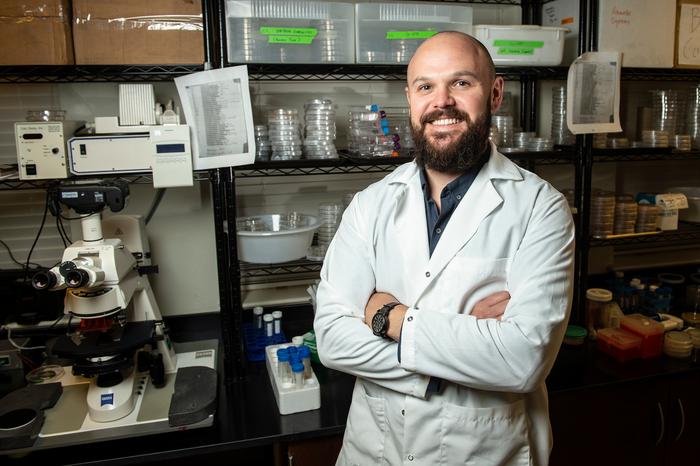
In a new paper published in July in the esteemed peer-reviewed journal Proceedings of the National Academy of Sciences, Donald L. Hall Professor of Biology Matthew Brown unearths a specific area of under-studied fossils: microbial eukaryotes—more specifically, testate amoebae from 750 million years ago. His novel research on testates will continue to help researchers understand Earth’s evolution, thereby allowing better predictions of what the planet may look like millions of years from now.

“Using fossils, we can estimate the divergence times and evolutionary paths leading to today’s testate amoebae found across the globe,” Brown said. “Testates are particularly significant for understanding the history of early Earth and the history of life. They represent some of the earliest confirmed heterotrophic eukaryotes.

“From the data we collected, scientists now can examine the evolutionary history of these intriguing amoebae like never before through bioinformatic approaches called molecular clocks,” he continued. “In evolution, genes and the proteins they encode evolve in a somewhat clock-like manner, making evolutionary changes somewhat predictable and model-able.”

Brown and his co-senior author Professor Daniel Lahr at the University of Sao Paulo, Brazil, collaborated with Brazilian paleontologist Luana Morais; Alfredo Porfirio-Sousa, a visiting scholar from the University of Sao Paulo; Alexander Tice, a previous postdoctoral student in Brown’s lab who is a faculty member at Texas Tech University; and Quentin Blandenier, another past postdoctoral student of Brown’s.

Today, Porfirio-Sousa and Blandenier are recognized as testate amoebae experts in the research community.

Brown also credits Nicholas Fry, Tristan Henderson and Felicity Kleitz-Singleton, all Ph.D. students in his lab, with assistance on his project.  

Established in 1914, PNAS is one of the world’s most cited and comprehensive multidisciplinary scientific journals, publishing more than 3,500 global research papers annually.

For more details about MSU’s College of Arts and Sciences or the Department of Biological Sciences, visit www.cas.msstate.edu or www.biology.msstate.edu.

Mississippi State University is taking care of what matters. Learn more at www.msstate.edu.


Journal

Proceedings of the National Academy of Sciences

Method of Research

Data/statistical analysis

Subject of Research

Cells

Article Title

Amoebozoan testate amoebae illuminate the diversity of heterotrophs and the complexity of ecosystems throughout geological time

Article Publication Date

16-Jul-2024

COI Statement

N/A
Share12Tweet8Share2ShareShareShare2

Related Posts

Rising Sightings of Blue and Fin Whales in the South East Atlantic — Biology

Rising Sightings of Blue and Fin Whales in the South East Atlantic

May 23, 2026
New Maps Reveal How European Landscapes Can Simultaneously Promote Climate Action and Biodiversity Conservation — Biology

New Maps Reveal How European Landscapes Can Simultaneously Promote Climate Action and Biodiversity Conservation

May 22, 2026

University of Cincinnati Structural Biologists Achieve World First in Visualizing Crucial Cell Protein

May 22, 2026

Reducing Fertilizer Use Through Strategic Scientific Partnerships

May 22, 2026

POPULAR NEWS

  • ESMO 2025: mRNA COVID Vaccines Enhance Efficacy of Cancer Immunotherapy

    314 shares
    Share 126 Tweet 79
  • New Study Reveals Plants Can Detect the Sound of Rain

    734 shares
    Share 293 Tweet 183
  • Research Indicates Potential Connection Between Prenatal Medication Exposure and Elevated Autism Risk

    847 shares
    Share 339 Tweet 212
  • Common Food Preservatives Associated with Elevated Blood Pressure and Increased Heart Disease Risk

    56 shares
    Share 22 Tweet 14

About

We bring you the latest biotechnology news from best research centers and universities around the world. Check our website.

Follow us

Recent News

Comparing Robust Intelligent Controls for 3-DOF Robots

Predicting Flashover on Polluted Insulators with CNN-LSTM

Sepsis from C. difficile Infection Has Comparable Mortality

Subscribe to Blog via Email

Enter your email address to subscribe to this blog and receive notifications of new posts by email.

Join 83 other subscribers
  • Contact Us

Bioengineer.org © Copyright 2023 All Rights Reserved.

Welcome Back!

Login to your account below

Forgotten Password?

Retrieve your password

Please enter your username or email address to reset your password.

Log In
No Result
View All Result
  • Homepages
    • Home Page 1
    • Home Page 2
  • News
  • National
  • Business
  • Health
  • Lifestyle
  • Science

Bioengineer.org © Copyright 2023 All Rights Reserved.