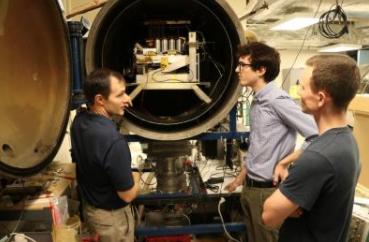
Credit: Aerospace Engineering, Grainger Engineering
In smaller spacecraft such as CubeSat satellites, a salt-based monopropellant is showing promise. It can be used both in high-thrust chemical propulsion for fast time-sensitive maneuvers, and electric mode for slow maneuvers, such as orbit maintenance. Now, researchers in the Department of Aerospace Engineering at the University of Illinois at Urbana-Champaign have more knowledge about how it performs under pressure.
The propellant, called FAM-110A, is a mixture of two commercially available salts.
Watch a video of the combustion: https:/
“Unlike hydrazine, the most commonly used monopropellant available today, our mixture is nontoxic. It’s also denser, so a smaller tank can be used for storage. And because it can be used in a combined chemical-electric thruster, it requires less plumbing than two separate thruster systems with their own propellants,” said Nicolas Rasmont, a graduate student who is working with AE faculty member Joshua Rovey.
Rasmont said his research project looked at the velocity of its combustion in the high-thrust chemical mode and how it performs under different pressures. The findings will help inform the design of a rocket engine using this type of propellant.
“We learned that the preparation and storage conditions have a deeper influence on combustion velocity than we anticipated,” Rasmont said. “We don’t have a complete explanation for that, yet. We think it’s because FAM-110A can absorb moisture from the atmosphere very quickly. Both components are hygroscopic, and other researchers found that even a small increase in water content can alter the combustion properties of similar propellants.”
The experiment studied FAM-110A along with two controls whose combustion behaviors are well known: nitromethane, and a mixture of 80 percent HAN with 20 percent water. The propellants were subjected to a range of pressures from 0.5 to 11.0 Megapascal, while a high-speed camera captured images of the flame to calculate the burn rate.
“The liquid propellant is placed in a quartz tube inside of the high-pressure combustion chamber. The chamber is closed and pressurized with nitrogen, then the top of the liquid is ignited, the flame front descends down the tube, and is observed through a viewport. Full combustion can take between a few seconds to a few hundredths of a second.”
“The burn rate influences how you design an engine,” Rasmont said. “If your burn rate is too high, you’re going to have combustion flashback–in which the decomposition flame will try to go back through the piping to the tank. It’s going so fast that it can blow up everything.
“But on the other hand, if your burn rate is too low, then the combustion will be difficult to maintain. In the end, we want to operate in a Goldilocks zone where the burn rate is not too high, so it’s safe, and not too low, so that the combustion is stable and efficient. We found that FAM-110A has a Goldilocks zone which is fairly wide, without any abrupt change in burn rate with increasing pressure.
In addition, the burn rate plateaus at a high pressure, which is also a desirable behavior.
“It means we could build a rocket engine using our propellant to be practical at almost any kind of pressure level. However, we also learned that FAM-110A leaves a significant amount of liquid residue after it burns. This is undesirable because it means that the combustion is incomplete. We might have to change the formulation in order to improve the efficiency of its combustion.”
Rasmont said the next step is to try to use it on an actual rocket engine to see if it is practical. “The tests we have done here are encouraging, but they also point out limitations and places we can improve.”
###
The study, “Linear burn rate of green ionic liquid multimode monopropellant,” written by Nicolas Rasmont, Emil J. Broemmelsiek, and Joshua L. Rovey, appears in Combustion and Flame.
Rasmont conducted this research while completing his master’s degree in aerospace engineering at Illinois and will be continuing on a Ph.D. this year.
Media Contact
Debra Levey Larson
[email protected]
Original Source
https:/
Related Journal Article
http://dx.