Research using the world’s most energetic laser has shed light on the properties of highly compressed matter – essential to understanding the structure of giant planets and stars, and to develop controlled nuclear fusion, a process that could harvest carbon-free energy.
Credit: Greg Stewart/SLAC National Accelerator Laboratory
Inset by Jan Vorberger/Helmholtz-Zentrum Dresden-Rossendorf
Research using the world’s most energetic laser has shed light on the properties of highly compressed matter – essential to understanding the structure of giant planets and stars, and to develop controlled nuclear fusion, a process that could harvest carbon-free energy.
Matter in the interior of giant planets and some relatively cool stars is highly compressed by the weight of the layers above. The extreme pressures generated are strong enough to charge of atoms and generate free electrons, in a process known as ionisation. The material properties of such matter are mostly determined by the degree of ionisation of the atoms. While ionisation in burning stars is primarily determined by temperature, pressure-driven ionization dominates in cooler stellar objects. However, this process is not well understood, and the extreme states of matter required are very difficult to create in the laboratory limiting the predictive power required to model celestial objects.
Extreme conditions also occur in laser-driven fusion experiments where hydrogen atoms are fused under high pressures and temperatures to helium, a heavier element. This process has been heralded as an unlimited, carbon free energy source – by using large excess energy generated by the fusion reactions to generate electricity. Progress in this grand scientific challenge relies heavily on numerical modelling and the ionisation balance in high-pressure systems is of central importance.
The only way to study this complex process in the laboratory is to dynamically compress matter to extreme densities which requires very large energy inputs in a very short time. In a new experiment published today in Nature, scientists have done just that using the largest and most energetic laser in the world, the National Ignition Facility (NIF). Through their research at the Lawrence Livermore National Laboratory (LLNL), US, the team provide new insights on the complex process of pressure-driven ionisation in giant planets and stars. They investigated the properties and behaviour of matter under extreme compression, offering important implications for astrophysics and nuclear fusion research.
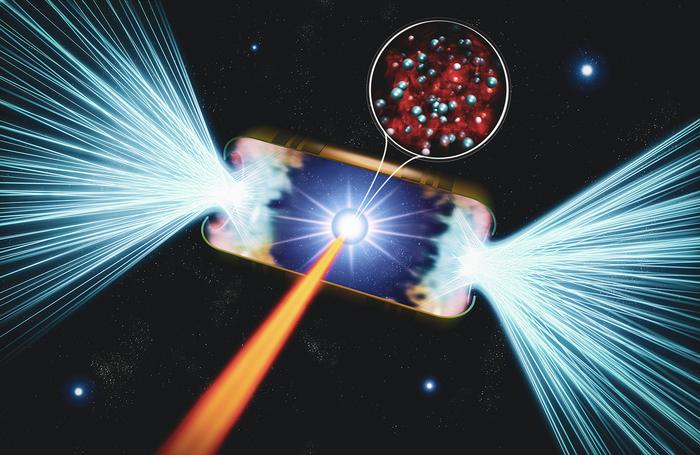
The international research team used NIF to generate the extreme conditions necessary for pressure-driven ionisation. They focused 184 laser beams on a cavity, converting the laser energy into X-rays that heated a 2mm metal shell placed in the centre. As the outside of the shell rapidly expanded due to the heating, the inside was driven inwards – reaching temperatures around two million kelvins (1.9m degrees Celsius) and pressures up to three billion atmospheres – creating a tiny piece of matter as found in dwarf stars for just a few nanoseconds.
The highly compressed metal shell (made of beryllium) was then analysed using X-rays to reveal its density, temperature, and electron structure. The findings revealed that, following strong heating and compression, at least three out of four electrons in beryllium transitioned into conducting states, that is, they can move independent from the nuclear cores of the atoms. Additionally, the study uncovered unexpectedly weak elastic X-ray scattering, indicating reduced localization of the remaining electron, that is a new stage shortly before all electrons become free and thus revealing the pathways to a fully ionised state.
LLNL physicist Tilo Döppner, who led the project, said: “By recreating extreme conditions similar to those inside giant planets and stars, we were able to observe changes in material properties and electron structure that are not captured by current models. Our work opens new avenues for studying and modeling the behavior of matter under extreme compression. The ionization in dense plasmas is a key parameter as it affects the equation of state, thermodynamic properties, and radiation transport through opacity.”
Associate Professor Dirk Gericke, University of Warwick, Department of Physics, added: “Having created and diagnosed these extreme pressures in the laboratory gives an invaluable benchmark for our theoretical models. Improved predictive capabilities are urgently needed not only for astrophysics but also for further progress toward controlled nuclear fusion which would allow to harvest the energy source of the stars for humanity.”
The pioneering research was the result of an international collaboration to develop x-ray Thomson scattering at the NIF as part of LLNL’s Discovery Science program. Collaborators included scientists from University of Rostock (Germany), University of Warwick (U.K.), GSI Helmholtz Center for Heavy Ion Research (Germany), University of California Berkeley, SLAC National Accelerator Laboratory, Helmholtz-Zentrum Dresden-Rossendorf (Germany), University of Lyon (France), Los Alamos National Laboratory, Imperial College London (U.K.), and First Light Fusion Ltd. (U.K.).
DOI
10.1038/s41586-023-05996-8