• HOME
  • NEWS
  • EXPLORE
    • CAREER
      • Companies
      • Jobs
    • EVENTS
    • iGEM
      • News
      • Team
    • PHOTOS
    • VIDEO
    • WIKI
  • BLOG
  • COMMUNITY
    • FACEBOOK
    • INSTAGRAM
    • TWITTER
Monday, June 29, 2026
BIOENGINEER.ORG
No Result
View All Result
  • Login
  • HOME
  • NEWS
  • EXPLORE
    • CAREER
      • Companies
      • Jobs
        • Lecturer
        • PhD Studentship
        • Postdoc
        • Research Assistant
    • EVENTS
    • iGEM
      • News
      • Team
    • PHOTOS
    • VIDEO
    • WIKI
  • BLOG
  • COMMUNITY
    • FACEBOOK
    • INSTAGRAM
    • TWITTER
  • HOME
  • NEWS
  • EXPLORE
    • CAREER
      • Companies
      • Jobs
        • Lecturer
        • PhD Studentship
        • Postdoc
        • Research Assistant
    • EVENTS
    • iGEM
      • News
      • Team
    • PHOTOS
    • VIDEO
    • WIKI
  • BLOG
  • COMMUNITY
    • FACEBOOK
    • INSTAGRAM
    • TWITTER
No Result
View All Result
Bioengineer.org
No Result
View All Result
Home NEWS Science News Biology

Uncovering your preferences via brain activity and mood

Bioengineer by Bioengineer
September 20, 2021
in Biology
Reading Time: 2 mins read
0
Uncovering Your Preferences via Brain Activity and Mood
Share on FacebookShare on TwitterShare on LinkedinShare on RedditShare on Telegram

People can struggle to accurately assess how they feel about something, especially something they feel social pressure to enjoy, like waking up early for a yoga class. How they really feel can be gleaned from their mood and their brain activity in reward regions, according to new research published in JNeurosci.
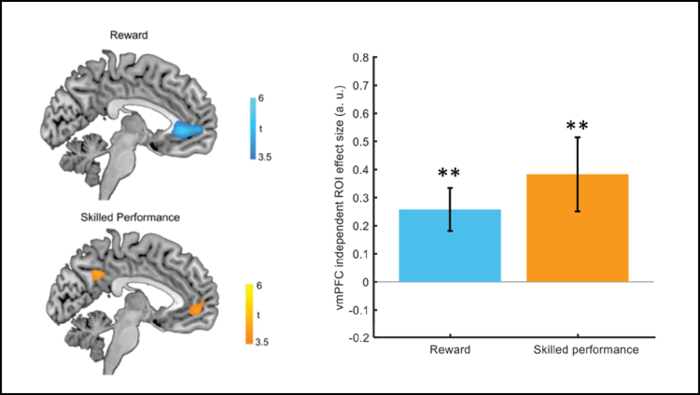
Uncovering Your Preferences via Brain Activity and Mood

Credit: Chew, Blain et al., JNeurosci 2021

People can struggle to accurately assess how they feel about something, especially something they feel social pressure to enjoy, like waking up early for a yoga class. How they really feel can be gleaned from their mood and their brain activity in reward regions, according to new research published in JNeurosci.

Chew, Blain et al. measured participants’ mood with repeated questions and their brain activity with fMRI as they earned two types of rewards. Participants chose a box to earn points tied to how much money they would earn at the end of the task — an extrinsic reward. Then they played a game where they navigated a cursor through on-screen barriers. They did not earn anything for playing the game beyond their own satisfaction with doing well — an intrinsic reward. The participants answered questions about how they felt throughout the study.

The research team developed a mathematical equation to determine how much intrinsic and extrinsic rewards contributed to the participants’ mood in a particular moment. Most people felt happier after earning more points or successfully completing the game, but the contribution of either reward to happiness varied from person to person. People whose happiness was more swayed by intrinsic rewards had more activity in their ventromedial prefrontal cortex, a reward area, during intrinsic rewards compared to extrinsic rewards, and vice versa. These results provide a potential avenue to assess preferences without outright asking.

###

Paper title: A Neurocomputational Model for Intrinsic Reward

Please contact [email protected] for the full-text PDF and to join SfN’s journals media list.

About JNeurosci

JNeurosci, the Society for Neuroscience’s first journal, was launched in 1981 as a means to communicate the findings of the highest quality neuroscience research to the growing field. Today, the journal remains committed to publishing cutting-edge neuroscience that will have an immediate and lasting scientific impact, while responding to authors’ changing publishing needs, representing breadth of the field and diversity in authorship.

About The Society for Neuroscience

The Society for Neuroscience is the world’s largest organization of scientists and physicians devoted to understanding the brain and nervous system. The nonprofit organization, founded in 1969, now has nearly 37,000 members in more than 90 countries and over 130 chapters worldwide.


Journal

JNeurosci

DOI

10.1523/JNEUROSCI.0858-20.2021

Subject of Research

People

Article Title

A neurocomputational model for intrinsic reward

Article Publication Date

20-Sep-2021
Share12Tweet8Share2ShareShareShare2

Related Posts

Natural Hallucinogens: Evolution’s Ecological Tools, Not Mere Chemical Byproducts

June 25, 2026

This Famous Butterfly Revealed: Three Distinct Species Hidden in One

June 25, 2026

Scientists Attack Soybean Cyst Nematode by Starving Its Food Source

June 25, 2026

Decoding the Secret Code of a Crucial Immune Sensor

June 24, 2026

POPULAR NEWS

  • Saying Goodbye to PGY-6: Pediatric Fellowship Realities

    103 shares
    Share 41 Tweet 26
  • Multi-Hospital Study Reveals Long Covid Burden Is Twice as High as Current Estimates

    92 shares
    Share 36 Tweet 23
  • Detection of EDCs in Breast Milk and Infant Urine Up to Six Months Highlights Early Exposure Risks

    77 shares
    Share 31 Tweet 19
  • New Drug Candidate Developed at McMaster Shows Potential for Treating Brain Cancer

    58 shares
    Share 23 Tweet 15

About

We bring you the latest biotechnology news from best research centers and universities around the world. Check our website.

Follow us

Recent News

Tracking Lanthanide-Labeled Microplastics in Plants

POSTECH Researchers Slash Cost of Reconstituted Cell-Free Systems by 95%

AI and Physics Collaborate to Design Advanced Hydrogen Storage Materials

Subscribe to Blog via Email

Success! An email was just sent to confirm your subscription. Please find the email now and click 'Confirm' to start subscribing.

Join 82 other subscribers
  • Contact Us

Bioengineer.org © Copyright 2023 All Rights Reserved.

Welcome Back!

Login to your account below

Forgotten Password?

Retrieve your password

Please enter your username or email address to reset your password.

Log In
No Result
View All Result
  • Homepages
    • Home Page 1
    • Home Page 2
  • News
  • National
  • Business
  • Health
  • Lifestyle
  • Science

Bioengineer.org © Copyright 2023 All Rights Reserved.