The Idea
Credit: DelGiorno, et. al.
The Idea
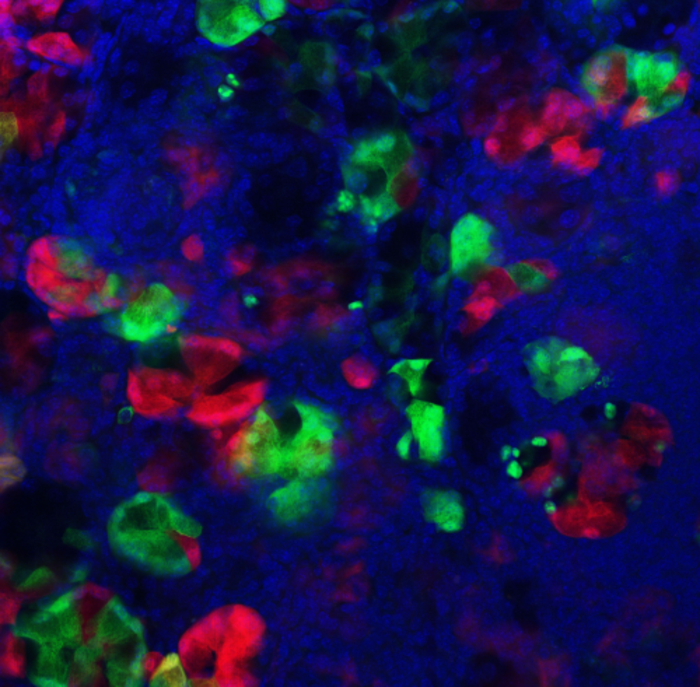
Pioneering research from scientists at the Vanderbilt University School of Medicine Basic Sciences and the Salk Institute for Biological Studies shows that acinar cells in the pancreas form new cell types to mitigate injury but are then susceptible to cancerous mutations.
This research, led by Kathy DelGiorno, assistant professor of cell and developmental biology at the School of Medicine Basic Sciences, Geoffrey Wahl, professor in the Gene Expression Laboratory and holder of the Daniel and Martina Lewis Chair at the Salk Institute, and first author Zhibo Ma, postdoctoral fellow in the Wahl lab, was published in Gastroenterology on October 22.
The findings establish a “better understanding of the mechanisms of healing in the pancreas and when these processes go awry,” DelGiorno said. The team used a multidisciplinary approach that combined single-cell RNA sequencing, ultrastructural microscopy, genetically engineered models, and patient samples to identify the cell types that form in response to pancreatic injury. Vanderbilt contributions included computational analysis by Ken Lau, associate professor of cell and developmental biology, and various microscopy approaches by Dylan Burnette, associate professor of cell and developmental biology, and Rafael Arrojo e Drigo, assistant professor of molecular physiology and biophysics.
From this approach, “we compared our dataset to published datasets of gastric injury, oncogene-induced pancreatic neoplasia, and human pancreatitis to identify conserved processes across species and organ systems,” said DelGiorno. According to Wahl, the findings of this paper “support our long-held thesis that tissue inflammation causes cells to reprogram to a more primitive, developmentally plastic state that under normal circumstances contributes to tissue repair. When subverted by oncogenes like RAS in pancreas cancer, it causes one of the most incalcitrant cancers known to medical science.”
Why It Matters
Pancreatic cancer is a major public health burden and is slated to become the second-leading cause of cancer-related deaths in the U.S. by the year 2030. Currently, the average five-year survival rate for pancreatic cancer is only 10 percent, one of the worst of any cancer type. New and innovative treatments are greatly needed to change these outcomes for pancreatic cancer patients.
“Our work captured how these acinar cells change in response to injury with incredible resolution. We’ve been able to identify multiple diverse cells generated by the acinar cells and uncover where they came from. Our findings provide a valuable resource to the field of pancreatic cancer research for understanding the processes that happen early in pancreas injury and tumorigenesis,” Ma said.
“We hope to co-opt and/or target these processes for the benefit of patients needing treatment for pancreatitis and cancer,” DelGiorno said.
What’s Next?
The Vanderbilt team has received a National Institute of General Medical Sciences Maximizing Investigators’ Research Award to follow up on this work. “We will be using genetically engineered models to study the lineage trajectories and functional role of the cell types identified in this study,” DelGiorno said. “We will identify the physiological role of these cell types in pancreatic injury, regeneration, and tumorigenesis.”
Go Deeper
The article “Single-cell transcriptomics reveals a conserved metaplasia program in pancreatic injury” was published in Gastroenterology on October 22.
Funding
This research was funded by multiple private and governmental sources, including local Nashville-based non-profit organization Linda’s Hope Fund for Pancreatic Cancer Research, which raises money for pancreatic cancer research. In addition, the following organizations provided funding: the National Institutes of Health, the Hope Funds for Cancer Research, the Sky Foundation, the Chapman Foundation, the Waitt Foundation, the Chan-Zuckerberg Initiative, the National Science Foundation, the Nikki Mitchell Foundation Pancreas Club, the Department of Veterans Affairs, Cancer UK, the Isacoff Gastrointestinal Research Foundation, the Freeberg Foundation, the Leona M. and the Harry B. Helmsley Charitable Trust, the American Gastroenterological Association, and additional Vanderbilt and Salk institutional funds.
Journal
Gastroenterology
Article Title
Single-cell transcriptomics reveals a conserved metaplasia program in pancreatic injury
Article Publication Date
22-Oct-2021