• HOME
  • NEWS
  • EXPLORE
    • CAREER
      • Companies
      • Jobs
    • EVENTS
    • iGEM
      • News
      • Team
    • PHOTOS
    • VIDEO
    • WIKI
  • BLOG
  • COMMUNITY
    • FACEBOOK
    • INSTAGRAM
    • TWITTER
Friday, October 30, 2026
BIOENGINEER.ORG
No Result
View All Result
  • Login
  • HOME
  • NEWS
  • EXPLORE
    • CAREER
      • Companies
      • Jobs
        • Lecturer
        • PhD Studentship
        • Postdoc
        • Research Assistant
    • EVENTS
    • iGEM
      • News
      • Team
    • PHOTOS
    • VIDEO
    • WIKI
  • BLOG
  • COMMUNITY
    • FACEBOOK
    • INSTAGRAM
    • TWITTER
No Result
View All Result
Bioengineer.org
No Result
View All Result
Home NEWS Science News Technology

Ultrathin BiFeO3 films show altermagnetic signatures without a dead layer

by
October 28, 2026
in Technology
Reading Time: 2 mins read
0
Ultrathin BiFeO3 films show altermagnetic signatures without a dead layer

Ultrathin BiFeO3 films show altermagnetic signatures without a dead layer

Share on FacebookShare on TwitterShare on LinkedinShare on RedditShare on Telegram

The work, published in Nature Materials, combines first-principles calculations, symmetry analysis, atomic-resolution imaging and magnetic imaging to characterize the films.

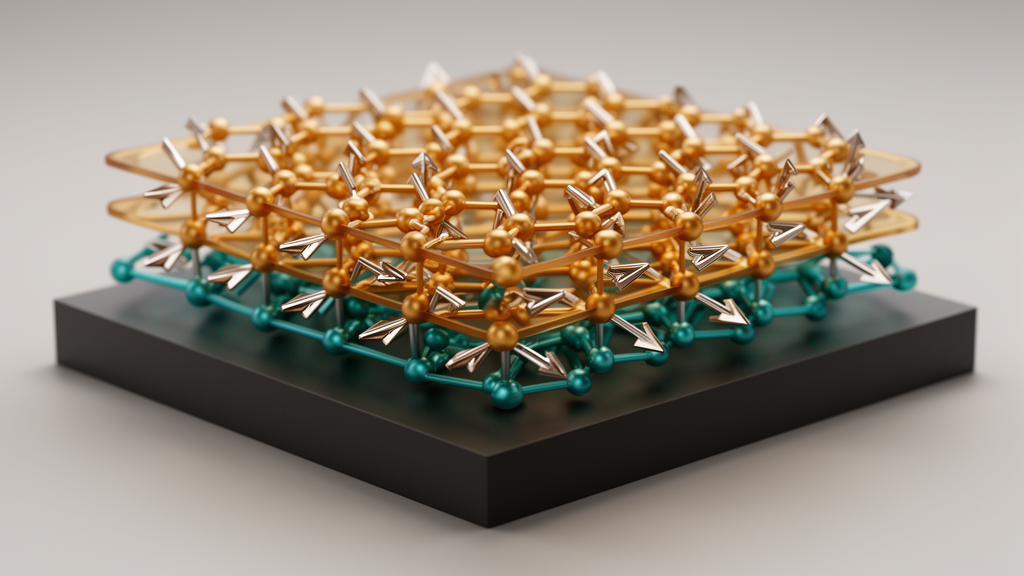
Ultrathin multiferroics are attractive because magnetoelectric materials, which couple electric and magnetic order, promise low-power switching, non-volatile memory and signal transduction. But shrinking them to device-relevant thicknesses has long been problematic. Uncompensated bound charge drives depolarization in ferroelectrics, while off-stoichiometry, reduced magnetic anisotropy and charge transfer at interfaces can produce magnetic dead layers, regions where magnetic order collapses. The new study reports a multiferroic phase of BiFeO3 with no dead layer, achieved by growing the films epitaxially on a metallic SrRuO3 bottom electrode and using epitaxial strain to stabilize a monoclinic crystal structure.

According to the abstract, short-circuit electrostatic boundary conditions and epitaxial strain together drive a continuous, thickness-induced phase transition accompanied by multiferroic topological textures. At four unit cells, these boundary conditions stabilize a collinear monoclinic phase with d-wave altermagnetic order. The reported altermagnetic signatures in the ultrathin films are supported by magnetic circular dichroism and spin-resolved photoemission measurements.

The study is framed as establishing a pathway to stabilize unconventional multiferroicity at device-relevant thicknesses, reframing scaling limits for oxide electronics. Because the reported findings rest on the abstract and figure captions of the published paper, the detailed experimental conditions, quantitative measurements and the full scope of the imaging and spectroscopic evidence are described in the underlying article, which is available by subscription. The authors include researchers from multiple institutions working on oxide molecular-beam epitaxy, electron microscopy, spin-resolved spectroscopy and first-principles theory.

Subject of Research: Altermagnetism and multiferroic order in ultrathin BiFeO3 thin films

Article Title: Altermagnetic signatures and topological textures in ultrathin multiferroic BiFeO3

Article References: Fratian, G., Ramesh, M., Li, X., Golias, E., Nahas, Y., Schultheis, S. M. U., Skolaut, J., Checa, M., Ghosal, A., Krysko, E., Malinowski, P., Faeth, B. D., Priessnitz, J., Fobasso Mbognou, F. C., Hariki, A., Sakurai, K., Furo, M., Ojha, S. K., Congdon, M., … Caretta, L. (2026). Altermagnetic signatures and topological textures in ultrathin multiferroic BiFeO3. Nature Materials. https://doi.org/10.1038/s41563-026-02786-1

Image Credits: AI Generated

DOI: 10.1038/s41563-026-02786-1

Keywords: BiFeO3, multiferroic, altermagnetism, ultrathin films, ferroelectricity, magnetic dead layer, epitaxial strain, topological textures, oxide electronics, spin-resolved photoemission, magnetic circular dichroism, SrRuO3

News Source: Denise Maddox. (October 28, 2026). Ultrathin BiFeO3 films show altermagnetic signatures without a dead layer. Scienmag.


Tags: altermagnetismBiFeO3epitaxial strainferroelectricitymagnetic circular dichroismmagnetic dead layermultiferroicoxide electronicsspin-resolved photoemissionSrRuO3topological texturesultrathin films
Share12Tweet7Share2ShareShareShare1

Related Posts

Graph neural network model learns design element links for sharper style transfer

Graph neural network model learns design element links for sharper style transfer

October 30, 2026
New Fourth-Order Time-Stepping Schemes Promise Faster Flow Simulations

New Fourth-Order Time-Stepping Schemes Promise Faster Flow Simulations

October 30, 2026

New Indexing Scheme Brings Filtered Vector Search to Edge Devices

October 30, 2026

From student barracks to student cities: how Sweden invented a housing type

October 30, 2026

POPULAR NEWS

  • Inflammation-Weighted Nutrition Score Predicts Survival After Liver Cancer Surgery

    Inflammation-Weighted Nutrition Score Predicts Survival After Liver Cancer Surgery

    29 shares
    Share 12 Tweet 7
  • RAS Inhibitor Daraxonrasib Redefines Pancreatic Cancer Treatment After FDA Approval

    29 shares
    Share 12 Tweet 7
  • Few Ethiopian Mothers Receive Quality Care Across Maternity Continuum

    29 shares
    Share 12 Tweet 7
  • Particle Swarm Optimization Steers Client Selection in Decentralized Federated Learning

    29 shares
    Share 12 Tweet 7

About

We bring you the latest biotechnology news from best research centers and universities around the world. Check our website.

Follow us

Recent News

Nomogram predicts catheter-related thrombosis risk in people living with HIV

Graph neural network model learns design element links for sharper style transfer

New Fourth-Order Time-Stepping Schemes Promise Faster Flow Simulations

Subscribe to Blog via Email

Enter your email address to subscribe to this blog and receive notifications of new posts by email.

Join 86 other subscribers
  • Contact Us

Bioengineer.org © Copyright 2023 All Rights Reserved.

Welcome Back!

Login to your account below

Forgotten Password?

Retrieve your password

Please enter your username or email address to reset your password.

Log In
No Result
View All Result
  • Homepages
    • Home Page 1
    • Home Page 2
  • News
  • National
  • Business
  • Health
  • Lifestyle
  • Science

Bioengineer.org © Copyright 2023 All Rights Reserved.