• HOME
  • NEWS
  • EXPLORE
    • CAREER
      • Companies
      • Jobs
    • EVENTS
    • iGEM
      • News
      • Team
    • PHOTOS
    • VIDEO
    • WIKI
  • BLOG
  • COMMUNITY
    • FACEBOOK
    • INSTAGRAM
    • TWITTER
Thursday, June 11, 2026
BIOENGINEER.ORG
No Result
View All Result
  • Login
  • HOME
  • NEWS
  • EXPLORE
    • CAREER
      • Companies
      • Jobs
        • Lecturer
        • PhD Studentship
        • Postdoc
        • Research Assistant
    • EVENTS
    • iGEM
      • News
      • Team
    • PHOTOS
    • VIDEO
    • WIKI
  • BLOG
  • COMMUNITY
    • FACEBOOK
    • INSTAGRAM
    • TWITTER
  • HOME
  • NEWS
  • EXPLORE
    • CAREER
      • Companies
      • Jobs
        • Lecturer
        • PhD Studentship
        • Postdoc
        • Research Assistant
    • EVENTS
    • iGEM
      • News
      • Team
    • PHOTOS
    • VIDEO
    • WIKI
  • BLOG
  • COMMUNITY
    • FACEBOOK
    • INSTAGRAM
    • TWITTER
No Result
View All Result
Bioengineer.org
No Result
View All Result
Home NEWS Science News Health

Ultrasound yields similar cancer detection rates after digital mammography, tomosynthesis

Bioengineer by Bioengineer
September 27, 2019
in Health
Reading Time: 2 mins read
0
IMAGE
Share on FacebookShare on TwitterShare on LinkedinShare on RedditShare on Telegram

Dense breast ultrasound screening after digital mammography — versus after digital breast tomosynthesis–yielded ‘no significant difference’ in additional cancer detection rate, according to AJR
IMAGE

Credit: American Journal of Roentgenology (AJR)

Leesburg, VA, September 27, 2019–An ahead-of-print article in the December issue of the American Journal of Roentgenology (AJR) comparing dense breast ultrasound (US) screening after digital mammography (DM) versus after digital breast tomosynthesis (DBT) yielded “no significant difference” in additional cancer detection rate.

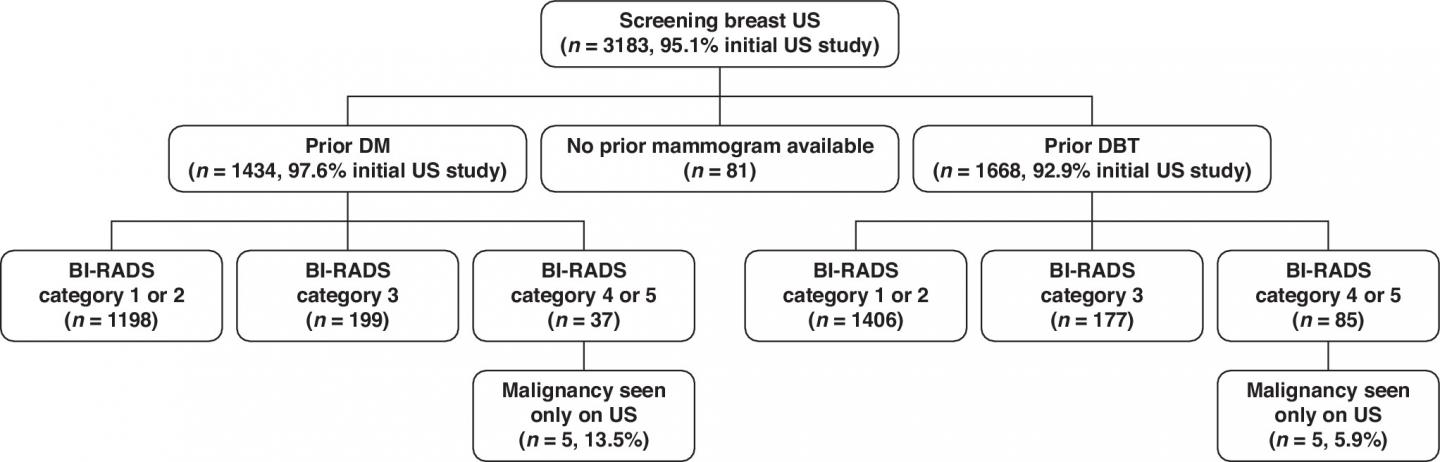
Lead investigator Elizabeth H. Dibble of Brown University and colleagues retrospectively searched databases at two tertiary breast imaging centers and an office practice, focusing on 3183 screening breast US examinations performed from October 2014 to September 2016–1434 (45.1%) after DM and 1668 (52.4%) after DBT.

Of these 3183 examinations, 81 (2.5%) had no prior mammogram available. Of the 122 DM and DBT patients for whom biopsy or cyst aspiration was recommended–all BI-RADS assessment category 4 or 5 studies–118 (96.7%) had biopsy or cyst aspiration results available.

Of the 36 biopsies or aspirations after DM, 6 (16.7%) were malignant, and 30 (83.3%) were benign. Of the 82 biopsies or aspirations after DBT, 11 (13.4%) were malignant, and 71 (86.6%) were benign (p = 0.8583).

Overall, the additional cancer detection rate by US after DM was 5/1434, or 3.5 per 1000 women screened; after DBT, the detection rate was 5/1668, or 3.0 per 1000 women screened (p = 0.9999).

Dibble concluded: “DBT does not obviate additional US screening in women with dense breast tissue. No evidence was found of a difference in additional cancer detection rate with screening US after DM versus after DBT. Knowing that the cancer yield of screening US is similar after DBT versus DM may help inform clinical practice, because questions abound about whether DBT is sufficient screening for women with dense breast tissue.”

###

Founded in 1900, the American Roentgen Ray Society (ARRS) is the first and oldest radiology society in the North America, dedicated to the advancement of medicine through the profession of radiology and its allied sciences. An international forum for progress since the discovery of the x-ray, ARRS maintains its mission of improving health through a community committed to advancing knowledge and skills with an annual scientific meeting, monthly publication of the peer-reviewed American Journal of Roentgenology (AJR), quarterly issues of InPractice magazine, AJR Live Webinars and Podcasts, topical symposia, print and online educational materials, as well as awarding scholarships via The Roentgen FundĀ®.

Media Contact
Logan K. Young
[email protected]

Original Source

https://arrs.org/ARRSLIVE/Pressroom/PressReleases/ultrasound-after-digital-mammography-digital-breast-tomosynthesis-cancer.aspx

Related Journal Article

http://dx.doi.org/10.2214/AJR.18.20748

Tags: Breast CancercancerDiagnosticsGynecologyHealth CareHealth Care Systems/ServicesInsuranceMedicine/HealthPublic Health
Share12Tweet8Share2ShareShareShare2

Related Posts

Building Robust Foundation Models for Digital Pathology

June 11, 2026

Bacteria Exploit LILRB3 to Evade Antibody Immunity

June 11, 2026

Tumor T Cells and Dendritic Cells Unite in Melanoma Immunotherapy

June 11, 2026

Melatonin and Cerium Oxide Alleviate Drug-Induced Liver Toxicity

June 11, 2026
Please login to join discussion

POPULAR NEWS

  • ESMO 2025: mRNA COVID Vaccines Enhance Efficacy of Cancer Immunotherapy

    324 shares
    Share 130 Tweet 81
  • Saying Goodbye to PGY-6: Pediatric Fellowship Realities

    95 shares
    Share 38 Tweet 24
  • Multi-Hospital Study Reveals Long Covid Burden Is Twice as High as Current Estimates

    90 shares
    Share 36 Tweet 22
  • Common Food Preservatives Associated with Elevated Blood Pressure and Increased Heart Disease Risk

    58 shares
    Share 23 Tweet 15

About

We bring you the latest biotechnology news from best research centers and universities around the world. Check our website.

Follow us

Recent News

Urothelial Changes Increase UTI Risk Post-VCUG

Building Robust Foundation Models for Digital Pathology

Bacteria Exploit LILRB3 to Evade Antibody Immunity

Subscribe to Blog via Email

Enter your email address to subscribe to this blog and receive notifications of new posts by email.

Join 82 other subscribers
  • Contact Us

Bioengineer.org Ā© Copyright 2023 All Rights Reserved.

Welcome Back!

Login to your account below

Forgotten Password?

Retrieve your password

Please enter your username or email address to reset your password.

Log In
No Result
View All Result
  • Homepages
    • Home Page 1
    • Home Page 2
  • News
  • National
  • Business
  • Health
  • Lifestyle
  • Science

Bioengineer.org Ā© Copyright 2023 All Rights Reserved.