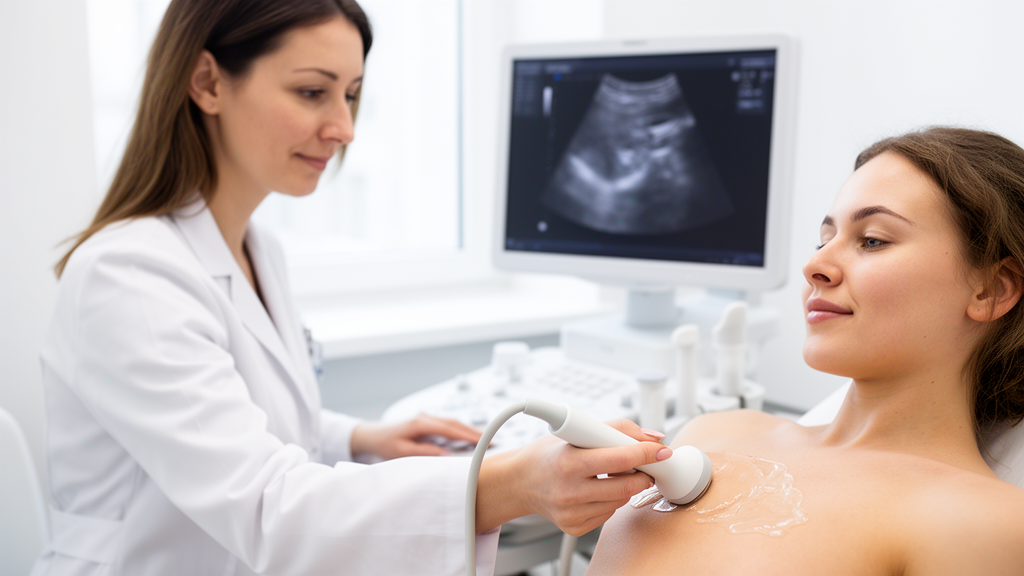
Changes in tumor stiffness measured by a non-invasive ultrasound technique closely mirror how breast cancers respond to chemotherapy given before surgery, according to a prospective study from Yunnan Cancer Hospital in Kunming, China, published in Frontiers in Oncology. The research followed 66 breast cancer patients through neoadjuvant chemotherapy (NAC), using shear wave elastography (SWE) to quantify how stiff the tumors and the tissue immediately surrounding them became as treatment progressed, and then compared those measurements against the verdict delivered by pathologists examining the surgically removed tissue. The team measured four SWE parameters within each tumor: the maximum stiffness (Emax), mean stiffness (Emean), minimum stiffness (Emin), and the standard deviation of stiffness (Esd), which captures internal heterogeneity.
Crucially, they did not stop at the visible tumor margin. The researchers extended their stiffness measurements into rings of tissue 1, 2, and 3 millimeters beyond the tumor edge, capturing both the pre-treatment baseline and the post-NAC state. After surgery, each patient's pathological response was graded using the Miller-Payne system.
Grades 3 through 5 were classified as an effective response, while grades 1 and 2 were classified as ineffective. This pathological grading served as the reference standard against which every ultrasound measurement was judged, allowing the team to calculate how accurately stiffness changes corresponded to the pathological outcome. The results separated the two groups cleanly.
In patients whose tumors responded effectively to chemotherapy, post-treatment scans showed significant reductions in Emax, Emean, and Esd both within the lesion and in the surrounding peri-lesional tissue, with all comparisons reaching statistical significance at P < 0.05. In contrast, the ineffective group maintained high stiffness values throughout treatment, indicating that tumors resistant to the drugs retained their mechanical character after therapy. The single most powerful discriminator was the percentage change in maximum stiffness, ΔEmax, calculated between the pre- and post-treatment scans.
When measured inside the lesion, ΔEmax achieved an area under the receiver operating characteristic curve (AUC) of 0.941, with a 95 percent confidence interval of 0.887 to 0.995. At a cutoff of greater than 49.12 percent reduction, the metric identified responding tumors with 88.89 percent sensitivity and 85.71 percent specificity. The peri-lesional measurements added value of their own.
When ΔEmax was assessed in the 1 to 3 millimeter rings around the tumor, the AUC remained above 0.9 and specificity exceeded 90 percent, meaning the technique rarely misclassified a non-responder as a responder when the surrounding tissue was included in the analysis. In this cohort, the stiff rim sign disappeared after chemotherapy exclusively in the effective-response group, while it persisted in non-responders. The authors conclude that SWE parameters, particularly ΔEmax, together with the dynamic behavior of the stiff rim sign, are promising non-invasive biomarkers that correlate with pathological response to neoadjuvant chemotherapy.
The team is careful about scope: the study involved a single prospective cohort of 66 patients at Chinese hospitals, and the researchers explicitly state that prospective validation in larger cohorts is warranted before the approach is implemented clinically. For now, the findings position shear wave elastography as a candidate for post-treatment response evaluation, but they remain hypothesis-generating rather than practice-changing.
Subject of Research: Shear wave elastography stiffness changes as biomarkers of pathological response to neoadjuvant chemotherapy in breast cancer
Article Title: Assessment of shear wave elastography for evaluating neoadjuvant chemotherapy efficacy in breast cancer: correlation of stiffness changes with pathological response
Article References: Yang, H., Liu, S., Luo, X., Zhang, Z., Su, Q., Pu, W., Chen, H., An, Q., Liu, X., Luan, L., Zhang, N., Yao, P., Zhang, Y., Zhang, L., Yu, J., Li, Z., & Chuan, Z. (2026). Assessment of shear wave elastography for evaluating neoadjuvant chemotherapy efficacy in breast cancer: correlation of stiffness changes with pathological response. Frontiers in Oncology, 16, Article 1839381. https://doi.org/10.3389/fonc.2026.1839381
Image Credits: AI Generated
DOI: 10.3389/fonc.2026.1839381
Keywords: breast cancer, neoadjuvant chemotherapy, shear wave elastography, tumor stiffness, stiff rim sign, Miller-Payne grading, pathological response, treatment response, ultrasound, ROC analysis, peri-lesional tissue, biomarkers
News Source: Nathaniel Bowman. (October 27, 2026). Ultrasound Stiffness Tracking Shows Strong Accuracy for Breast Cancer Chemo Response. Scienmag.