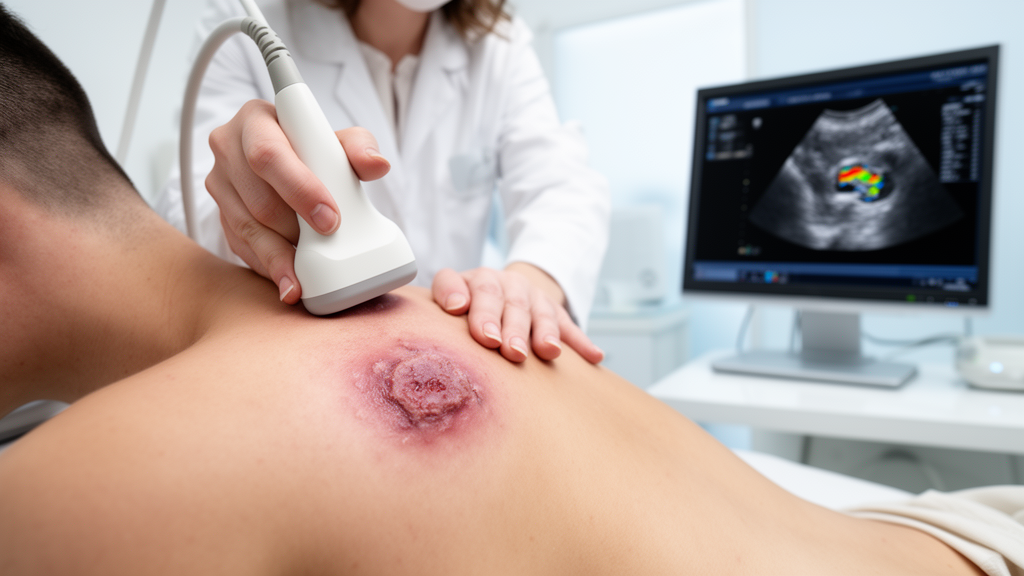
A prospective preliminary study found that high-frequency ultrasound combined with superb microvascular imaging (SMI) could quantify the thickness and microvascular characteristics of keloids. In 21 patients with 60 keloids, the lesions were thicker and had higher vascular index values than healthy skin at corresponding sites on the opposite side of the body. The researchers also tested whether the imaging approach could measure short-term changes after intralesional triamcinolone acetonide injection, although the vascular result was not statistically significant when analyzed by patient.
High-frequency ultrasound was used to measure skin thickness at each keloid and at the corresponding healthy contralateral site. SMI was used to detect microvascular blood flow in the skin and calculate the vascular index. Across the 60 keloids, mean skin thickness was 3.37 ± 1.34 mm, compared with 1.57 ± 0.30 mm in the healthy skin. Median vascular index was 7.34% in keloids, with an interquartile range of 4.94–14.78%, versus 0.70% in healthy skin, with an interquartile range of 0.51–1.44%. Both differences were statistically significant, with P values below 0.05.
For the treatment assessment, 23 keloids in nine patients received a single intralesional triamcinolone acetonide injection and were reassessed one month later. At the lesion level, the injected keloids showed statistically significant reductions in skin thickness, vascular index and modified Vancouver Scar Scale score. Median skin thickness fell from 3.70 mm, with an interquartile range of 2.10–4.20 mm, to 2.90 mm, with an interquartile range of 2.10–3.70 mm. Median vascular index declined from 7.60%, with an interquartile range of 4.60–12.60%, to 5.70%, with an interquartile range of 1.20–10.00%. The median scar-scale score decreased from 10, with an interquartile range of 9–11, to 8, with an interquartile range of 7–10. The investigators reported P values below 0.05 for these lesion-level changes.
Aggregating the findings by patient produced a more limited result. Mean lesion thickness decreased by 0.56 mm, and that reduction remained statistically significant, with P below 0.05. The mean vascular index change, however, was a decrease of 2.47 percentage points and was not statistically significant, with P = 0.203. Thus, the significant vascular-index reduction observed when the 23 lesions were analyzed individually was not corroborated by the patient-level analysis.
The findings support high-frequency ultrasound combined with SMI as a non-invasive way to quantify keloid thickness and microvascular characteristics, while showing that the evidence for a short-term change in vascular index after injection depends on the level of analysis. The study was preliminary, included 21 patients and 60 keloids, and assessed treatment changes over only one month. Its authors cautioned that the results should be interpreted cautiously. The work demonstrates an imaging approach that may be useful for monitoring treatment response, but the reported data do not establish a consistent reduction in keloid vascularity following injection.
Subject of Research: Assessment of keloid thickness and microvascular characteristics using high-frequency ultrasound and superb microvascular imaging
Article Title: Superb microvascular imaging for assessing keloids and short-term changes after intralesional triamcinolone acetonide injection: a preliminary study
Article References: Chen, X., Li, H., Zhang, Y., Liu, J., Zhang, Y., Hu, B., & Bai, X. (2026). Superb microvascular imaging for assessing keloids and short-term changes after intralesional triamcinolone acetonide injection: a preliminary study. BMC Medical Imaging. https://doi.org/10.1186/s12880-026-02950-8
Image Credits: AI Generated
DOI: 10.1186/s12880-026-02950-8
Keywords: keloids, superb microvascular imaging, high-frequency ultrasound, vascular index, triamcinolone acetonide, skin thickness, scar assessment, microvascular blood flow, prospective study, Superb, microvascular, imaging
News Source: Ophelia Keating. (October 20, 2026). Ultrasound imaging measures keloids; patient-level vascular change uncertain. Scienmag.