• HOME
  • NEWS
  • EXPLORE
    • CAREER
      • Companies
      • Jobs
    • EVENTS
    • iGEM
      • News
      • Team
    • PHOTOS
    • VIDEO
    • WIKI
  • BLOG
  • COMMUNITY
    • FACEBOOK
    • INSTAGRAM
    • TWITTER
Monday, October 5, 2026
BIOENGINEER.ORG
No Result
View All Result
  • Login
  • HOME
  • NEWS
  • EXPLORE
    • CAREER
      • Companies
      • Jobs
        • Lecturer
        • PhD Studentship
        • Postdoc
        • Research Assistant
    • EVENTS
    • iGEM
      • News
      • Team
    • PHOTOS
    • VIDEO
    • WIKI
  • BLOG
  • COMMUNITY
    • FACEBOOK
    • INSTAGRAM
    • TWITTER
  • HOME
  • NEWS
  • EXPLORE
    • CAREER
      • Companies
      • Jobs
        • Lecturer
        • PhD Studentship
        • Postdoc
        • Research Assistant
    • EVENTS
    • iGEM
      • News
      • Team
    • PHOTOS
    • VIDEO
    • WIKI
  • BLOG
  • COMMUNITY
    • FACEBOOK
    • INSTAGRAM
    • TWITTER
No Result
View All Result
Bioengineer.org
No Result
View All Result
Home NEWS Science News

Ultrafast camera takes 1 trillion frames per second of transparent objects and phenomena

Bioengineer by Bioengineer
January 21, 2020
in Science News
Reading Time: 3 mins read
0
IMAGE
Share on FacebookShare on TwitterShare on LinkedinShare on RedditShare on Telegram

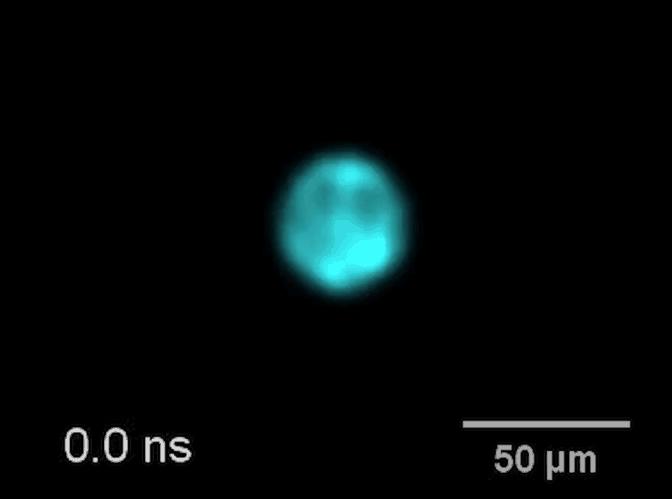
Lihong Wang has adapted his picosecond imaging technology to take pictures and video of transparent objects like cells and phenomena like shockwaves
IMAGE

Credit: Caltech


A little over a year ago, Caltech’s Lihong Wang developed the world’s fastest camera, a device capable of taking 10 trillion pictures per second. It is so fast that it can even capture light traveling in slow motion.

But sometimes just being quick is not enough. Indeed, not even the fastest camera can take pictures of things it cannot see. To that end, Wang, Bren Professor of Medical Engineering and Electrical Engineering, has developed a new camera that can take up to 1 trillion pictures per second of transparent objects. A paper about the camera appears in the January 17 issue of the journal Science Advances.

The camera technology, which Wang calls phase-sensitive compressed ultrafast photography (pCUP), can take video not just of transparent objects but also of more ephemeral things like shockwaves and possibly even of the signals that travel through neurons.

Wang explains that his new imaging system combines the high-speed photography system he previously developed with an old technology, phase-contrast microscopy, that was designed to allow better imaging of objects that are mostly transparent such as cells, which are mostly water.

Phase-contrast microscopy, invented nearly 100 years ago by Dutch physicist Frits Zernike, works by taking advantage of the way that light waves slow down and speed up as they enter different materials. For example, if a beam of light passes through a piece of glass, it will slow down as it enters the glass and then speed up again as it exits. Those changes in speed alter the timing of the waves. With the use of some optical tricks it is possible to distinguish light that passed through the glass from light that did not, and the glass, though transparent, becomes much easier to see.

“What we’ve done is to adapt standard phase-contrast microscopy so that it provides very fast imaging, which allows us to image ultrafast phenomena in transparent materials,” Wang says.

The fast-imaging portion of the system consists of something Wang calls lossless encoding compressed ultrafast technology (LLE-CUP). Unlike most other ultrafast video-imaging technologies that take a series of images in succession while repeating the events, the LLE-CUP system takes a single shot, capturing all the motion that occurs during the time that shot takes to complete. Since it is much quicker to take a single shot than multiple shots, LLE-CUP is capable of capturing motion, such as the movement of light itself, that is far too fast to be imaged by more typical camera technology.

In the new paper, Wang and his fellow researchers demonstrate the capabilities of pCUP by imaging the spread of a shockwave through water and of a laser pulse traveling through a piece of crystalline material.

Wang says the technology, though still early in its development, may ultimately have uses in many fields, including physics, biology, or chemistry.

“As signals travel through neurons, there is a minute dilation of nerve fibers that we hope to see. If we have a network of neurons, maybe we can see their communication in real time,” Wang says. In addition, he says, because temperature is known to change phase contrast, the system “may be able to image how a flame front spreads in a combustion chamber.”

###

The paper describing pCUP is titled “Picosecond-resolution phase-sensitive imaging of transparent objects in a single shot.” Co-authors include Taewoo Kim, a postdoctoral scholar in medical engineering, and Jinyang Liang and Liren Zhu, both formerly of Caltech.

Funding for the research was provided by the National Institutes of Health.

Media Contact
Emily Velasco
 @caltech

626-395-6487

Original Source

https://www.caltech.edu/about/news/ultrafast-camera-takes-1-trillion-frames-second-transparent-objects-and-phenomena

Related Journal Article

http://dx.doi.org/10.1126/sciadv.aay6200

Tags: Cell BiologyChemistry/Physics/Materials SciencesElectrical Engineering/ElectronicsMedicine/HealthOpticsTechnology/Engineering/Computer Science
Share12Tweet8Share2ShareShareShare2

Related Posts

Greener HPLC Method Tracks Leukemia Drug and Anti-Nausea Partner in Blood Plasma

Greener HPLC Method Tracks Leukemia Drug and Anti-Nausea Partner in Blood Plasma

October 5, 2026
Fingertip Scan Reveals Hidden Heart Health in People Over 80

Fingertip Scan Reveals Hidden Heart Health in People Over 80

October 5, 2026

Suicidality Predicts Rising Anxiety and Depression in Autistic and Non-Autistic Students

October 5, 2026

Early Fever May Not Seal Fate in Status Epilepticus, Landmark French Registry Finds

October 5, 2026
Please login to join discussion

POPULAR NEWS

  • Alloys That Shrink Their Own Grains: New PIX Mechanism Refines Metals With Heat Alone

    Alloys That Shrink Their Own Grains: New PIX Mechanism Refines Metals With Heat Alone

    29 shares
    Share 12 Tweet 7
  • Endurance Exercise Reshapes the Liver in Males and Females Through Distinct Molecular Routes

    29 shares
    Share 12 Tweet 7
  • Single Transcription Factor PU.1 Rapidly Converts Fibroblasts into Macrophage-Lineage Cells

    29 shares
    Share 12 Tweet 7
  • New Scale Measures How Ready Nurse Educators Really Are for the AI Era

    29 shares
    Share 12 Tweet 7

About

We bring you the latest biotechnology news from best research centers and universities around the world. Check our website.

Follow us

Recent News

Alloys That Shrink Their Own Grains: New PIX Mechanism Refines Metals With Heat Alone

Endurance Exercise Reshapes the Liver in Males and Females Through Distinct Molecular Routes

Single Transcription Factor PU.1 Rapidly Converts Fibroblasts into Macrophage-Lineage Cells

Subscribe to Blog via Email

Success! An email was just sent to confirm your subscription. Please find the email now and click 'Confirm' to start subscribing.

Join 85 other subscribers
  • Contact Us

Bioengineer.org © Copyright 2023 All Rights Reserved.

Welcome Back!

Login to your account below

Forgotten Password?

Retrieve your password

Please enter your username or email address to reset your password.

Log In
No Result
View All Result
  • Homepages
    • Home Page 1
    • Home Page 2
  • News
  • National
  • Business
  • Health
  • Lifestyle
  • Science

Bioengineer.org © Copyright 2023 All Rights Reserved.