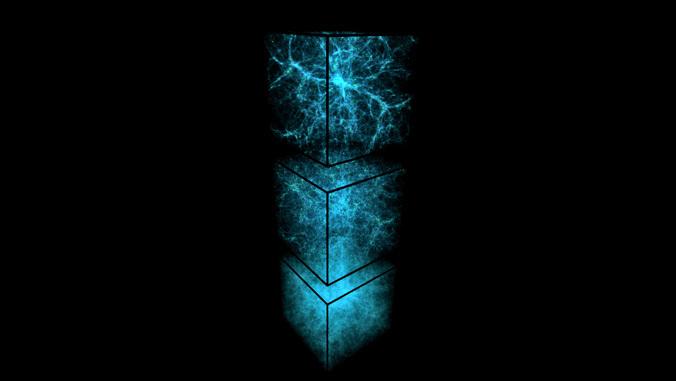
Credit: Volker Springel and the Max-Planck-Institute for Astrophysics
Astronomers have known for two decades that the expansion of the universe is accelerating, but the physics of this expansion remains a mystery. Now, a team of researchers at the University of Hawai’i at Mānoa have made a novel prediction–the dark energy responsible for this accelerating growth comes from a vast sea of compact objects spread throughout the voids between galaxies. This conclusion is part of a new study published in The Astrophysical Journal.
In the mid-1960s, physicists first suggested that stellar collapse should not form true black holes, but should instead form Generic Objects of Dark Energy (GEODEs). Unlike black holes, GEODEs do not ‘break’ Einstein’s equations with singularities. Instead, a spinning layer surrounds a core of dark energy. Viewed from the outside, GEODEs and black holes appear mostly the same, even when the “sounds” of their collisions are measured by gravitational wave observatories.
Because GEODEs mimic black holes, it was assumed they moved through space the same way as black holes. “This becomes a problem if you want to explain the accelerating expansion of the universe,” said UH Mānoa Department of Physics and Astronomy research fellow Kevin Croker, lead author of the study. “Even though we proved last year that GEODEs, in principle, could provide the necessary dark energy, you need lots of old and massive GEODEs. If they moved like black holes, staying close to visible matter, galaxies like our own Milky Way would have been disrupted.”
Croker collaborated with UH Mānoa Department of Physics and Astronomy graduate student Jack Runburg, and Duncan Farrah, a faculty member at the UH Institute for Astronomy and the Physics and Astronomy department, to investigate how GEODEs move through space. The researchers found that the spinning layer around each GEODE determines how they move relative to each other. If their outer layers spin slowly, GEODEs clump more rapidly than black holes. This is because GEODEs gain mass from the growth of the universe itself. For GEODEs with layers that spin near the speed of light, however, the gain in mass becomes dominated by a different effect and the GEODEs begin to repel each other. “The dependence on spin was really quite unexpected,” said Farrah. “If confirmed by observation, it would be an entirely new class of phenomenon.”
The team solved Einstein’s equations under the assumption that many of the oldest stars, which were born when the universe was less than 2 percent of its current age, formed GEODEs when they died. As these ancient GEODEs fed on other stars and abundant interstellar gas, they began to spin very rapidly. Once spinning quickly enough, the GEODEs’ mutual repulsion caused most of them to ‘socially distance’ into regions that would eventually become the empty voids between present-day galaxies.
This study supports the position that GEODEs can solve the dark energy problem while remaining in harmony with different observations across vast distances. GEODEs stay away from present-day galaxies, so they do not disrupt delicate star pairs counted within the Milky Way. The number of ancient GEODEs required to solve the dark energy problem is consistent with the number of ancient stars. GEODEs do not disrupt the measured distribution of galaxies in space because they separate away from luminous matter before it forms present-day galaxies. Finally, GEODEs do not directly affect the gentle ripples in the afterglow of the Big Bang, because they are born from dead stars hundreds of millions of years after the release of this cosmic background radiation.
The researchers were cautiously optimistic about their results. “It was thought that, without a direct detection of something different than a Kerr [Black Hole] signature from LIGO-Virgo [gravitational wave observatories], you’d never be able to tell that GEODEs existed,” said Farrah. Croker added, “but now that we have a clearer understanding of how Einstein’s equations link big and small, we’ve been able to make contact with data from many communities, and a coherent picture is beginning to form.”
According to Runburg, whose primary research interest is unrelated to GEODEs, “the most exciting consequence, for me, is that previously disconnected communities of researchers now have common ground. When different communities work together, the whole always becomes something greater than the sum of the parts.”
###
Media Contact
Roy Gal
[email protected]
Related Journal Article
http://dx.