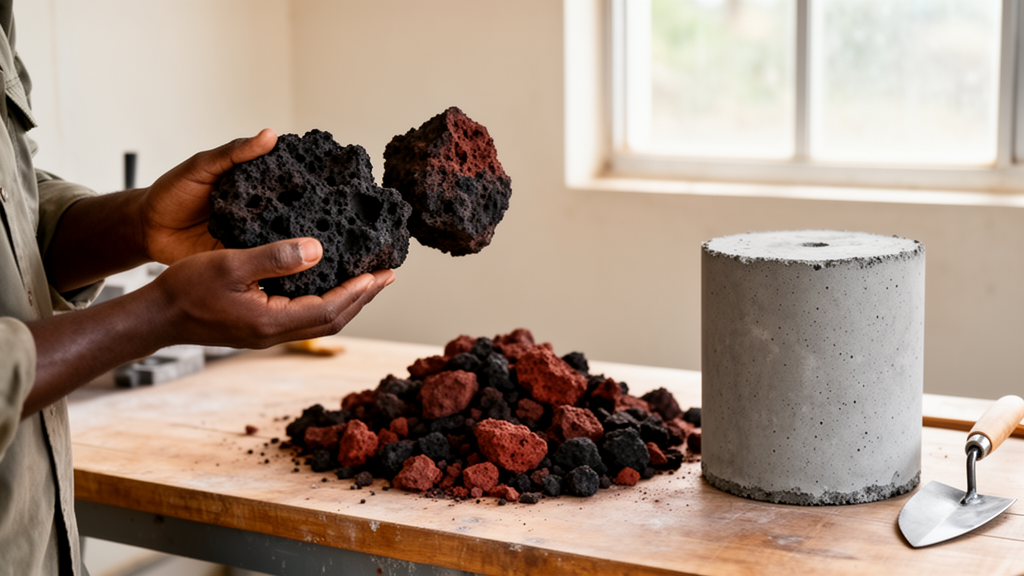
Volcanic scoria quarried from Uganda’s Bufumbira volcanic field in Kisoro District can serve as a coarse aggregate for structural lightweight concrete, according to a new study by researchers at Makerere University. The team, led by Allan R. Okodi with George Kangume, Derrick Matsiko and John Mary Joseph Yiga, reports that lightweight concretes built on the porous volcanic rock achieved dry densities between 1725.9 and 2007.8 kilograms per cubic meter, an average reduction of 21 percent compared with a granite-based normal-weight control, while reaching average 28-day compressive strengths equivalent to 71 percent of the control concrete. All mixes exceeded the minimum strength requirements specified for lightweight concrete by ASTM C330 and Eurocode 2, positioning the locally abundant rock as a candidate material for low- to medium-rise buildings and other lightly to moderately loaded structures where cutting structural dead load is the priority.
The study is presented as the first comprehensive evaluation of scoria from this part of southwestern Uganda, which sits within the Virunga volcanic province shared by Uganda, Rwanda and the Democratic Republic of Congo. The authors argue that deposit-specific characterization is essential because scoria properties vary with geological origin, mineralogy and cooling history, so results from deposits in Kenya, Tanzania, Cameroon, Saudi Arabia, Yemen, Turkey, Portugal, China and Nigeria cannot simply be transferred. Reported literature values compiled by the team show bulk densities ranging from 560 to 1518 kilograms per cubic meter, specific gravities from 1.48 to 2.59, water absorption from 13.1 to 17.0 percent and aggregate crushing values from 25.6 to 56.4 percent across those deposits, a spread wide enough to justify testing the Ugandan material on its own terms.
To characterize the aggregate, the researchers extracted volcanic scoria rock from the Bufumbira field, transported it to the structural engineering laboratory at Makerere University in Kampala, crushed it manually with handheld hammers and sieved it to a particle size range of 4.75 to 20 millimeters for use as coarse lightweight aggregate. Water absorption was measured on washed, soaked and oven-dried samples according to BS EN 1097, relative and particle densities followed BS EN 1097-6, and bulk density followed ASTM C-567. The crushed scoria registered a specific gravity of 1.73, a bulk density of 727.2 kilograms per cubic meter and an average water absorption of 7.14 percent, satisfying lightweight aggregate requirements. Its average aggregate impact value was 44.7 percent.
One mechanical property stood out as a limitation. The aggregate crushing value of the scoria was 56.1 percent, exceeding the 45 percent limit recommended by BS 812 for normal-weight aggregates and indicating relatively low resistance to compressive crushing. The authors note that no standardized aggregate crushing value acceptance criterion currently exists for lightweight aggregates in the codes they studied, so the normal-weight limit was used only as a qualitative benchmark. The measured value is comparable to the 56.4 percent reported for Yemeni scoria, and the team cautions that this high crushing value limits the use of the resulting lightweight concrete in applications demanding high compressive resistance.
Concrete mixes targeting the C25 grade, commonly used for structural work in Uganda’s building industry, were proportioned using three methods: the Weight method and the Volumetric method, both under ACI 211.2-98, and the Chandra and Brooke method, a volume-based approach developed specifically for lightweight aggregates with low density, high porosity and high water absorption. A normal-weight concrete mix designed according to ACI 211 with crushed granite served as the control. Water-to-cement ratios were similar across mixes, 0.57 for the volumetric method and 0.61 for the other two, so observed performance differences were attributed mainly to the quantities of aggregate and cement each method produced per cubic meter. Scoria and river sand were brought to a saturated surface dry condition before mixing to minimize absorption of mixing water.
Fresh and hardened properties were tested in depth. Slumps of the lightweight mixes ranged from 64 to 84 millimeters against 112 millimeters for the normal-weight concrete, a difference attributed to the porous, low-density and irregular surface texture of the crushed scoria, though the authors judge all mixes acceptably workable without bleeding or floating of aggregates. Compressive strength was measured on 150-millimeter cubes after 7, 14, 28 and 56 days of water curing, with five specimens per age, and splitting tensile and flexural strengths were tracked on cylinders and prisms over the same schedule. The normal-weight control averaged 44 megapascals in compression at 28 days, while lightweight mixes ranged from 62 to 82 percent of that value, with tensile splitting strengths at 62 to 88 percent and flexural strengths at 69 to 88 percent of the control.
The Chandra and Brooke method emerged as the clear performer, yielding the highest 28-day compressive strength at 35.92 megapascals, the highest strength-to-density ratio at 1.9 percent, and a density of 1909.4 kilograms per cubic meter, which the authors acknowledge is relatively high but still complies with the Eurocode 2 limit for lightweight concrete. This mix also showed the lowest apparent porosity and water absorption among the lightweight concretes, with its porosity exceeding the normal-weight concrete’s by 26 percent, compared with larger excesses for the Volumetric and Weight method mixes. Because cement content was identical across mixes while coarse aggregate quantities varied, the porosity trend confirms the influence of the aggregate-to-binder ratio, though the authors note that specimen integrity and pore connectivity may also have played roles that microstructure characterization, outside this study’s scope, could not resolve.
Strength development patterns offered additional insight. The lightweight concretes gained 75 to 83 percent of their 28-day compressive strength within 7 days and 91 to 95 percent within 14 days, outpacing the normal-weight concrete, which reached 67 percent at 7 days and 83 percent at 14 days. The researchers attribute this accelerated early gain to self-curing by water retained in the scoria’s porous structure, which enhances hydration and improves the interfacial transition zone, although they stress that this mechanism could not be directly verified without microstructural analysis. Beyond 28 days the lightweight mixes gained only about 4 percent on average by 56 days, versus 10 percent for the control, and none of the mixes reached a ceiling strength. Water absorption of the hardened lightweight concretes ranged from 7.39 to 15.28 percent, always higher than the normal-weight concrete, reflecting the porous aggregate but falling within ranges commonly reported for lightweight aggregate concretes in the literature.
The durability evaluation carries a methodological caveat the authors disclose openly: rather than dedicated undisturbed specimens, representative fragments recovered from previously tested compressive-strength cubes were used for the ASTM C642-97 absorption, density and porosity measurements, an approach deemed acceptable because all mixes were assessed under identical conditions. The team also emphasizes that economic claims remain unquantified. While prior work they cite, including a study by Behera and colleagues, found that a roughly 20 percent reduction in structural weight translated into a 9.2 percent overall building cost saving with 27 percent lower foundation costs, no detailed cost or life-cycle assessment was performed here, and the authors call for such analyses along with studies of admixtures and supplementary cementitious materials to reduce porosity, evaluation of scoria as a fine aggregate, and microstructural investigation before routine structural adoption.
For now, the practical takeaway is specific and bounded. Bufumbira scoria satisfied the principal ASTM and Eurocode requirements for lightweight aggregates apart from its elevated crushing and water absorption values, and properly proportioned mixes with it met structural lightweight concrete performance thresholds for workability, strength and durability. The researchers recommend the Chandra and Brooke method for proportioning lightweight concrete with this material and frame its most appropriate use as low- to moderately loaded construction, such as low- to medium-rise buildings, where reducing dead load matters more than maximizing compressive capacity. If subsequent cost and durability studies support the laboratory results, a volcanic resource that has long blanketed the hills of Kisoro could find a new role in affordable construction across Uganda and the surrounding region.
Subject of Research: Evaluation of Ugandan volcanic scoria as a coarse aggregate for structural lightweight concrete
Article Title: Evaluating the performance of indigenous volcanic scoria rocks from Uganda as a coarse aggregate for structural lightweight concrete applications
Article References: Okodi, A. R., Kangume, G., Matsiko, D., & Yiga, J. M. J. (2026). Evaluating the performance of indigenous volcanic scoria rocks from Uganda as a coarse aggregate for structural lightweight concrete applications. Discover Concrete and Cement, 2(1), Article 78. https://doi.org/10.1007/s44416-026-00121-0
Image Credits: AI Generated
DOI: 10.1007/s44416-026-00121-0
Keywords: volcanic scoria, lightweight concrete, Uganda, Bufumbira, coarse aggregate, compressive strength, mix design, Chandra and Brooke method, ASTM C330, Eurocode 2, water absorption, construction materials
News Source: Denise Maddox. (October 29, 2026). Uganda’s Volcanic Scoria Shows Promise as Lightweight Concrete Aggregate. Scienmag.