


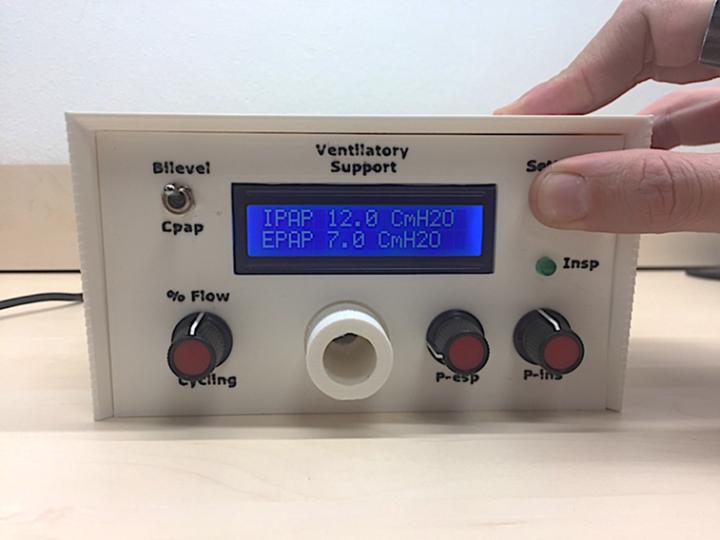
Credit: R. Farré/UB
Researchers from the Biophysics and Bioengineering Unit of the University of Barcelona have created a non-invasive low-cost ventilator, to support patients with respiratory diseases in areas with limited means. Researchers published the results of the study in the European Respiratory Journal together with open source technical features to build it.
Non-invasive ventilators are usually used to treat patients with respiratory failure: for instance, those with severe symptoms with COVID-19. Non-invasive ventilation is administrated through facial masks that bring pressured air to the lungs. This support to the natural breathing process, when the disease causes the lungs to fail, enables the body to fight the infection and therefore improve.
The study was carried out in the Biophysics and Bioengineering Unit of the Faculty of Medicine and Health Sciences of the University of Barcelona, led by Ramono Farré, professor of Physiology and member of the August Pi i Sunyer Biomedical Research Institute (IDIBAPS) and the Respiratory Diseases Networking Biomedical Research Centre (CIBERES). “Considering the growing need for ventilator support devices everywhere due to the COVID-19 pandemic, we designed a ventilator that can be built with commercial elements at a low cost. The ventilator is aimed at hospitals and health systems to help cover the demand of respiratory equipment due to the coronavirus and other severe lung diseases”, notes Farré.
The article describes how to build the ventilator in open code, and it can be copied in areas with limited means. The research team has designed, built and carried out the tests for the ventilator using a small high-pressure turbine, two pressure transducer and a monitor with digital screen. In order to build it one needs a basic knowledge on engineering, but no previous knowledge on ventilation, although the application in patients requires a medical supervision.
To assess the efficiency of the prototype of the ventilator compared to a commercial device, the research team tested it in twelve healthy volunteers. The participants’ breathing was obstructed to simulate different levels of lung rigidity and respiratory obstruction.
Participants wore facial masks over their nose to ease breathing and marked their feeling of comfort or discomfort, both with and without a respiratory support. The tests showed the ventilator adapted to the spontaneous breathing rhythm and provided a feeling of breathing relief similar to a commercial ventilator.
The team carried out a respiratory test bank, in which they used lung simulators to assess the response of the ventilator in patients with different levels of air flow obstruction and lung rigidity. The test was carried out in sixteen different simulation situations, covering conditions of real life in which non-invasive ventilation is usually used in clinical practices. In all the simulated cases, the prototype of the ventilator was efficient so that lungs could efficiently breath.
“Our tests showed the prototype could behave similarly to a high-quality conventional device providing support to patients who, with difficulties, can try to breathe by themselves”, notes Farré.
The prototype is a non-invasive ventilator that provides respiratory support; therefore, it is not aimed at those patients with severe cases who are intubated and need a mechanical ventilator in the intensive care unit.
Scientific support to new prototypes
The Biophysics and Bioengineering Unit of the UB has experience on instrumentation to treat respiratory diseases, specially in the field of sleep apnoea. Recently, Farré and his team provided advice on the design of emergency ventilator device prototypes from Protofy.xyz, GPA Innova and GAS N2. The three devices, built with the support from the Hospital Clínic and Can Ruti, and the UB, are under clinical studyu with patients, after the initial approval to conduct the study given by the Spanish Agency of Medicines and Medical Products (AEMPS). Farré’s team has also provided support to the device carried out by the Technical University of Valencia, now in its final phase of development.
###
Article reference:
O. Garmendia, M. A. Rodríguez-Lazaro, J. Otero, P. Phan, A. Stonyanova, A. Tuan Dinh-Xuan. D. Gozal, D. Navajas, J. M. Montserrat and R. Farré. ‘Low-cost, easy-to-build non-invasive pressure support ventilator for under-resourced regions: open source hardware description, performance and feasibility testing’. European Respiratory Journal, abril de 2020.
Media Contact
Bibiana Bonmatí
[email protected]
Original Source
https:/
Related Journal Article
http://dx.



