Improving ability to track mobile tumors in real time could lead to safer and possibly automated radiation therapy, radiologists say
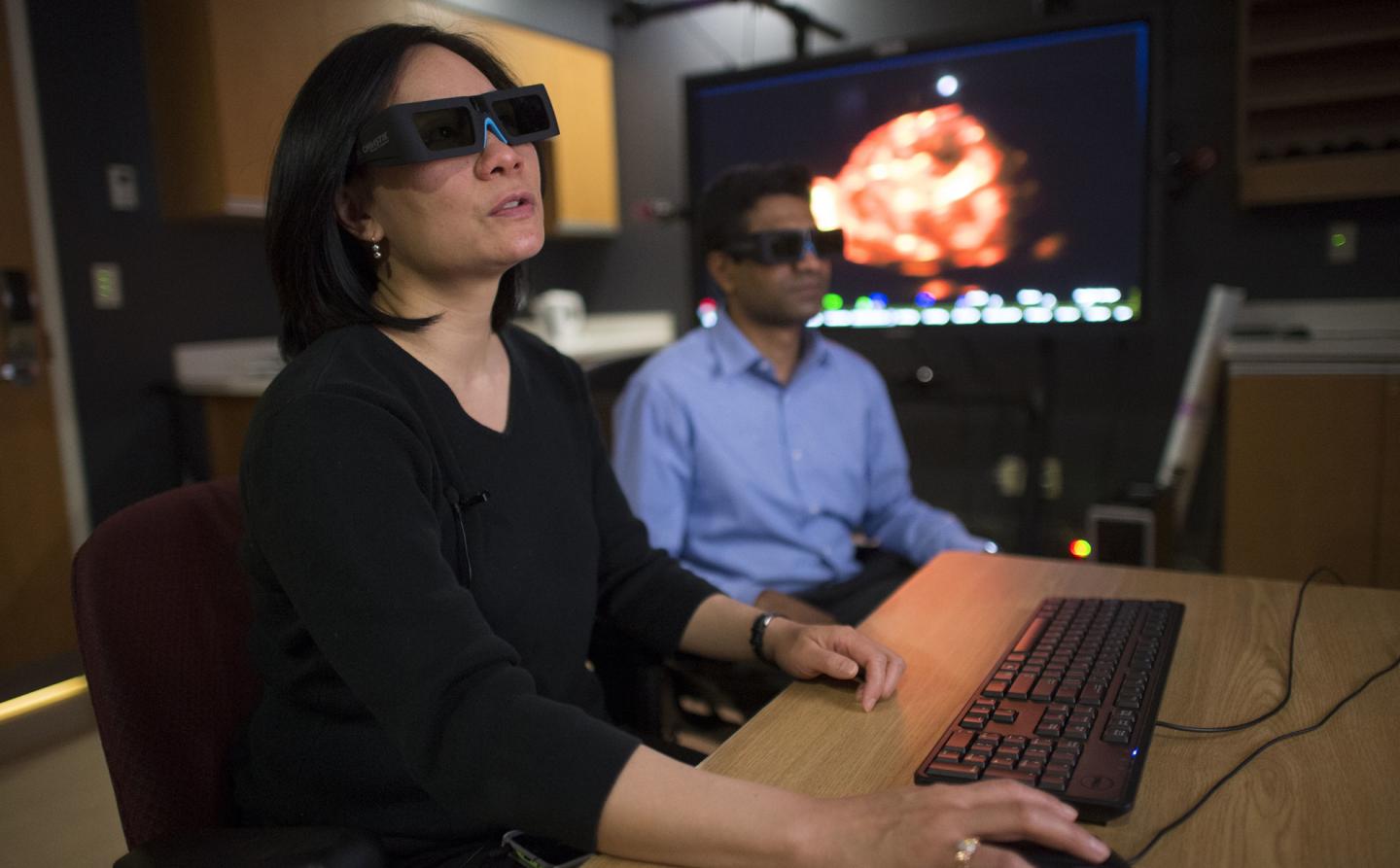
Credit: Supplied (UAlberta Faculty of Medicine & Dentistry)
(Edmonton, AB) A team of University of Alberta researchers has developed a faster way of tracking the movement of tumours in the body during radiation therapy, which could significantly improve outcomes for cancer patients.
“When a patient is getting radiation treatment, for example on the lungs, the tumour might be moving because of the patient’s breathing,” said Michelle Noga, a U of A radiologist who also works at MIC Medical Imaging and is the study’s co-author.
“We normally have to radiate a bigger area than the actual tumour to account for that movement. So the idea is that if you could track their breathing and adjust the beam to match that, you wouldn’t have to radiate such a big area and potentially damage healthy tissue.”
The team’s work builds on the Linac-MR project, a radiation beam (linear accelerator or “linac”) and magnetic resonance imaging (MRI) hybrid machine developed by researchers at the Cross Cancer Institute in 2013.
As patients lie in the machine, the MRI provides constant imaging of the tumour, allowing the system to track its movement and keep the radiation focused only on that area. However, real-time tracking requires significant processing power and the current approach is too slow for day-to-day use, said the study’s lead researcher, Kumaradevan Punithakumar.
“The original version of the tracking algorithm runs through the computer’s central processing unit, but it can only handle eight or 12 processes at a time. That’s too slow for real-time tracking,” he said. “So we adapted the algorithm to use the graphics processing unit (GPU), which can handle thousands of processes at once.”
The U of A team–which included medical physicists Jihyun Yun and Gino Fallone, and computing scientists Nazanin Tahmasebi and Pierre Boulanger–found the GPU processing increased the speed of the process by five times.
“These are very good results,” said Punithakumar, who, along with Noga, is also a member of the Women and Children’s Health Research Institute. “Improving the computational performance has been an issue for a number of imaging applications, and we’ve done that.
“We are also seeing improved tracking accuracy [over] previous methods. So the combination of improved performance and accuracy is a very, very good result.”
Punithakumar notes that although the algorithm was applied to the Linac-MR system in this specific study, it could be used for similar medical imaging applications or other organ delineation tasks, such as cardiac ventricle segmentation using MRI.
For now, the next steps include fully integrating the algorithm into the Linac-MR system, then running more tests to ensure it consistently works as expected, Punithakumar said. Then, the team hopes to be able to move on to clinical testing.
“In the future, this could be completely automated,” Punithakumar said. “The patient will come in, move into the machine, and the machine will be able to determine which area to target and provide that information to the oncologist. Once the oncologist confirms the target, then the system starts the radiation therapy, adjusting to any movement in real time automatically.”
###
The study, “Real-Time Lung Tumor Tracking Using a CUDA Enabled Nonrigid Registration Algorithm for MRI,” was published in the IEEE Journal of Translational Engineering and Health and supported in part by a grant from Alberta Innovates Technology Futures and Servier Canada.
Media Contact
Laura Vega
[email protected]
Original Source
https:/
Related Journal Article
http://dx.