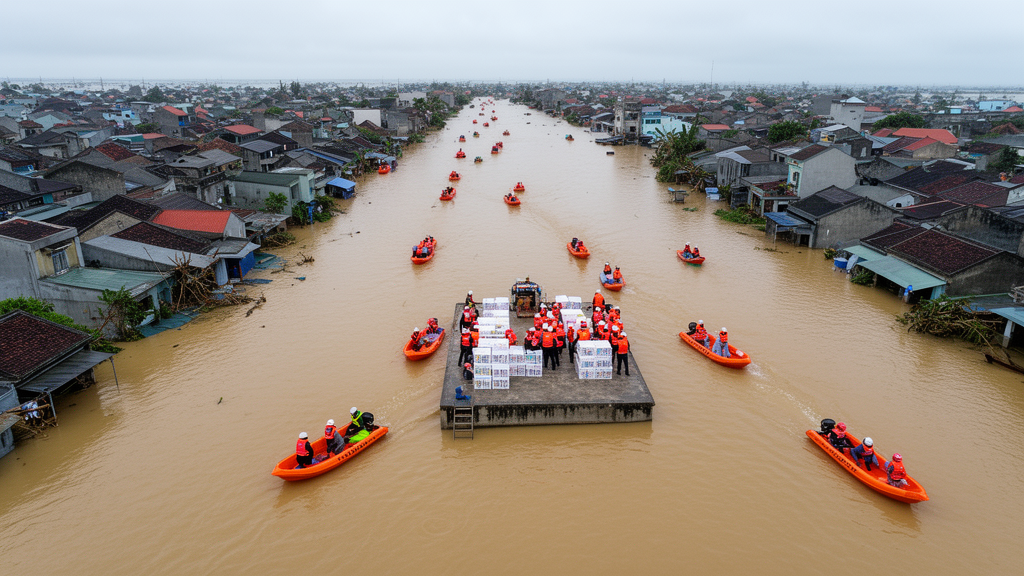
When Super Typhoon Yagi slammed into the coast of Wenchang in China’s Hainan Province on 6 September 2024, it arrived with maximum wind speeds exceeding Category 17, leaving four people dead, 95 injured, and a trail of economic devastation across one of the country’s most economically dynamic coastal regions. But beyond the immediate destruction, Yagi became something else: a vast natural experiment in how dozens of government agencies, enterprises, and nongovernmental organizations weave themselves into a working web of cooperation under extreme pressure. A new study published in the International Journal of Disaster Risk Science has now mapped that web with unprecedented statistical precision, revealing that the specific support tasks organizations must perform—rescue, logistics, medical care, infrastructure repair—actively drive and sculpt the shape of emergency collaboration networks.
The research, conducted by Xinyu Teng, Jida Liu, Xiaoyu Lu, and Jian Wang of the School of Management at Harbin Institute of Technology, tackles a long-standing blind spot in disaster science. Emergency management frameworks have traditionally focused on early warnings before disasters strike and reactive responses afterward, without deeply examining how the daily grind of support tasks—the need to move supplies, restore power, evacuate residents—actually forges new collaborative ties between organizations that might otherwise never work together. The team’s central insight is deceptively simple but analytically powerful: tasks do not merely occupy organizations; they recruit them into networks.
To capture this dynamic, the researchers constructed what network scientists call two-mode networks, in which one set of nodes represents organizations and the other represents eleven categories of emergency support tasks, from emergency rescue and medical service to basic livelihood support, personnel support, communication support, and financial and technical support. An organization is linked to a task only when official documents or credible media reports explicitly show it substantively participated in that type of work. The team combed national, provincial, and municipal government websites and the Baidu News platform for records published between 1 and 30 September 2024, yielding 528 valid textual records, of which 384 explicitly documented cross-organizational collaboration centered on support tasks.
The temporal architecture of the study follows the disaster itself. The preventive preparedness stage runs from 1 September, when the typhoon formed, until 5 September, the day before landfall. The emergency response stage spans the landfall date through 8 September, covering the critical ‘golden 72 hours’ of disaster rescue. The recovery and reconstruction stage extends from 9 to 30 September, ending at a provincial government summary meeting on the fight against the typhoon. Within these windows, the networks comprised 87 organizations in the preparedness phase, 79 in the response phase, and 129 in the recovery phase—a striking expansion that hints at how collaboration broadens as a disaster’s demands shift from rapid action to lengthy rebuilding.
Social network analysis revealed that different organizations rise to prominence as the disaster unfolds. In the preparedness stage, the Ministry of Transport and the Hainan Meteorological Bureau anchored the network—one keeping supply routes clear, the other providing the forecasts on which every other organization depended. When Yagi struck, the Ministry of Emergency Management and the Ministry of Water Resources took the helm, organizing rescue deployments and regulating water infrastructure at the intersection of multiple task types. By the recovery stage, the Hainan Provincial Public Security Department and the Wenchang Emergency Management Bureau dominated, maintaining public order and mobilizing reconstruction equipment. Centrality statistics traced the same pattern: during the response stage, closeness centrality clustered tightly around a mean of 0.67, showing most organizations sat at short network distances from each other—exactly what rapid information flow demands—while in recovery, eigenvector and betweenness centralities fell, spreading structural influence across a wider roster of participants.
The study’s most technically ambitious move was applying an exponential random graph model, or ERGM, to each stage-specific network. ERGMs are statistical frameworks that estimate the probability of observing a given network structure by weighing multiple competing mechanisms simultaneously—in this case, structural effects, homophily effects, Matthew effects, and concurrency effects. After systematically testing decay parameters from 0.1 to 0.9, the team settled on 0.2, which produced stable, significant estimates and the best fit as measured by Akaike’s and Bayesian information criteria across all three networks.
The model results are revealing. Negative edges coefficients in all three networks indicate that support tasks suppress random connections, instead driving precise matching between organizations and the work they actually perform. A strongly positive degree-distribution parameter showed that key organizations act as core hubs concentrating resources—peaking at 360.64 during the emergency response, when rapid decision making made core coordination most valuable. Homophily, captured by attribute-matching statistics, was strongest in the response stage at 0.27, meaning organizations preferentially teamed with those of similar type and administrative level when urgency demanded seamless cooperation; by recovery it had faded to 0.08 as tasks became integrative and cross-sector, driven by functional complementarity rather than similarity.
Perhaps most intriguing are the findings on the Matthew effect—the tendency of well-connected organizations to attract yet more connections—and the concurrency effect. The degree-covariate parameter peaked at 50.28 during the response stage, confirming that resources and new collaborative ties flowed disproportionately to already-central organizations like the meteorological bureau, which served as a critical information hub during landfall. Meanwhile, significantly negative concurrency coefficients—reaching −49.07 in the response stage—demonstrate that urgent support tasks actually suppress organizations’ capacity to juggle multiple collaborations, forcing them to focus vertically on core missions while peripheral ties are temporarily suspended. As the disaster moved into recovery, concurrency gradually returned and the network reopened, settling into a dynamic balance.
The practical implications reach far beyond Hainan. The authors argue that emergency response plans should proactively design collaboration mechanisms matched to the task profiles of each disaster stage, rather than relying on ad hoc coordination once catastrophe hits. Institutionalized information-sharing platforms and flexible cross-organizational mechanisms could lower the friction costs of forming new ties rapidly. Just as important, the warning about the Matthew effect suggests policymakers should deliberately guard against networks collapsing around a handful of overloaded hubs, since excessive concentration leaves disaster response brittle if a central node fails.
The researchers acknowledge limitations: their data derive from public documents and media reports, which during disasters can be delayed or incomplete, and the analysis does not capture non-material factors such as public sentiment or local governance dynamics. Still, the robustness of the key effects across three structurally different network stages—and goodness-of-fit tests showing the models can reproduce the observed structures—gives the findings considerable weight. As climate change intensifies typhoon frequency and severity worldwide, understanding that tasks themselves are the hidden architects of cooperation may prove one of the most valuable lessons Yagi left behind.
Subject of Research: Task-driven cross-organizational emergency collaboration networks in typhoon disaster response
Article Title: How Emergency Support Tasks Drive and Influence Cross-Organizational Emergency Collaboration in Typhoon Disaster Scenarios
Article References: How Emergency Support Tasks Drive and Influence Cross-Organizational Emergency Collaboration in Typhoon Disaster Scenarios. (n.d.). https://doi.org/10.1007/s13753-026-00773-3
Image Credits: AI Generated
DOI: 10.1007/s13753-026-00773-3
Keywords: Typhoon Yagi, emergency collaboration, social network analysis, ERGM, disaster risk science, emergency support tasks, cross-organizational networks, homophily, Matthew effect, centrality, Hainan, disaster recovery
News Source: Denise Maddox. (October 15, 2026). Typhoon Yagi Reveals How Support Tasks Shape Disaster Collaboration Networks. Scienmag.