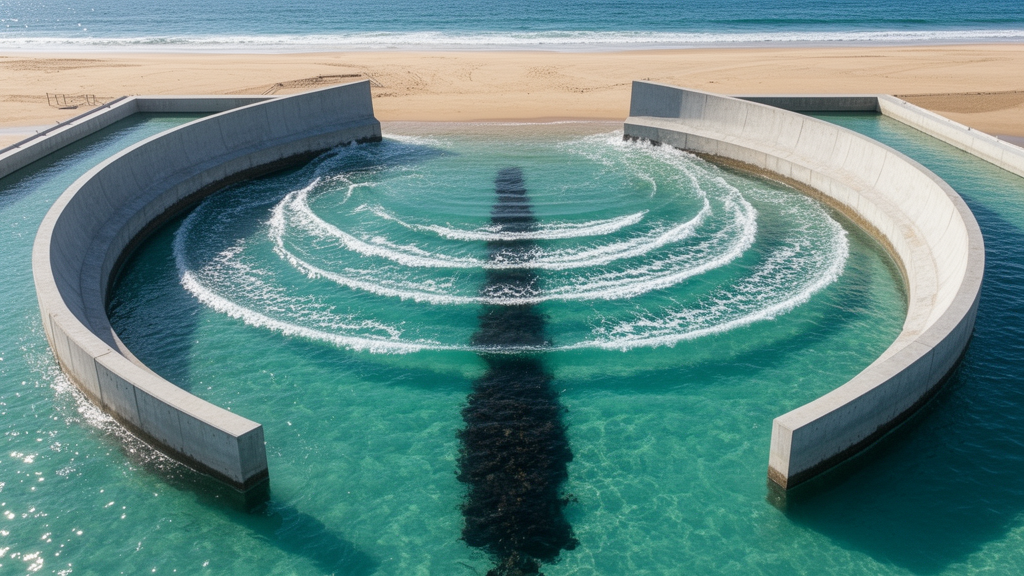
Coastal engineers have long treated breakwaters as purely defensive structures, built to absorb wave energy and shield harbors from the open sea. A new study published in Communications Engineering proposes flipping that logic on its head: instead of simply blocking waves, a carefully shaped breakwater could concentrate them, turning a wall of water into a focused beam that wave energy converters can harvest. The research, led by Xiangyu Zhang, Dezhi Ning, Robert Mayon, and Haoyu Ding at the State Key Laboratory of Coastal and Offshore Engineering at Dalian University of Technology, with Ding also affiliated with the University of Bath, introduces a dual-parabolic breakwater configuration designed to realize phase-modulated wave focusing through a submerged secondary element.
The core idea builds on a well-established principle in wave physics: parabolic reflectors focus incoming parallel wavefronts to a single point, much as a satellite dish concentrates electromagnetic signals. A single surface-piercing parabolic breakwater can already act as a wave concentrator, bending incoming ocean waves so that their energy converges at a focal region where a wave energy converter could be placed. But the Dalian team went a step further. They coupled this primary parabolic concentrator with a second, fully submerged parabolic structure positioned downstream. This secondary wall scatters the incoming waves with a delay, producing scattered waves that interact with the primary focused field in ways that can either amplify or suppress the overall concentration depending on the relative phases of the two wave paths.
What makes this approach distinctive is that the focusing is no longer determined solely by geometry. Because the secondary element generates delayed scattered waves, the final focal amplification depends on multi-path superposition, the interference between waves that have traveled different routes to reach the same point. When the scattered waves from the submerged wall arrive at the focal region in step with the primary focused field, constructive interference boosts the wave height dramatically. When they arrive out of step, destructive interference can flatten the focus entirely. This gives engineers a phase-based mechanism for tuning wave focusing, something that a single fixed breakwater simply cannot offer.
To explore this mechanism quantitatively, the researchers developed a second-order three-dimensional higher-order boundary element model. Boundary element methods reduce the computational burden of simulating wave-structure interactions by solving for the fluid behavior only on the boundaries of the domain rather than throughout the entire volume. The second-order formulation captures nonlinear wave effects that become important when waves are strongly focused and wave heights grow large relative to their wavelengths. The team verified the mesh convergence of their model numerically, ensuring that refining the computational grid did not change the results, and validated the single-breakwater baseline against wave-basin experiments, giving confidence that the simulations reflect real hydrodynamics.
With this validated tool in hand, the researchers systematically varied the configuration of the dual-breakwater system. One of the most consequential parameters is the distance between the two focal points, one associated with the primary parabolic concentrator and one with the submerged secondary structure. Changing this separation alternates between constructive and destructive interference at the focal region, and the team found that the optimal configuration shifts in a predictable manner as the distance changes. This predictability is crucial for practical design, because it means engineers can compute the required spacing for a given wave climate rather than relying on trial and error.
The chord length of the secondary wall, the horizontal extent of the submerged parabolic element, also plays a surprising role. The team discovered that its effect on focal amplification is non-monotonic, meaning that increasing the chord length does not simply increase or decrease the focus in a straightforward way. Instead, changing the chord length alters the effective phase of the scattered waves produced by the secondary wall, which in turn shifts whether those waves reinforce or oppose the primary focused field. A longer wall is not necessarily better; there is an optimal size that depends on the wavelength of the incoming waves and the geometry of the overall system.
These findings establish clear frequency selectivity in the dual-breakwater system. Because the phase relationship between the primary focused waves and the delayed scattered waves depends on the wavelength of the incoming swell, the configuration that produces maximum amplification at one wave frequency will not necessarily do so at another. This is a double-edged sword for wave energy applications. On one hand, frequency selectivity means the system can be tuned to match the dominant wave frequencies at a particular site, maximizing energy concentration for the waves that carry the most power. On the other hand, it means performance will vary across the broad spectrum of wave conditions that any real ocean location experiences, and designers must account for this variability when integrating wave energy converters with the breakwater.
The broader motivation for this work lies in the economics of coastal renewable energy. Wave energy converters remain expensive to deploy and maintain, and one promising pathway to reducing costs is to integrate them with existing or planned coastal infrastructure. A breakwater that also serves as a wave concentrator could share foundation costs, reduce the need for separate mooring and anchoring systems, and improve the use of nearshore wave energy, where waves have already been partially shaped by the coastal bathymetry. The dual-parabolic configuration proposed here takes this integration concept further by adding an active tuning mechanism, allowing the focusing behavior to be adjusted through the geometry of the secondary element rather than requiring a completely new primary structure.
The study was financially supported by the National Natural Science Foundation of China under grants U25B20228, U22A20242, and 52271260. The work was published open access under a Creative Commons Attribution-NonCommercial-NoDerivatives 4.0 International License, making the detailed findings available to researchers and engineers worldwide. The article was received on 12 March 2026, accepted on 2 September 2026, and published on 14 September 2026, with a transparent peer review file and supplementary information available alongside the main paper.
As coastal communities grapple with rising seas and growing energy demands, the idea that the same structure can protect a shoreline and concentrate wave energy for harvesting represents a compelling convergence of engineering goals. The phase-based tuning mechanism identified by the Dalian and Bath team provides a quantitative foundation for designing such hybrid systems, offering guidance that goes beyond intuition to specific geometric relationships between focal point separation, chord length, and wave frequency. Whether these dual-parabolic breakwaters will move from numerical models and wave basins into real ocean deployments remains to be seen, but the study demonstrates that the physics of wave interference can be harnessed deliberately, not just observed, opening a new dimension in the design of multifunctional coastal structures.
Subject of Research: Phase-tuned wave focusing by dual-parabolic breakwaters with a submerged secondary element
Article Title: Phase-tuned wave focusing by dual-parabolic breakwaters with a submerged secondary element
Article References: Zhang, X., Ning, D., Mayon, R., & Ding, H. (2026). Phase-tuned wave focusing by dual-parabolic breakwaters with a submerged secondary element. Communications Engineering. https://doi.org/10.1038/s44172-026-00777-3
Image Credits: AI Generated
DOI: 10.1038/s44172-026-00777-3
Keywords: Phase-tuned, wave, focusing, dual-parabolic, breakwaters, submerged, secondary, element, scientific research
News Source: Denise Maddox. (October 15, 2026). Phase-tuned wave focusing by dual-parabolic breakwaters with a submerged secondary element. Scienmag.