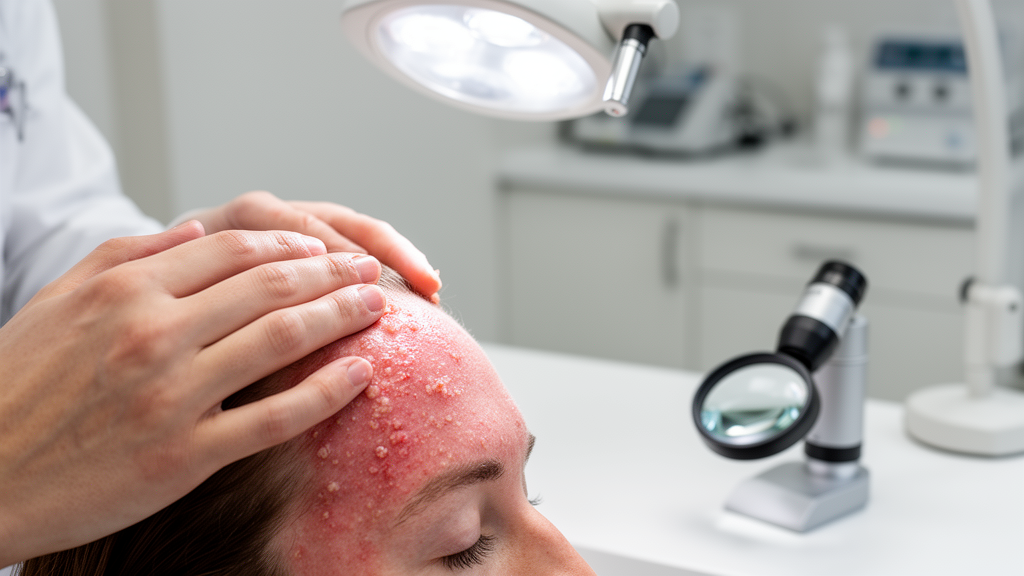
Two of the most common chronic inflammatory skin conditions in the world may be far more intertwined than many clinicians assume. A new analysis of more than a decade of United States ambulatory care data has found that patients seen for psoriasis are more than eight times as likely to also carry a diagnosis of seborrheic dermatitis compared with patients without psoriasis, and the relationship runs in both directions. The findings, published in the Archives of Dermatological Research, offer some of the clearest practice-based evidence yet that the overlap syndrome informally known as sebopsoriasis is a real and measurable phenomenon in everyday medicine, not merely a curiosity of dermatology textbooks.
The study, led by Ajay Pandey and senior author Raj Chovatiya, drew on the National Ambulatory Medical Care Survey, a federally administered dataset that captures representative snapshots of visits to office-based physicians across the country. By pooling survey waves from 2003 through 2015, the researchers assembled a weighted sample of approximately 12.4 billion ambulatory care visits, an enormous denominator that allowed them to examine relatively uncommon diagnoses with meaningful statistical precision. Within that population, roughly 0.10 percent of visits involved seborrheic dermatitis and 0.23 percent involved psoriasis, figures that reflect the share of routine outpatient encounters rather than the prevalence of the diseases in the general population.
The central result was striking in its symmetry. Patients with psoriasis had more than eightfold increased odds of having a comorbid seborrheic dermatitis diagnosis, with an adjusted odds ratio of 8.36 and a 95 percent confidence interval running from 4.28 to 16.32. When the analysis was reversed, patients with seborrheic dermatitis showed nearly identical odds of also having psoriasis, at an adjusted odds ratio of 8.19. Both associations were highly statistically significant, with p values below 0.0001. The bidirectional consistency matters because it argues against a one-way artifact, such as dermatologists simply being more likely to note a second diagnosis once one inflammatory skin disease is already on the chart.
To understand why this overlap exists, it helps to look at the biology the two diseases share. Seborrheic dermatitis is classically associated with the lipophilic yeast Malassezia, which colonizes sebum-rich areas of the skin such as the scalp, eyebrows, nasolabial folds, and chest. The yeast is not simply an infection; rather, its metabolic activity and presence appear to trigger an innate immune response involving inflammasome activation and downstream T helper cell signaling. Psoriasis, by contrast, is driven by a cascade centered on interleukin-23 and interleukin-17, producing the accelerated keratinocyte proliferation and plaques that define the disease. Yet the two pathways converge in important ways, including shared involvement of T helper 17 signaling, antimicrobial peptide dysregulation, and defects in the skin barrier that permit both microbial colonization and inflammatory amplification.
This immunological common ground is what gave rise to the term sebopsoriasis, describing patients whose clinical presentation blends features of both conditions, often in the scalp and facial regions where the diseases are difficult to distinguish. Previous systematic reviews and meta-analyses, including work published by overlapping author groups in 2024, had suggested an elevated co-occurrence of the two diseases in clinical studies. What the new analysis adds is population-level evidence drawn from ordinary outpatient practice rather than from specialized referral centers, where selection bias could inflate apparent associations. The consistency of the eightfold signal across such a broad, nationally representative sample strengthens the case that the comorbidity is genuine rather than an artifact of tertiary care.
Perhaps the most clinically consequential finding, however, concerned what did not differ. The researchers examined healthcare resource utilization metrics, including the time patients spent with their physicians and the number of healthcare visits, and found no significant differences among patients with psoriasis alone, seborrheic dermatitis alone, or both conditions together. On the surface, that might suggest that comorbid disease does not impose a heavier burden on the healthcare system. But the authors caution that these are coarse measures. A single office visit may absorb substantial complexity without registering as longer or more frequent, and the survey data cannot capture prescriptions filled, emergency department use, or the cumulative toll of managing two chronic conditions simultaneously.
Where the groups clearly diverged was in prescribing patterns. Patients carrying both diagnoses were significantly more likely to receive topical antifungal agents, combination topical corticosteroid and vitamin D analog formulations, and topical sulfur preparations. They were also numerically the most likely to be prescribed systemic antibiotics, topical corticosteroids, and topical salicylic acid. That prescription fingerprint tells a story of therapeutic improvisation. Combination corticosteroid and vitamin D analog products are a mainstay of psoriasis treatment, while antifungals target the Malassezia-driven component of seborrheic dermatitis. Patients with both diseases appear to receive a blended regimen that addresses both inflammatory axes at once, even though no formal treatment guidelines exist for the overlap syndrome.
The absence of dedicated guidance is precisely why the authors argue that more research is needed. If sebopsoriasis represents a distinct immunological phenotype rather than simple coincidence, it may respond differently to emerging targeted therapies. Recent dermatology literature has explored phosphodiesterase 4 inhibitor-responsive dermatoses as an emerging concept, and expert consensus panels have weighed the risks of long-term topical corticosteroid therapy against newer advanced topical treatments for inflammatory skin disease. Multi-omics studies published in 2025 have begun identifying shared diagnostic targets between seborrheic dermatitis and scalp psoriasis, hinting that molecular signatures could eventually guide therapy selection for patients whose disease straddles the two diagnoses.
There are also broader implications for how the conditions are studied. A 2026 retrospective cohort study reported bidirectional associations between seborrheic dermatitis and a range of epithelial barrier diseases, and separate JAMA Dermatology work documented elevated rates of epithelial barrier diseases among adults with seborrheic dermatitis. Taken together with the new ambulatory care analysis, a picture emerges of seborrheic dermatitis not as an isolated cosmetic nuisance but as a condition embedded in a wider network of barrier and immune dysfunction. That reframing could influence screening practices, encouraging clinicians who diagnose one inflammatory skin disease to consider whether a second, subtly different process is also at play, particularly in overlapping anatomical territories.
The study is not without limitations, and the authors are careful about what their data can and cannot show. Cross-sectional survey data capture associations at single points in time and cannot establish that one disease causes the other, nor can they distinguish whether the comorbidity reflects shared genetic susceptibility, common environmental triggers such as Malassezia colonization and barrier injury, or diagnostic clustering by physicians. The weighted prevalence figures describe visits rather than people, so they cannot be read directly as population prevalence. Still, with an effect size as large as eightfold in both directions, drawn from billions of weighted encounters, the signal is difficult to dismiss. For the millions of patients living with these chronic, relapsing conditions, the message is that the boundary between dandruff’s inflammatory cousin and psoriasis may be blurrier than the clinic’s diagnostic codes suggest, and that treatment for one may need to account for the other.
Subject of Research: The association between seborrheic dermatitis and psoriasis and its impact on healthcare utilization and prescribing patterns in the United States
Article Title: Association of seborrheic dermatitis and psoriasis and impact on healthcare utilization in the United States
Article References: Pandey, A., Hopkins, T., Maher, S., & Chovatiya, R. (2026). Association of seborrheic dermatitis and psoriasis and impact on healthcare utilization in the United States. Archives of Dermatological Research, 318(1), Article 399. https://doi.org/10.1007/s00403-026-04886-z
Image Credits: AI Generated
DOI: 10.1007/s00403-026-04886-z
Keywords: seborrheic dermatitis, psoriasis, sebopsoriasis, comorbidity, dermatology, healthcare utilization, NAMCS, Malassezia, topical corticosteroids, skin barrier, inflammatory skin disease, prescribing patterns
News Source: Ophelia Keating. (October 14, 2026). Two Skin Diseases, One Overlap: Study Finds Strong Link Between Seborrheic Dermatitis and Psoriasis. Scienmag.