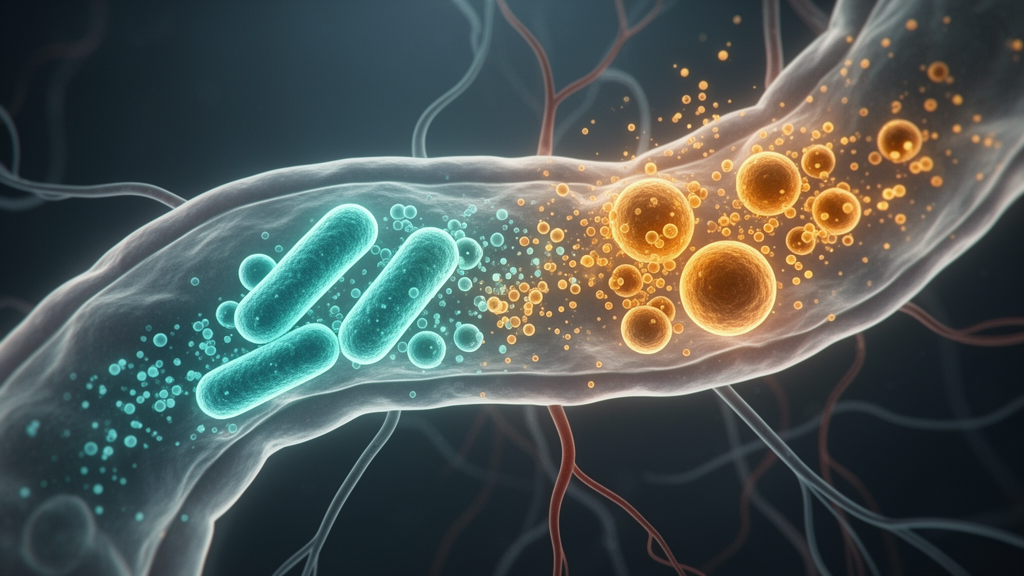
A comparative study published in BMC Microbiology has identified distinct extracellular metabolic profiles in two specific probiotic strains, Lactiplantibacillus plantarum LP140 and Bifidobacterium breve BB010. The research, led by Tamara Aleksandrzak-Piekarczyk and colleagues, utilized combined genomic and metabolomic profiling to link the metabolic potential of these bacteria with their measurable extracellular output.
The study design focused on mechanistic evaluation, requiring a direct link between genomic metabolic potential and actual extracellular production. The researchers compared the two strains to identify distinct metabolic traits that are potentially relevant to gut-brain-axis-associated functions.
Genome-based pathway reconstruction predicted distinct metabolic capacities for the two strains. Additionally, LP140 exhibited a broader succinate-associated fermentative framework. In contrast, Bifidobacterium breve BB010 demonstrated stronger de novo capacity for B3 and NAD-related pathways, PdxST-dependent PLP biosynthesis, and broader support for glutamine and glutamate interconversion.
Species-level pangenome analysis provided further context for these genomic predictions. The analysis revealed that many of the canonical metabolic loci underlying these predicted capacities were conserved across the respective species rather than being unique to the focal strains LP140 and BB010. This suggests that while the specific strains have distinct profiles, the underlying genetic machinery for these metabolic pathways is a shared characteristic of their broader species.
Replicated targeted liquid chromatography-tandem mass spectrometry, or LC-MS/MS, confirmed major strain-resolved extracellular differences. LP140 showed pronounced accumulation of lactate, with a mean difference of 127.0 plus or minus 8.9 millimoles per liter, a statistically significant result with a q-value of 0.0089. The strain also accumulated succinate at 999 plus or minus 49 micromoles per liter (q = 0.0147) and GABA at 60.6 plus or minus 4.2 micromoles per liter (q = 0.0157).
Bifidobacterium breve BB010 displayed a different pattern of metabolite accumulation. The strain showed strong accumulation of nicotinic acid at 22.8 plus or minus 0.8 micromoles per liter, with a highly significant q-value of 0.0009. BB010 also accumulated glutamine at 347 plus or minus 38 micromoles per liter (q = 0.0204) and glycine at 5.55 plus or minus 0.64 millimoles per liter (q = 0.0204).
The relationship between the genome and the resulting metabolite pools was not uniformly direct. Regarding polyamines, the findings were more consistent with turnover processes rather than broad de novo biosynthesis. Furthermore, histamine and tyramine did not accumulate under the tested conditions.
The authors conclude that LP140 and BB010 exhibit distinct, condition-specific extracellular metabolic profiles that are only partly predictable from genomic pathway content. These strain-resolved genome-metabolome relationships provide a functional basis for further testing in physiologically relevant host-interaction models.
Subject of Research: Comparative genomic and metabolomic analysis of probiotic strains LP140 and BB010
Article Title: Comparative genomic and extracellular metabolomic profiling of Lactiplantibacillus plantarum LP140 and Bifidobacterium breve BB010 reveals distinct gut–brain-axis-associated metabolite profiles
Article References: Aleksandrzak-Piekarczyk, T., Szczepankowska, A. K., Radkiewicz, M., Samborowska, E., Majsiak, E., & Cukrowska, B. (2026). Comparative genomic and extracellular metabolomic profiling of Lactiplantibacillus plantarum LP140 and Bifidobacterium breve BB010 reveals distinct gut–brain-axis-associated metabolite profiles. BMC Microbiology. https://doi.org/10.1186/s12866-026-05842-7
Image Credits: AI Generated
DOI: 10.1186/s12866-026-05842-7
Keywords: probiotics, gut-brain axis, metabolomics, genomics, Lactiplantibacillus plantarum, Bifidobacterium breve, neurophysiology, microbiota, metabolic profiling, BMC Microbiology, Comparative, genomic
News Source: Cassandra Pierce. (November 11, 2026). Two Probiotic Strains Show Distinct Gut-Brain Metabolic Profiles. Scienmag.