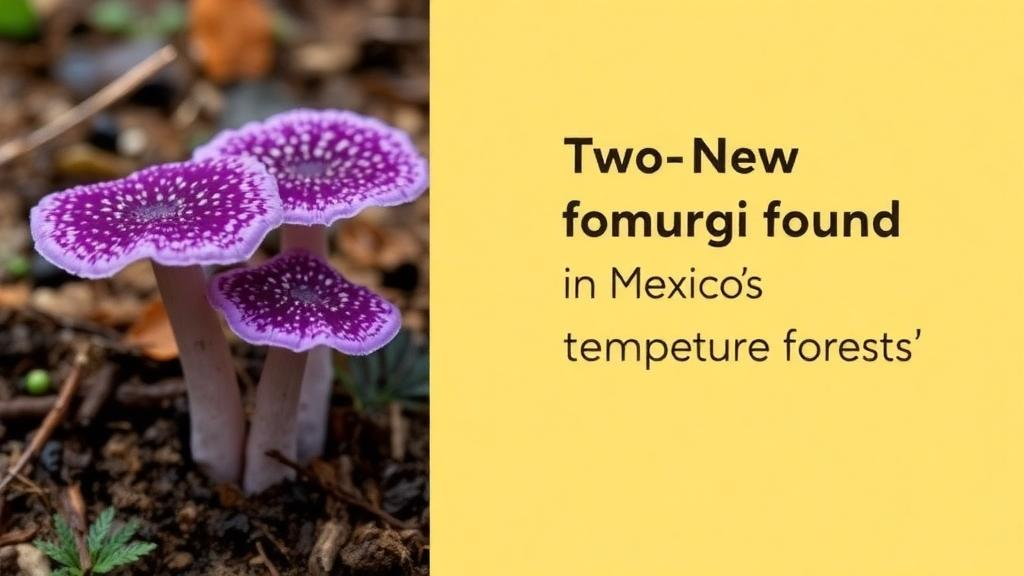
Two species of cup-shaped fungi with striking violet fruiting bodies have been identified in temperate forests of Mexico, expanding the known diversity of Pezizales and revealing a chemical trait that may have broader interest. The mushrooms were formally named Marcelleina evangelinae and Smardaea perezsilvae in a study combining microscopic anatomy, histochemical testing and DNA analysis. Both species belong to the order Pezizales, a group of ascomycete fungi that includes many cup fungi and is especially diverse in temperate conifer forests. The discoveries were made in separate mountain systems: Marcelleina evangelinae was collected in the Sierra Madre Occidental and nearby forests of Estado de México, while Smardaea perezsilvae was found on the Transversal Neovolcanic Axis. Both honor Mexican mycologist Evangelina Pérez-Silva, described as a pioneer in the study of Mexican ascomycetes.
Marcelleina evangelinae is a small woodland fungus with sessile, disc-shaped apothecia, the open reproductive structures commonly called cups. Its fruiting bodies measure 5–9 millimetres across and are dark purple to nearly black, with a smooth hymenium and a slightly rugose outer surface. Young specimens can be cup-shaped before flattening as they mature. The species grows gregariously on decaying wood beneath the Mexican cypress, Cupressus lusitanica, in temperate, humid forest. Its holotype was collected near Los Pilares in Yécora municipality, Sonora, at 1,297 metres above sea level, while another specimen was recorded at San Simón El Alto in Malinalco, Estado de México.
The microscopic characters of M. evangelinae provide several ways to distinguish it from its nearest known relative, Marcelleina persoonii. Its asci are cylindrical, contain eight spores and measure 120–200 by 12–13 micrometres, shorter than the 180–250 by 12–16.5 micrometre asci reported for M. persoonii. Its paraphyses, the sterile filaments among the spore-bearing asci, are 3–4 micrometres wide rather than less than 3 micrometres in the comparison species. Most conspicuous in electron-microscope images are the globose ascospores, which measure 9–11 micrometres and carry a dense, complete reticulum: a continuous raised network of ridges about 0.5–0.8 micrometres high. The species is also unusual within its genus because it grows on decaying wood rather than directly on soil.
Smardaea perezsilvae has a different microscopic profile but shares the conspicuous purple coloration. Its apothecia range from 5 to 11 millimetres in diameter and are deep violet to dark violet, remaining somewhat cup-shaped when young and becoming slightly disc-like at maturity. The specimens were found gregariously in soil beneath Abies religiosa, or oyamel fir, at Monte Tlaloc in Texcoco municipality, Estado de México, at an altitude of 3,106 metres. Its spores are larger and more elongated than those of M. evangelinae, measuring 20–26 by 10–12 micrometres. They are ellipsoid to fusoid, contain two conspicuous oil droplets and bear low ridges together with a small number of pustules. This ornamentation separates the fungus from Smardaea amethystina, whose similar-sized spores carry thick, rounded pustules.
DNA evidence supported the separation of both fungi from known species. For M. evangelinae, the researchers combined sequences from the internal transcribed spacer region of ribosomal DNA, the nuclear large-subunit ribosomal gene and the beta-tubulin gene. The resulting matrix contained 1,891 aligned positions across 17 taxa. Maximum-parsimony, maximum-likelihood and Bayesian analyses consistently recovered the new species as a distinct, highly supported lineage, with 100% bootstrap support and a Bayesian posterior probability of 1. For S. perezsilvae, the analysis combined nuclear large-subunit ribosomal DNA, the mitochondrial small-subunit region and translation elongation factor 1-alpha, producing 2,121 aligned positions across 12 taxa. All three analytical methods again supported the new species with full bootstrap support and a posterior probability of 1.
The study also used chemical stains to probe what might be responsible for the fungi’s purple appearance. Ferric chloride produced gray-to-black reactions, indicating phenolic compounds in several tissues and extracellular matrices. Tests with other reagents indicated furan derivatives, terpenoids, peptides and alkaloids in particular structures. M. evangelinae contained phenolic material in parts of its outer and inner tissues, paraphyses and immature spores; alkaloids also occurred in immature spores and the extracellular matrix of the medullary excipulum. S. perezsilvae showed phenolic material in its paraphyses and ectal excipulum, terpenoids in asci, paraphyses, ectal tissue and spore oil droplets, peptides in the spore wall, and alkaloids in the medullary excipulum. These tests identify broad chemical classes, not the exact pigment molecules, which remain unknown.
The violet fungi are more than a colorimetric curiosity. Purple pigments are known in several Pezizales families and are commonly concentrated in paraphyses, but the precise chemistry of many remains unresolved. Related groups have produced molecules with antioxidant, anti-inflammatory or other biological effects, and the phenolic substances detected here make the new species promising candidates for further chemical investigation. The research did not directly test those activities, so their efficacy cannot yet be inferred from color alone. Establishing the structures of the pigments would require isolation, purification and molecular characterization, and could clarify both their ecological roles and their potential uses in biotechnology or medicine.
Both discoveries also illustrate how much remains unknown about cup fungi in Mexico’s mountain forests. Pezizales are important components of forest ecosystems, where many species participate in ectomycorrhizal associations, form partnerships with tree roots, and help break down organic matter. The authors note that temperate conifer forests are particularly vulnerable to climate change, soil loss and wildfire. M. evangelinae represents the first Marcelleina species described from the Americas, whereas S. perezsilvae is the first member of that genus formally reported from Mexico based on the new material. The occurrence of both fungi in well-studied regions suggests that additional collecting could uncover more species, especially where decaying wood and forest soils remain undisturbed.
The taxonomy also exposes unresolved relationships within Pezizales. Marcelleina was historically treated in different ways and was eventually placed in Pezizaceae through molecular research, while Smardaea became part of the family Pyropyxidaceae. The analysis showed that M. evangelinae belongs to a group of related Marcelleina species, whereas S. perezsilvae is closest among the sampled taxa to S. verrucispora, despite marked differences in spore form and ornamentation. Limited DNA sampling remains a constraint: only three of the previously recognized 11 Smardaea species had suitable nuclear large-subunit sequences available for this study. The researchers therefore recommend broader systematic sampling to clarify species boundaries, generic relationships and the criteria used to classify members of Pezizales.
What emerges from the work is a portrait of two understated but ecologically intriguing organisms whose purple color is only the most visible feature. One species exploits decaying wood in Mexican cypress forest; the other fruits in soil beneath high-altitude fir. Between them, they combine distinctive spores, molecular identities and a shared chemistry of phenolic pigments. The findings extend the recorded range of both genera, demonstrate the value of combining field observation with microscopy and sequencing, and point toward a still-unexplored reservoir of fungal diversity in threatened temperate forests of Mexico.
Subject of Research: Description of two new purple Pezizales species from temperate forests in Mexico using morphology, histochemistry and multilocus phylogeny
Article Title: Two new purplish species of Pezizales from the temperate forests of Mexico: Marcelleina evangelinae ( Pezizaceae ) and Smardaea perezsilvae ( Pyropyxidaceae )
Article References: Raymundo, T., Sánchez-Flores, M., Martínez González, C. R., Alvarez-Cortés, P. M., García-Jiménez, J., & Esqueda, M. (2026). Two new purplish species of Pezizales from the temperate forests of Mexico: Marcelleina evangelinae (Pezizaceae) and Smardaea perezsilvae (Pyropyxidaceae). MycoKeys, 136, 37-59. https://doi.org/10.3897/mycokeys.136.195741
Image Credits: AI Generated
DOI: 10.3897/mycokeys.136.195741
Keywords: mycology, Pezizales, Mexico, purple fungi, new species, DNA phylogeny, forest ecology, microscopy, fungal pigments, purplish, species, temperate
News Source: Roger Howard. (October 19, 2026). Two New Purple Fungi Found in Mexico’s Temperate Forests. Scienmag.