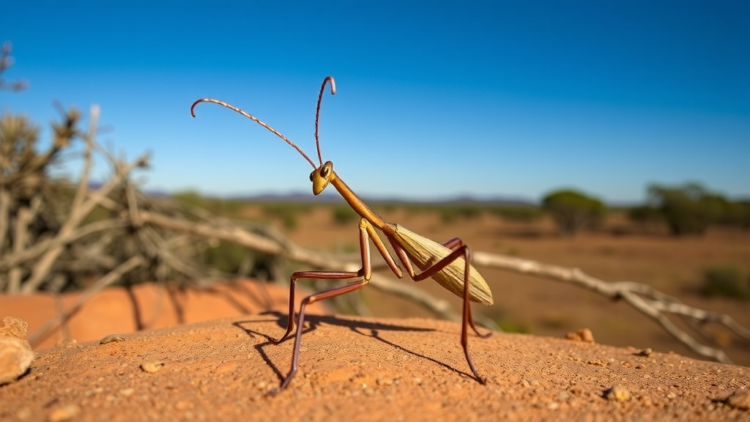
Australia’s stick insects have just become considerably more diverse, at least on paper. Researchers at the University of Sydney have completed a comprehensive revision of the Australian representatives of the stick insect genus Anchiale, and the results are striking: what scientists had long treated as two species turn out to be five distinct ones. Among them are two species entirely new to science, including a large insect found only in one of the country’s most critically endangered rainforests, and a third species that has been effectively hiding in plain sight for decades after being folded into another species’ identity. The study, published in the journal Austral Entomology, stretches the known range of these insects from northern New South Wales through coastal Queensland and into the tropical north, and it carries a sober message about how little is still known about insect life even in some of the most intensively studied landscapes on the continent.
The project was led by Dr Braxton Jones, a Postdoctoral Research Associate in the Molecular Ecology, Evolution and Phylogenomics Laboratory and a member of the Aola Richards Sydney Insect Hub at the University of Sydney. Jones describes taxonomic work of this kind as a form of detective investigation, in which scattered clues gathered from museum drawers, field surveys, captive colonies and online photograph databases must be pieced together into a coherent evolutionary story. Even among some of Australia’s most photographed and most frequently reported insects, the team found species that had escaped formal scientific recognition. The fact that thousands of people have posted images of these very insects on citizen science platforms, without anyone realising that several different species were being conflated, underscores how easily biodiversity can slip past even an attentive public.
The methodological foundation of the revision was deliberately broad. Jones and colleagues combined DNA analysis with the examination of museum specimens, targeted field surveys, citizen science records submitted through iNaturalist and the Atlas of Living Australia, and studies of captive populations kept by insect enthusiasts. More than 1000 citizen science observations of stick insects were available to the researchers, a remarkable evidence base for any invertebrate group. By integrating genetic data with subtle differences in body shape, egg morphology and geographic distribution, the team was able to demonstrate that the two recognised Australian Anchiale species were in fact masks covering five separate evolutionary lineages. This kind of integrative taxonomy, in which no single line of evidence is treated as decisive on its own, has become the standard for resolving species boundaries in groups where external appearances are misleadingly similar.
One of the biggest surprises involved a large stick insect that has been familiar to scientists and amateur insect keepers for generations. After combining every available source of evidence, the researchers concluded that this well-known animal had been misidentified for decades. It is now formally described as Anchiale robusta, an entirely new species that had been living under the name of a relative. For a creature so large and so conspicuous, found in backyards and bushland within easy reach of entomologists, the discovery is a vivid illustration of the limits of traditional species inventories. Museum collections, the study suggests, are not static archives of what is known but reservoirs of unrecognised diversity waiting for the right analytical tools and the right questions.
The second new species, Anchiale mabiensis, carries an ecological warning with its name. It was discovered in Queensland’s Mabi rainforest on the Atherton Tablelands, an ecosystem officially listed as critically endangered and now reduced to small, fragmented patches. Perhaps the most remarkable feature of this insect is its eggs, which contain a structural lid unlike anything previously recorded in stick insects or their closest relatives. Egg morphology is a crucial diagnostic character in phasmid taxonomy, because eggs are often more distinctive than the insects themselves, and the lidded eggs of A. mabiensis represent a genuinely novel structure within the broader radiation of these insects. That such an anatomical novelty was found in a threatened habitat adds urgency to its documentation, since the species’ future is tied directly to the survival of the forest fragments it inhabits.
The revision also has immediate practical consequences beyond the cataloguing of new life. One of the species previously lumped under a single name is notorious for forming plague-like population outbreaks, sometimes in numbers large enough to strip foliage from trees, creating problems for forestry and agricultural operations. The study found that this outbreak-forming insect actually consists of more than one species, which means that past records of its biology, distribution and pest potential may have blended together the traits of several distinct organisms. Untangling those species relationships, the researchers argue, will be essential for improving future management of the impacts these insects have on commercial plantations and crops. Understanding which species is capable of what kind of outbreak, and where each one lives, is the first step toward targeted rather than blanket control measures.
The detective work is not even complete. The study identified a likely additional, still undescribed species from Cape York on the far northern tip of the continent, but the team concluded that more specimens are needed before its identity can be confirmed with confidence. This lingering question mark is itself telling. A single regional revision of one genus has yielded two new species, one reinstated species and one candidate species, suggesting that the true diversity of Australian Phasmatodea may be substantially underestimated. With roughly 130 described stick insect species in Australia and about 3609 worldwide, the country’s phasmid fauna is clearly only beginning to be mapped.
The broader message the researchers draw from the work is a cautionary one about the pace of discovery versus the pace of environmental change. Despite decades of scientific study and a citizen science infrastructure that now captures well over a thousand observations of these insects, Australia is, in their assessment, still only scratching the surface of its insect diversity. Jones emphasises that findings of this kind demonstrate the importance of protecting threatened ecosystems and documenting the country’s extraordinary biodiversity before species are lost without ever having been discovered. An insect like Anchiale mabiensis, confined to a critically endangered rainforest type, is a concrete example of a species that could have vanished entirely before anyone knew it existed.
For a group of animals built to be invisible, stick insects have a remarkable ability to surprise the people who study them. Their name-bearing order, Phasmatodea, derives from an ancient Greek word meaning phantom or ghost, a reference to camouflage so effective that the insects seem to vanish among the vegetation. Many species can reproduce without mating, females producing female-only clones through parthenogenesis; some can spray irritating chemicals at predators, flash brightly coloured wings, rustle their wings to startle attackers, or deliberately shed a grabbed leg and regrow it over successive moults. Australia’s longest stick insect reaches around 62 centimetres, just short of the world record of 64 centimetres. Baby Extatosoma tiaratum nymphs even hatch in association with ant nests, mimicking the ants’ appearance and behaviour long enough to scramble unnoticed into the treetops. The newly recognised Anchiale species now add a further layer of wonder to this catalogue of oddities, and they serve as a reminder that even the phantoms of the backyard have stories left to tell.
Subject of Research: Taxonomic revision of Australian Anchiale stick insects revealing two new species and a reinstated species
Article Title: New large stick insect species revealed in Australia’s backyards and rainforests
Article References: New large stick insect species revealed in Australia’s backyards and rainforests. (n.d.). Original publication
Image Credits: AI Generated
DOI: Not provided
Keywords: stick insects, Anchiale, taxonomy, Australia, new species, Austral Entomology, Mabi rainforest, citizen science, entomology, biodiversity, Phasmatodea, University of Sydney
Cite Scienmag News
APA MLA Chicago
Gavin Prescott. (September 23, 2026). Two New Giant Stick Insect Species Discovered Hiding in Australia’s Well-Studied Landscapes. Scienmag. https://scienmag.com/two-new-giant-stick-insect-species-discovered-hiding-in-australias-well-studied-landscapes/
Gavin Prescott. “Two New Giant Stick Insect Species Discovered Hiding in Australia’s Well-Studied Landscapes.” Scienmag, 23 September 2026, https://scienmag.com/two-new-giant-stick-insect-species-discovered-hiding-in-australias-well-studied-landscapes/. Accessed 23 September 2026.
Gavin Prescott. “Two New Giant Stick Insect Species Discovered Hiding in Australia’s Well-Studied Landscapes.” Scienmag. September 23, 2026. https://scienmag.com/two-new-giant-stick-insect-species-discovered-hiding-in-australias-well-studied-landscapes/
Copy citation Download RIS
Tags: AnchialeAustral EntomologyAustraliaAustralian rainforest insect diversityAustralian stick insect genus Anchiale revisionbiodiversitycitizen scienceconservation implications of new insect discoveriesentomologyGiant stick insect species discovery in Australiahidden biodiversity of Australian insectsimpact of habitat loss on insect speciesimportance of comprehensive insect surveysinsect taxonomy and species identificationMabi rainforestmolecular phylogenomics of stick insectsnew insect species in endangered rainforestsnew speciesPhasmatodearole of molecular ecology in taxonomystick insectstaxonomyundiscovered insect species in well-studied landscapesUniversity of Sydney