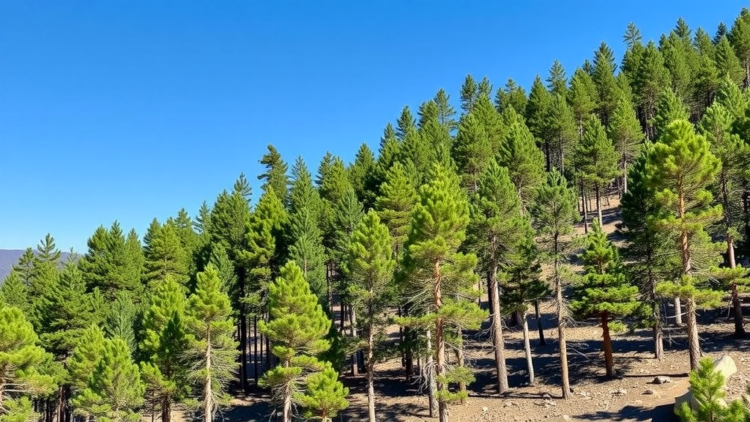
High on the dry, sun-scorched slopes of the northwestern Himalayas grows one of the region’s most valuable and most vulnerable trees: Pinus gerardiana, the Chilgoza pine. Prized for its edible seeds, which fetch premium prices in local and international markets, and revered in traditional medicine, this endemic conifer is now classified as near-threatened on the IUCN Red List. A new study published in Plant Biosystems has delivered one of the most detailed portraits yet of the forests this species dominates, and the picture it paints is one of remarkable ecological richness shadowed by a worrying failure of natural regeneration.
Researchers from Dr. Yashwant Singh Parmar University of Horticulture and Forestry in Himachal Pradesh, led by Rajender Kumar with Aditi Sharma, Hari Paul Sankhyan and Anita Kumari, systematically surveyed Chilgoza pine stands across two of the state’s most important strongholds for the species: the districts of Kinnaur and Chamba. Using systematic random sampling, the team established sample plots of 0.1 hectares each across multiple forest stands, a design that allowed them to capture the variability of these dry temperate ecosystems across different valleys, elevations and disturbance histories. Within each plot, they recorded every tree, shrub and herb, quantifying species composition, phytosociological attributes, diversity indices and regeneration parameters according to standard forest ecology protocols.
The scale of botanical diversity documented surprised even the researchers. Across the surveyed stands, the team recorded a total of 10 tree species, 24 shrub species and 44 herb species, confirming that Chilgoza pine forests are far more than monocultural conifer stands. Rather, they support layered communities in which the pine canopy shelters a diverse understory of woody shrubs and herbaceous plants, many of which hold value for the tribal communities who have lived alongside these forests for generations. The richness was not evenly distributed, however, and the spatial pattern of diversity tells its own story about how local environmental conditions shape these mountain forests.
Pangi, in Chamba district, emerged as the hotspot for tree diversity, recording the highest tree species richness of any site surveyed, alongside the highest Shannon-Wiener diversity index for the tree layer. Kilba, in Kinnaur, boasted the greatest shrub richness and the highest shrub diversity values, while Moorang, also in Kinnaur, exhibited the highest herb diversity. This site-to-site mosaic illustrates a key principle of mountain ecology: at fine spatial scales, differences in slope, aspect, soil moisture, grazing pressure and human use can produce strikingly different community structures even within a single forest type. For conservation planners, the message is that no single site can represent the full diversity of the ecosystem, and stand-level strategies tailored to local conditions are essential.
The phytosociological analysis left no doubt about which species rules these forests. Pinus gerardiana recorded the highest Importance Value Index, a composite measure combining relative density, relative dominance and relative frequency, reaching 212.85, a figure that reflects its overwhelming ecological dominance across the surveyed stands. It was followed by Cedrus deodara, the majestic deodar cedar, and Pinus wallichiana, the blue pine, both of which occur as important associates in these dry temperate communities. The prominence of these three conifers underscores how the dry inner valleys of the northwestern Himalayas favor a distinctive set of drought-tolerant, cold-hardy trees that together define one of the most characteristic forest landscapes of the region.
But the study’s most consequential findings concern regeneration, the process by which mature trees produce seedlings that survive to replace the aging canopy. Regeneration success varied dramatically among the sites surveyed. Moorang showed comparatively better regeneration, with 19.17 percent of measured regeneration parameters indicating successful recruitment, while Pooh exhibited the poorest performance at just 10.00 percent. In ecological terms, these numbers matter enormously. A forest in which adult trees are abundant but seedlings and saplings are scarce is a forest slowly aging toward decline, a phenomenon ecologists describe as a regenerating failure or a skewed population structure. The low and uneven regeneration figures recorded across sites suggest that Chilgoza pine forests in Himachal Pradesh are, to varying degrees, struggling to reproduce themselves naturally.
Why is regeneration faltering? The researchers point to a convergence of pressures. The seeds of the Chilgoza pine are its most famous product, and the same cones that sustain local economies are also the sole source of the species’ natural renewal. Intensive cone harvesting removes seed before it can germinate, while free-ranging livestock graze out seedlings, and anthropogenic disturbances such as lopping, fire and fuelwood collection degrade the forest understory. Climate change compounds these threats in the dry temperate zone, where warming temperatures, shifting precipitation patterns and increasingly erratic snowfall alter the narrow climatic envelope to which this endemic pine is adapted. Previous habitat modeling studies have projected substantial contractions in suitable Chilgoza habitat under future climate scenarios, lending urgency to the field observations recorded in this survey.
The stakes extend well beyond a single tree species. Chilgoza pine forests anchor fragile mountain soils, regulate water flows in snow-fed valleys, and provide habitat for a suite of associated plants and animals. For the tribal communities of Kinnaur and Pangi, the pine nut trade is woven into cultural identity and household income, and studies have documented how the organization of the seed market chain directly influences forest regeneration, since different harvesting practices leave different amounts of seed on the forest floor. A decline in Chilgoza pine would therefore cascade through both ecosystems and livelihoods, a coupling that makes the species a textbook example of why biodiversity conservation and sustainable resource use must be planned together in human-dominated landscapes.
The authors argue that their findings point clearly toward stand-level conservation strategies, an approach that treats each forest stand as a distinct management unit with its own regeneration status, diversity profile and disturbance regime. Where regeneration is relatively healthy, as at Moorang, protecting natural recruitment and moderating seed collection may suffice. Where it is failing, as at Pooh, targeted interventions such as assisted natural regeneration, controlled grazing, rotational cone harvesting and enrichment planting with genetically appropriate seed sources may be required. The study also provides baseline diversity indices and phytosociological data against which future change can be measured, a critical asset in an era when Himalayan forests are shifting rapidly in response to warming.
As climate change accelerates across the Hindu Kush Himalaya, the fate of the Chilgoza pine has become a bellwether for the dry temperate forests of the entire region. This new survey offers both a warning and a roadmap: the warning that one of the Himalayas’ most iconic and economically vital pines is reproducing too slowly to guarantee its own future, and the roadmap that carefully targeted, site-specific conservation can still tip the balance. Whether the pine nuts that grace Himalayan markets for generations to come will continue to come from wild forests, rather than increasingly desperate plantations, will depend on decisions made now in the valleys of Kinnaur and Chamba.
Subject of Research: Floristic composition and regeneration dynamics of Pinus gerardiana dominated forests in the northwestern Himalayas
Article Title: Floristic composition and structural dynamics of Pinus gerardiana (Pinaceae) dominated forests in the North-Western Himalayas
Article References: Floristic composition and structural dynamics of Pinus gerardiana (Pinaceae) dominated forests in the North-Western Himalayas. (n.d.). https://doi.org/10.1007/s44473-026-00259-6
Image Credits: AI Generated
DOI: 10.1007/s44473-026-00259-6
Keywords: Chilgoza pine, Pinus gerardiana, northwestern Himalayas, forest regeneration, phytosociology, biodiversity, Himachal Pradesh, IUCN near-threatened, Shannon-Wiener index, Importance Value Index, forest conservation, climate change
Cite Scienmag News
APA MLA Chicago
Margaret Porter. (September 23, 2026). Himalayan Chilgoza Pine Forests Face Regeneration Crisis, Landmark Survey Reveals. Scienmag. https://scienmag.com/himalayan-chilgoza-pine-forests-face-regeneration-crisis-landmark-survey-reveals/
Margaret Porter. “Himalayan Chilgoza Pine Forests Face Regeneration Crisis, Landmark Survey Reveals.” Scienmag, 23 September 2026, https://scienmag.com/himalayan-chilgoza-pine-forests-face-regeneration-crisis-landmark-survey-reveals/. Accessed 23 September 2026.
Margaret Porter. “Himalayan Chilgoza Pine Forests Face Regeneration Crisis, Landmark Survey Reveals.” Scienmag. September 23, 2026. https://scienmag.com/himalayan-chilgoza-pine-forests-face-regeneration-crisis-landmark-survey-reveals/
Copy citation Download RIS
Tags: biodiversityChilgoza pineclimate changeconservation challengesecological biodiversityedible pine seedsendemic coniferforest conservationforest regenerationforest regeneration failureforest surveyHimachal PradeshHimalayan Chilgoza pine forestsHimalayan ecosystemImportance Value IndexIUCN near-threatenednear-threatened speciesnorthwestern HimalayasphytosociologyPinus gerardianaregeneration crisisShannon-Wiener indextraditional medicinal plants