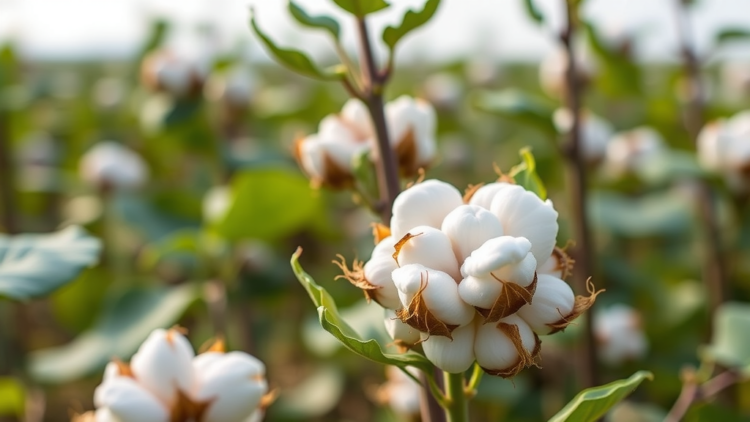
Verticillium wilt has long been one of the most stubborn enemies of cotton farmers worldwide. Caused by the soil-borne fungus Verticillium dahliae, the disease invades the plant’s vascular system, blocking water transport and leaving fields streaked with wilting, yellowing plants. Beyond cutting yields, the pathogen degrades fiber quality, striking at the very heart of what makes cotton commercially valuable. Because the fungus can persist in soil for years and resist most chemical controls, breeders have considered genetic resistance the most sustainable weapon. Now a research team reporting in Theoretical and Applied Genetics has taken a major step toward that goal, identifying fifteen candidate genes tied to the genetic loci that confer resistance in upland cotton, Gossypium hirsutum.
The challenge for geneticists has always been that Verticillium wilt resistance is a quantitative trait. Rather than being governed by a single gene, it emerges from the combined effects of multiple quantitative trait loci, or QTL, scattered across the genome. Detecting these loci reliably, let alone pinpointing the causal genes within them, demands dense genetic maps, replicated disease evaluations across environments, and systematic functional validation. Earlier mapping efforts in cotton had identified resistance regions on chromosomes D7 and D9, and genome-wide association studies added further candidate intervals, but the leap from a broad QTL to a specific gene has remained difficult, particularly in the large and complex allotetraploid cotton genome.
To narrow that gap, the team, led by Yunlei Zhao, Baimei Cheng and Jinfa Zhang with corresponding authors Jianhua Lu and Hongmei Wang of the Institute of Cotton Research at the Chinese Academy of Agricultural Sciences, constructed high-density genetic maps of the regions harboring major resistance QTL. The key tool was a genotyping technology called Kompetitive Allele-Specific PCR, or KASP, which allows thousands of individual plants to be scored rapidly and cheaply at specific single-nucleotide polymorphisms. By saturating the target QTL intervals with KASP markers, the researchers were able to fine-map the loci, shrinking previously vague genomic neighborhoods down to precise physical intervals on the reference genome.
The mapping effort identified six QTL for Verticillium wilt resistance, five of which qualified as major QTL because they were detected in at least two independent environments, a critical test of whether a locus genuinely contributes to resistance rather than reflecting environmental noise. Four of these loci, named qVW-D05-1, qVW-D05-2, qVW-D05-3 and qVW-A01-1, were fine mapped to remarkably compact physical regions of just 15.2 to 241.3 kilobases on chromosomes D05 and A01. In a genome spanning roughly 2.5 billion base pairs, intervals of that size contain only a handful of genes, transforming an intractable search into a manageable candidate list.
With the intervals defined, the researchers deployed a multi-layered strategy to find the genes that matter. They combined gene annotation of the reference genome with whole-genome resequencing of resistant and susceptible lines, transcriptome sequencing to capture differences in gene activity after pathogen challenge, and quantitative reverse-transcription PCR to confirm expression patterns independently. A gene only earned candidate status if it showed both DNA sequence variation between resistant and susceptible germplasm and a measurable difference in expression. This double filter proved powerful: fifteen genes emerged that carried both genetic variants and differential expression, making them the strongest current leads for the molecular basis of wilt resistance in upland cotton.
The functional work went further. Four candidate genes associated with the qVW-D05-1 locus were cloned and subjected to functional analysis using virus-induced gene silencing, a technique that temporarily suppresses a target gene’s activity in the plant, together with overexpression studies that boost it. These complementary approaches allowed the team to observe what happens to disease resistance when each gene’s function is dialled down or up. The results indicated that the genes associated with the major QTL do contribute to resistance, strengthening the case that the fine-mapped intervals harbor genuine resistance determinants rather than statistical artifacts of mapping.
Perhaps the most mechanistically revealing finding concerns the nature of the sequence variation itself. The researchers found that variation in functional gene sequences, especially variations that change amino acids within protein domains, appears to be the underlying molecular mechanism distinguishing resistant from susceptible cotton lines. In other words, resistance is not simply a matter of genes being switched on or off; the resistant alleles encode subtly altered proteins whose functional domains differ in ways that presumably improve recognition of the pathogen or the execution of defense responses. This kind of allelic diversity is exactly what marker-assisted breeding can exploit, because DNA markers linked to the favorable variants can be tracked through generations without waiting years for field evaluations.
The study also delivered a result with immediate practical implications for breeding programs: the power of pyramiding. When the team assembled lines that carried different combinations of the major resistance QTL, a clear dosage effect appeared. The more resistant QTL a line accumulated, the stronger and more durable its Verticillium wilt resistance became. Lines that polymerized all four major resistance loci showed markedly higher and more stable resistance across every environment tested. Because quantitative resistance built from multiple loci is generally harder for pathogens to overcome than single-gene resistance, these findings suggest that stacking the favorable alleles from qVW-D05-1, qVW-D05-2, qVW-D05-3 and qVW-A01-1 could produce cotton cultivars whose resistance endures in the field.
The candidate genes themselves connect to well-established pillars of plant immunity. Prior research in cotton has shown that lignin deposition in vascular tissue, driven by phenylpropanoid metabolism, physically reinforces the xylem vessels the fungus colonizes, while hormones such as jasmonic acid and brassinosteroids orchestrate defense signaling. Receptor-like kinases, including the wall-associated kinase GhWAK7A, have been shown to sense fungal chitin and trigger immune responses, and transcription factors of the MYB and bHLH families regulate defense gene networks. The newly identified candidates, evaluated against this background, fit into pathways that plausibly shape how cotton detects Verticillium dahliae and walls it off before the fungus can spread through the vascular stream.
For a crop grown on tens of millions of hectares and facing a pathogen that chemical fungicides struggle to reach, the study offers a concrete toolkit. The fine-mapped intervals and the KASP markers developed for them give breeders the ability to select resistant plants at the seedling stage, accelerating the introgression of resistance alleles into elite cultivars. The fifteen candidate genes and four functionally validated qVW-D05-1 genes provide starting points for deeper mechanistic study, potentially including genome editing of favorable alleles directly into susceptible varieties. As Verticillium wilt continues to constrain cotton production across major growing regions, the convergence of fine mapping, multi-omics screening and functional validation demonstrated here offers a template for dissecting other quantitative disease-resistance traits, moving cotton breeding decisively closer to durable, genetically anchored resistance.
Subject of Research: Identification of candidate genes within major quantitative trait loci controlling Verticillium wilt resistance in upland cotton (Gossypium hirsutum L.).
Article Title: Identification of candidate genes associated with major QTL controlling Vertcillium wilt resistance in cotton (Gossypium hirsutum L.)
Article References: Identification of candidate genes associated with major QTL controlling Vertcillium wilt resistance in cotton (Gossypium hirsutum L.). (n.d.). https://doi.org/10.1007/s00122-026-05355-x
Image Credits: AI Generated
DOI: 10.1007/s00122-026-05355-x
Keywords: cotton, Verticillium wilt, Gossypium hirsutum, QTL mapping, candidate genes, KASP markers, fine mapping, virus-induced gene silencing, plant disease resistance, Theoretical and Applied Genetics, marker-assisted selection, plant immunity
Cite Scienmag News
APA MLA Chicago
Juliet Wilcox. (September 23, 2026). Scientists Pin Down Genes Behind Cotton’s Defenses Against Wilt Disease. Scienmag. https://scienmag.com/scientists-pin-down-genes-behind-cottons-defenses-against-wilt-disease/
Juliet Wilcox. “Scientists Pin Down Genes Behind Cotton’s Defenses Against Wilt Disease.” Scienmag, 23 September 2026, https://scienmag.com/scientists-pin-down-genes-behind-cottons-defenses-against-wilt-disease/. Accessed 23 September 2026.
Juliet Wilcox. “Scientists Pin Down Genes Behind Cotton’s Defenses Against Wilt Disease.” Scienmag. September 23, 2026. https://scienmag.com/scientists-pin-down-genes-behind-cottons-defenses-against-wilt-disease/
Copy citation Download RIS
Tags: candidate genescottoncotton breeding for disease resistancecotton disease resistance genescotton fiber quality and diseasecotton genetic mappingcotton resistance gene identificationcotton Verticillium wilt resistancefine mappinggenetic resistance in cottongenome-wide association studies in cottonGossypium hirsutumKASP markersmarker-assisted selectionplant disease resistanceplant immunityQTL mappingquantitative trait loci in cottonsoil-borne fungal pathogens in cottonsustainable cotton disease managementTheoretical and Applied GeneticsVerticillium dahliae pathogenVerticillium wiltvirus-induced gene silencing