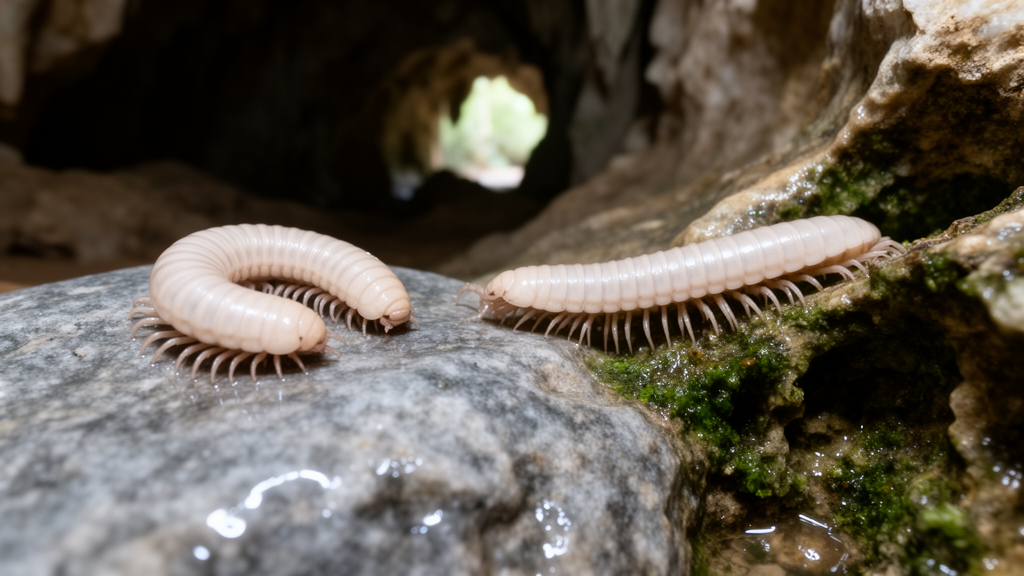
Deep in the dark zones of limestone caves in Battambang Province, northwestern Cambodia, two millipede species have been living unnoticed on bat guano and moist cave floors. Researchers have now formally described them as Plusioglyphiulus parviserratus and Plusioglyphiulus battambangensis, raising the number of Plusioglyphiulus species known from Cambodia from four to six and the global count of the genus to 32. The discovery, published in the journal ZooKeys, is the product of an integrated taxonomic approach that combines meticulous morphological analysis with DNA barcoding of the mitochondrial cytochrome c oxidase subunit I (COI) gene, and it offers a vivid reminder of how much undiscovered life may be hiding in Southeast Asia’s imperiled karst systems.
The genus Plusioglyphiulus is one of the most conspicuous and species-rich millipede lineages in Southeast Asia, ranging from southern Myanmar, Thailand, and Laos in the west to Borneo in the east. These millipedes are strongly associated with limestone karst landscapes, which are recognized biodiversity hotspots under severe threat across the region. Most species show a striking degree of micro-endemism: because of limited dispersal capabilities and specific habitat requirements, populations tend to be confined to a single cave or even a solitary limestone outcrop. Despite frequently forming massive populations within caves, nearly all Plusioglyphiulus species lack the classic troglomorphic features of true cave dwellers, such as elongated appendages or complete loss of eyes, and are therefore regarded as troglophiles. Bat guano serves as the primary nutrient source sustaining these subterranean ecosystems.
Cambodia’s karst systems, which blanket large areas of the country’s western and southern parts, remain dramatically understudied compared with neighboring Thailand, which alone harbors 14 recorded Plusioglyphiulus species documented from more than 300 sampled localities. Until recently, only two Cambodian species were known: Plusioglyphiulus dubius, described in 1938 from Angkor, and Plusioglyphiulus boutini, described in 1970 from a cave near Kampong Trach in Kampot Province. A 2020 field survey added two more cavernicolous species from the southern provinces of Kampot and Kep. The paucity of records, the researchers argue, reflects a severe lack of collecting effort rather than any true biogeographical pattern of the genus.
The two new species were collected by hand in August 2024 from separate cave localities in Battambang Province. Plusioglyphiulus parviserratus was found in the dark zone of Wat La-ang Phnom Takream, exclusively on bat guano deposits, where the type series comprised a holotype male together with 26 males and 43 females. Plusioglyphiulus battambangensis was discovered about 20 meters from the entrance of a cave at Asram Kompir Temple, occurring on moist limestone floor, with 17 males and 35 females joining its holotype. Live animals were photographed in their natural habitats with a macro lens, and specimens were preserved in ethanol for morphological study or in high-grade ethanol for molecular analysis, with the preservative replaced after 24 hours to prevent defensive secretions from compromising DNA quality. All type specimens are deposited in the Museum of Zoology, Chulalongkorn University in Bangkok.
Both new species are small, light brown millipedes with darker lateral sides and a narrow median line, adults ranging roughly from 18 to 41 millimeters in length depending on sex and species. Like all cambalopsids, they carry reduced but functional eyes, with each eye patch holding only 7 to 16 flat ommatidia arranged in two or three longitudinal rows. Their bodies are armored with low crests and tubercles whose arrangement, known as the carinotaxic formula, follows a precise pattern that differs between the two species and provides one of the key diagnostic characters separating them from relatives. The male genital structures, the gonopods, are the critical features for species-level identification in this group, and here the two new taxa show distinctive architectures: in P. parviserratus, the male first leg telopodite is distinctly two-segmented with a rudimentary knob-like second segment, the anterior gonopod coxosternal processes are long, slender, and regularly curved anteriorly, vividly resembling a bird’s head, and the broad flagellum process of the posterior gonopod bears a unique micro-serrate upper margin. In P. battambangensis, the second telopoditomere is significantly smaller, the paramedian coxal process is slender and elongated, and the flagellum process is narrow with a smooth margin.
The closest known relative of P. parviserratus is Plusioglyphiulus likhitrakarni, described from eastern Thailand. The two share remarkably similar general somatic characters and basic gonopod structure, but the new species is readily distinguishable by its unique carinotaxic pattern on the collum and midbody metaterga, a significantly reduced number of ommatidia, and two-segmented rather than one-segmented male first leg telopodites. Molecular data robustly support this differentiation: the uncorrected pairwise COI p-distance between the two species is 9.9 percent. The two new Cambodian species are separated from each other by an interspecific distance of 10.3 percent and show divergences of 9.6 to 9.9 percent from their closest known relatives. Although these values approach the lower threshold of the interspecific distances generally observed within the genus, which typically range between 11.4 and 18.2 percent, the substantial genetic gap coupled with clear diagnostic morphological boundaries strongly corroborates the independent evolutionary status of each newly described taxon.
Beyond the descriptions themselves, the study evaluates the resolution efficiency and practical limitations of multiple imaging modalities, offering a methodological comparison that will interest taxonomists working on any small, heavily sclerotized invertebrate. Digital stereomicroscopic photography remains indispensable for capturing true-to-life coloration and providing an overview of the body habitus, but even state-of-the-art optical systems often fail to resolve minute, densely crowded, or overlapping appendages. Traditional line drawings, prepared from focus-stacked digital renderings, allow selective emphasis of diagnostic features, yet their accuracy depends heavily on the investigator’s interpretation, particularly problematic for membranous or semi-translucent structures such as the delicate flagellum process of the posterior gonopods.
Scanning electron microscopy provides unparalleled resolution and depth of field, bypassing optical limitations associated with tissue translucency and rendering the entire specimen surface with uniform, crisp focus, making it the gold standard for illustrating micro-characters. Its drawbacks are that it reveals nothing about internal tissue density and requires preparatory procedures that demand structurally rigid specimens capable of withstanding high-vacuum conditions, with fragile elements risking distortion or artifactual displacement. Micro-computed tomography scanning, performed with a SkyScan 1273 at a voxel size of 4.0 micrometers, has emerged as a powerful, non-destructive alternative. The 3D reconstructions yield highly satisfactory visualizations of external somatic architecture, offering exceptional rotational capabilities and allowing virtual segmentation with color-coded isolation of internal and closely appressed structures in situ, removing the necessity for physical dissection that might damage a unique specimen.
Yet the researchers demonstrate that current in-situ tomographic data remain insufficient for resolving the highly condensed, tightly appressed gonopodial microscopic characters that are essential for species-level discrimination. The primary constraint lies in post-scanning segmentation, where manually delineating boundaries of densely packed structures is hampered by a lack of contrast. Subtle micro-characters, such as the exact setation pattern on the mesal surface of the first leg or the precise configuration of a vestigial second telopoditomere reduced to a mere knob, cannot be successfully discriminated. Because the anterior and posterior gonopods remain naturally tightly appressed in situ, without physical dissection prior to scanning these overlapping elements mutually obscure one another, making reconstruction of individual hidden surfaces exceedingly difficult. The team concludes that a tiered workflow, emphasizing routine photography for quick initial diagnosis while reserving advanced methods such as micro-CT and SEM for complex gonopod analysis, provides the best compromise between cost, time, and morphological resolution.
The discoveries also carry urgent conservation implications. Limestone karsts and their subterranean networks in Southeast Asia are critical hotspots of narrow-range endemism, but they are extremely fragile and increasingly threatened by commercial limestone mining for cement manufacture, agricultural development, and unmanaged cave tourism. Such activities destabilize underground microclimates and deplete essential organic resources, especially bat guano, the fundamental substrate with which many cambalopsid millipedes are intimately connected. Being micro-endemics strictly confined to isolated karst towers, both new species are highly vulnerable to habitat degradation, and any structural compromise to their type localities could result in extinction before their ecological roles are understood. The researchers provide an updated identification key to all six Cambodian Plusioglyphiulus species and stress that basic taxonomic inventories are an essential first step toward assessing the biological value of individual karsts, providing the empirical baseline needed to advocate for sustainable cave management and formal site protection. Given that Cambodia’s extensive limestone formations remain vastly under-sampled, future systematic explorations will undoubtedly reveal many more undescribed diplopods hiding in the region’s caves.
Subject of Research: Integrated taxonomy of two new cavernicolous Plusioglyphiulus millipede species from Cambodia
Article Title: Integrated taxonomy of two new species of the millipede genus Plusioglyphiulus Silvestri, 1923 from Cambodia ( Diplopoda , Spirostreptida )
Article References: Likhitrakarn, N., Golovatch, S. I., Srisonchai, R., Thi, S., Chhin, S., Lou, V., Sinovas, P., Jirapatrasilp, P., Sutcharit, C., Panha, S., & Seesamut, T. (2026). Integrated taxonomy of two new species of the millipede genus Plusioglyphiulus Silvestri, 1923 from Cambodia (Diplopoda, Spirostreptida). ZooKeys, 1289, 237-269. https://doi.org/10.3897/zookeys.1289.204580
Image Credits: AI Generated
DOI: 10.3897/zookeys.1289.204580
Keywords: millipedes, Cambodia, taxonomy, cave biology, karst conservation, COI barcoding, micro-CT, ZooKeys, Integrated, species, millipede, genus
News Source: Gavin Prescott. (October 19, 2026). Two new cave millipede species discovered in Cambodia’s limestone karsts. Scienmag.