Researchers at King Fahd University of Petroleum and Minerals in Saudi Arabia have compared two isocyanurate-based hyper-cross-linked resins, ICY-AM and ICYAN-PA, for removing caffeine and four reactive dyes from real batik wastewater, and their results reveal a counterintuitive twist: the resin that bound caffeine most strongly in the laboratory did not perform best in a flowing column. The study, published in the journal Environmental Surfaces and Interfaces, tested the materials under both batch and continuous fixed-bed conditions and paired the experiments with density functional theory (DFT) simulations to explain what happens at the molecular scale.
In batch tests, caffeine adsorption proved strongly dependent on pH. Maximum Langmuir capacities reached 121.2 mg/g for ICY-AM and 104.8 mg/g for ICYAN-PA near each resin’s point of zero charge, the pH at which the adsorbent surface carries no net charge. “DFT calculations showed that adsorption thermodynamics are governed by the resin’s charge state: neutral surfaces bind caffeine markedly more strongly because they avoid the energy penalty of stripping away solvating water molecules,” explains Professor Nisar Ullah, corresponding author of the study. At the molecular level, ICY-AM therefore showed the more favorable intrinsic affinity toward caffeine, with simulations of the most stable caffeine–adsorbent complexes identifying the primary interactions at the adsorption site.
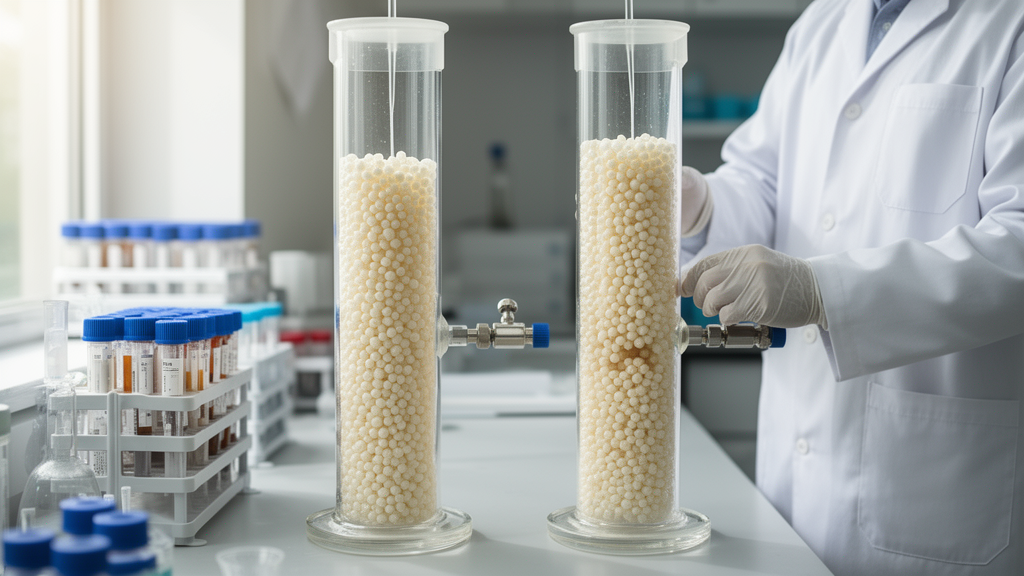
That advantage, however, did not translate to real-world flow conditions. “Notably, the resin with the stronger intrinsic affinity in batch tests was not the one that performed best under continuous flow,” Ullah notes. “Thermodynamic binding strength alone does not predict how an adsorbent will behave in a real fixed-bed column, where mass transfer is often the deciding factor.” In fixed-bed column experiments, ICYAN-PA delivered the superior dynamic performance for both caffeine and the batik wastewater, an outcome the researchers attribute to its greater density of amine sites and narrower mass-transfer zones, which allow contaminant molecules to reach binding sites more efficiently as water passes through the bed.
Breakthrough modeling quantified the difference. For caffeine, the models predicted higher dynamic capacities for ICYAN-PA, roughly 54.84 to 65.39 mg/g, than for ICY-AM, roughly 48.81 to 58.39 mg/g. When treating actual batik wastewater, ICYAN-PA achieved removal efficiencies between 64.5 and 95.3 percent with longer service times, while ICY-AM managed between 46.3 and 87.3 percent. The gap matters because batik dyeing generates effluent loaded with reactive dyes and organic residues that are difficult to treat with conventional methods, and a fixed-bed adsorber must sustain performance over many bed volumes rather than excel in a single equilibrium measurement.
The findings highlight the complementary roles of intrinsic binding affinity and mass-transfer behavior in determining adsorbent performance. A material whose surface chemistry forms the most stable complexes can still underperform if contaminant molecules cannot diffuse quickly into its structure, and the study suggests that evaluating adsorbents only through batch equilibrium data risks misleading material selection. “The findings highlight the complementary roles of intrinsic binding affinity and mass-transfer behavior in determining how an adsorbent performs, and position isocyanurate-based resins as promising, tunable materials for the simultaneous removal of multiple pollutants from complex wastewater streams,” says Ullah. The work was an experimental study, and the authors declare no known competing financial interests or personal relationships that could have influenced the reported results.
Subject of Research: Comparative batch and fixed-bed evaluation of two isocyanurate-based hyper-cross-linked resins for adsorbing caffeine and reactive dyes from batik wastewater, supported by DFT simulations
Article Title: Comparative evaluation of isocyanurate-based resin performance towards organic contaminants in a fixed-bed adsorption system
Article References: Comparative evaluation of isocyanurate-based resin performance towards organic contaminants in a fixed-bed adsorption system. Original publication (Bibliographic details unavailable.)
Image Credits: AI Generated
DOI: Not provided
Keywords: isocyanurate resin, hyper-cross-linked polymer, fixed-bed adsorption, caffeine removal, reactive dyes, batik wastewater, DFT simulation, Langmuir capacity, mass transfer, water treatment, Comparative, evaluation
News Source: Bethany Barker. (October 26, 2026). Two Isocyanurate Resins, One Lesson: Strongest Binding Is Not Best Column Performance. Scienmag.