• HOME
  • NEWS
  • EXPLORE
    • CAREER
      • Companies
      • Jobs
    • EVENTS
    • iGEM
      • News
      • Team
    • PHOTOS
    • VIDEO
    • WIKI
  • BLOG
  • COMMUNITY
    • FACEBOOK
    • INSTAGRAM
    • TWITTER
Saturday, February 7, 2026
BIOENGINEER.ORG
No Result
View All Result
  • Login
  • HOME
  • NEWS
  • EXPLORE
    • CAREER
      • Companies
      • Jobs
        • Lecturer
        • PhD Studentship
        • Postdoc
        • Research Assistant
    • EVENTS
    • iGEM
      • News
      • Team
    • PHOTOS
    • VIDEO
    • WIKI
  • BLOG
  • COMMUNITY
    • FACEBOOK
    • INSTAGRAM
    • TWITTER
  • HOME
  • NEWS
  • EXPLORE
    • CAREER
      • Companies
      • Jobs
        • Lecturer
        • PhD Studentship
        • Postdoc
        • Research Assistant
    • EVENTS
    • iGEM
      • News
      • Team
    • PHOTOS
    • VIDEO
    • WIKI
  • BLOG
  • COMMUNITY
    • FACEBOOK
    • INSTAGRAM
    • TWITTER
No Result
View All Result
Bioengineer.org
No Result
View All Result
Home NEWS Science News Biology

Turning cells into computers with protein logic gates

Bioengineer by Bioengineer
April 2, 2020
in Biology
Reading Time: 2 mins read
0
IMAGE
Share on FacebookShare on TwitterShare on LinkedinShare on RedditShare on Telegram

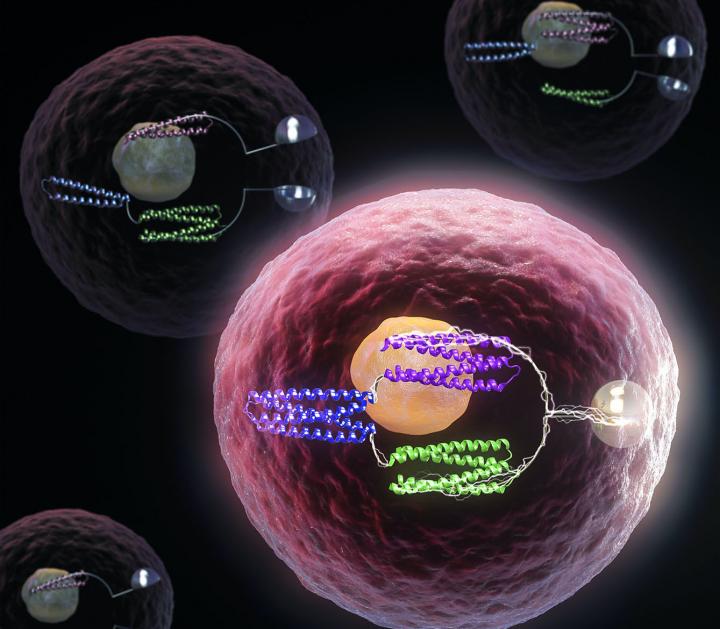
Biochemists have created “smart” proteins that function inside human cells by turning genes on and off
IMAGE

Credit: MolGraphics/UW Medicine Institute for Protein Design

The same basic tools that allow computers to function are now being used to control life at the molecular level. The advances have implications for future medicines and synthetic biology.

Reporting April 2 in the journal Science, a team led by the University of Washington School of Medicine has created artificial proteins that function as molecular logic gates. These tools, like their electronic counterparts, can be used to program the behavior of more complex systems.

The team showed that the new designer proteins can regulate gene expression inside human T-cells. This development may improve the safety and durability of future cell-based therapies.

“Bioengineers have made logic gates out of DNA, RNA and modified natural proteins before, but these are far from ideal. Our logic gates built from de novo designed proteins are more modular and versatile, and can be used in a wide range of biomedical applications” said senior author David Baker, professor of biochemistry at the UW School of Medicine and director of the Institute for Protein Design.

Whether electronic or biological, logic gates sense and respond to signals in predetermined ways. One of the simplest is the AND gate; it produces output only when one input AND another are present.

For example, when typing on a keyboard, pressing the Shift key AND the A key produces an uppercase letter A. Logic gates made from biological parts aim to bring this level of control into bioengineered systems.

With the right gates operating inside living cells, inputs such as the presence of two different molecules — or one and not the other — can cause a cell to produce a specific output, such as activating or suppressing a gene.

“The whole Apollo 11 Guidance Computer was built from electronic NOR gates,” said lead author Zibo Chen, a recent UW graduate student. “We succeeded in making protein-based NOR gates. They are not as complicated as NASA’s guidance computers, but nevertheless are a key step toward programming complex biological circuits from scratch.”

Recruiting a patient’s own immune cells in the fight against cancer has worked for certain forms of the disease. Nonetheless, targeting solid tumors with this so-called CAR-T cell therapy approach has proven challenging.

Scientists think part of the reason has to do with T cell exhaustion. Genetically altered T cells can fight for only so long before they stop working. There may be a way around this. With protein logic gates that respond to exhaustion signals, the team from UW Medicine hopes to prolong the activity of CAR T cells.

“Longer-lived T cells that are better programmed for each patient would mean more effective personalized medicine,” said Chen.

###

This work was led by researchers at the UW Medicine Institute for Protein Design. The research team also included biochemists from Northwestern University, The Ohio State University, Altius Institute for Biomedical Sciences and University of California San Francisco.

This news release was written by Ian Haydon of the UW Medicine Institute for Protein Design.

Media Contact
Leila Gray
[email protected]

Tags: BiochemistryBiologyBiomedical/Environmental/Chemical EngineeringBiotechnologyCell BiologyMolecular BiologyMolecular PhysicsNanotechnology/Micromachines
Share12Tweet8Share2ShareShareShare2

Related Posts

Florida Cane Toad: Complex Spread and Selective Evolution

Florida Cane Toad: Complex Spread and Selective Evolution

February 7, 2026
New Study Uncovers Mechanism Behind Burn Pit Particulate Matter–Induced Lung Inflammation

New Study Uncovers Mechanism Behind Burn Pit Particulate Matter–Induced Lung Inflammation

February 6, 2026

DeepBlastoid: Advancing Automated and Efficient Evaluation of Human Blastoids with Deep Learning

February 6, 2026

Navigating the Gut: The Role of Formic Acid in the Microbiome

February 6, 2026
Please login to join discussion

POPULAR NEWS

  • Robotic Ureteral Reconstruction: A Novel Approach

    Robotic Ureteral Reconstruction: A Novel Approach

    82 shares
    Share 33 Tweet 21
  • Digital Privacy: Health Data Control in Incarceration

    63 shares
    Share 25 Tweet 16
  • Study Reveals Lipid Accumulation in ME/CFS Cells

    57 shares
    Share 23 Tweet 14
  • Breakthrough in RNA Research Accelerates Medical Innovations Timeline

    53 shares
    Share 21 Tweet 13

About

We bring you the latest biotechnology news from best research centers and universities around the world. Check our website.

Follow us

Recent News

Florida Cane Toad: Complex Spread and Selective Evolution

Exploring Decision-Making in Dementia Caregivers’ Mobility

Succinate Receptor 1 Limits Blood Cell Formation, Leukemia

Subscribe to Blog via Email

Enter your email address to subscribe to this blog and receive notifications of new posts by email.

Join 73 other subscribers
  • Contact Us

Bioengineer.org © Copyright 2023 All Rights Reserved.

Welcome Back!

Login to your account below

Forgotten Password?

Retrieve your password

Please enter your username or email address to reset your password.

Log In
No Result
View All Result
  • Homepages
    • Home Page 1
    • Home Page 2
  • News
  • National
  • Business
  • Health
  • Lifestyle
  • Science

Bioengineer.org © Copyright 2023 All Rights Reserved.