• HOME
  • NEWS
  • EXPLORE
    • CAREER
      • Companies
      • Jobs
    • EVENTS
    • iGEM
      • News
      • Team
    • PHOTOS
    • VIDEO
    • WIKI
  • BLOG
  • COMMUNITY
    • FACEBOOK
    • INSTAGRAM
    • TWITTER
Wednesday, June 24, 2026
BIOENGINEER.ORG
No Result
View All Result
  • Login
  • HOME
  • NEWS
  • EXPLORE
    • CAREER
      • Companies
      • Jobs
        • Lecturer
        • PhD Studentship
        • Postdoc
        • Research Assistant
    • EVENTS
    • iGEM
      • News
      • Team
    • PHOTOS
    • VIDEO
    • WIKI
  • BLOG
  • COMMUNITY
    • FACEBOOK
    • INSTAGRAM
    • TWITTER
  • HOME
  • NEWS
  • EXPLORE
    • CAREER
      • Companies
      • Jobs
        • Lecturer
        • PhD Studentship
        • Postdoc
        • Research Assistant
    • EVENTS
    • iGEM
      • News
      • Team
    • PHOTOS
    • VIDEO
    • WIKI
  • BLOG
  • COMMUNITY
    • FACEBOOK
    • INSTAGRAM
    • TWITTER
No Result
View All Result
Bioengineer.org
No Result
View All Result
Home NEWS Science News Chemistry

Turbocharging the switch to efficient engines

Bioengineer by Bioengineer
March 28, 2019
in Chemistry
Reading Time: 2 mins read
0
IMAGE
Share on FacebookShare on TwitterShare on LinkedinShare on RedditShare on Telegram

IMAGE

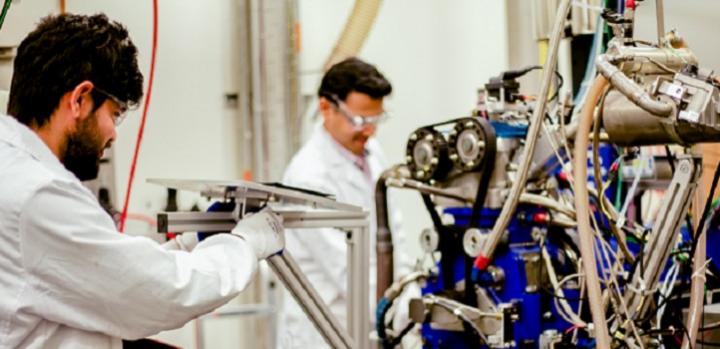
Credit: © 2019 Eshan Singh

A combustion problem that has troubled engine manufacturers since the industry began still plagues the designers of fuel-efficient engines. A team at KAUST’s Clean Combustion Research Center, led by Robert Dibble, focuses on understanding pre-ignition.

A single occurrence of pre-ignition–when fuel ignites prematurely in the engine cylinder to release a mistimed kick of energy–can cause major damage. Pre-ignition is sporadic and unpredictable. It is more prevalent in the downsized, turbocharged engines that car makers are now producing for improved fuel efficiency while maintaining power output.

“Pre-ignition remains a bottleneck to further downsizing and improving engine efficiency,” explains Eshan Singh, a Ph.D. student in Dibble’s team.

The team systematically changed engine parameters, including air intake temperature and exhaust back-pressure, thereby establishing the conditions most likely for pre-ignition. For example, the team observed more pre-ignition events with a higher exhaust back pressure: this occurs when the engine cylinder has less effective emptying of burnt fuel between combustion cycles.

The researchers combined all their observations to build a picture of the pre-ignition phenomenon. “Our work unravels the pre-ignition event is divided into several steps,” Singh says.

A pre-ignition event originates during the previous fuel combustion cycle, when fuel injected into the cylinder interacts with oil on the cylinder liner forming an oil-fuel droplet. At the end of each combustion cycle, the oil-fuel droplet is usually expelled from the cylinder; however, from time to time, the oil-fuel droplet remains and may trigger pre-ignition in the following cycle, the team showed. “Car makers need to break this chain of events to suppress pre-ignition,” Singh says.

Stopping the fuel and oil from interacting, or completely exhausting all the burnt mixture from the engine, are two points where the event chain can be broken. Preventing the injected fuel from hitting the oil-coated cylinder liner is one approach. “We are looking at practical methods to reduce pre-ignition by changing the injection strategy,” Singh says. “We have filed a patent that uses injection strategies to provide pre-ignition-free operation without compromising engine power.”

Other routes to break the chain of events demand deeper understanding of pre-ignition, Singh adds. “Our exciting discoveries are gratifying. Going forward, we are motivated to uncover additional controlling variables that allow for more accurate pre-ignition predictions.”

Due to graduate from KAUST in the fall of 2019, Eshan is currently interning at the Combustion Research Facility in Sandia National Laboratories, California. There he is exploring mixed-mode combustion for future internal combustion engines. “This experience has already exposed me to a plethora of tools that are frequently used in engine combustion diagnostics. Several new avenues have now opened for my research career, which is vested in tackling solutions to combat climate change.”

###

Media Contact
Carolyn Unck
[email protected]

Original Source

https://discovery.kaust.edu.sa/en/article/807/turbocharging-the-switch-to-efficient-engines

Tags: Chemistry/Physics/Materials SciencesIndustrial Engineering/ChemistryMechanical EngineeringVehicles
Share13Tweet8Share2ShareShareShare2

Related Posts

Plasma Technology Extends Catalyst Lifespan in Hydrogen Production

June 24, 2026

Electric Field and Oxygen Spillover Collaborate to Control Electrode Migration in SOECs

June 24, 2026

Innovative Speckle-Based Metrology System Advances Precision Measurement of Next-Generation X-Ray Mirrors

June 24, 2026

Water-Activated PVA Film Transforms from Bioplastic to High-Performance Wood Adhesive

June 24, 2026
Please login to join discussion

POPULAR NEWS

  • Saying Goodbye to PGY-6: Pediatric Fellowship Realities

    103 shares
    Share 41 Tweet 26
  • Multi-Hospital Study Reveals Long Covid Burden Is Twice as High as Current Estimates

    92 shares
    Share 36 Tweet 23
  • Detection of EDCs in Breast Milk and Infant Urine Up to Six Months Highlights Early Exposure Risks

    77 shares
    Share 31 Tweet 19
  • New Drug Candidate Developed at McMaster Shows Potential for Treating Brain Cancer

    58 shares
    Share 23 Tweet 15

About

We bring you the latest biotechnology news from best research centers and universities around the world. Check our website.

Follow us

Recent News

Gene Variant rs11030119 Impacts BDNF Platelet Function

Decades of Data Reveal Which Orcas Call Puget Sound Home

Introducing a Revolutionary Pixel Technology

Subscribe to Blog via Email

Enter your email address to subscribe to this blog and receive notifications of new posts by email.

Join 82 other subscribers
  • Contact Us

Bioengineer.org © Copyright 2023 All Rights Reserved.

Welcome Back!

Login to your account below

Forgotten Password?

Retrieve your password

Please enter your username or email address to reset your password.

Log In
No Result
View All Result
  • Homepages
    • Home Page 1
    • Home Page 2
  • News
  • National
  • Business
  • Health
  • Lifestyle
  • Science

Bioengineer.org © Copyright 2023 All Rights Reserved.