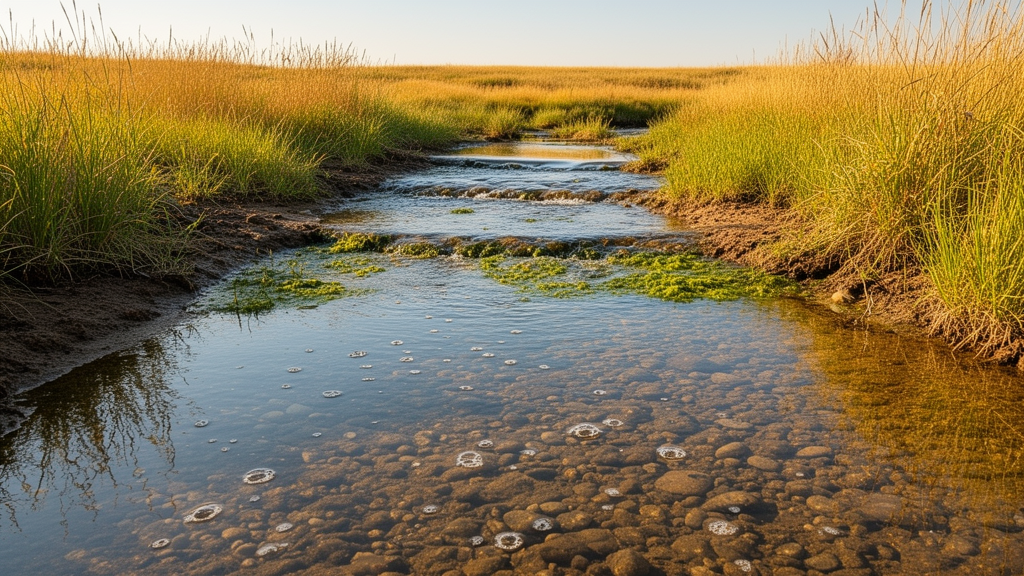
Dissolved gas concentrations in a non-perennial prairie stream network varied during the hydrological transition from flowing to pooling conditions, according to research conducted at Konza Prairie in Kansas, USA.
The multivariate analyses identified distinct environmental and chemical predictors for each dissolved gas evaluated in the study. Key predictors identified across the stream network included dissolved organic carbon, dissolved oxygen, nitrate, the magnesium-to-calcium ratio, and the hydrological flow state of the channel.
Network-scale sampling of these greenhouse and abundant gases during the drying sequence provided insight into patterns of aerobic and anaerobic processes in non-perennial streams.
The investigation was designed to address fundamental knowledge gaps by exploring two central research questions regarding drying waterways. First, the researchers asked what impact stream network dry-down exerts on variability in dissolved gas concentrations. Second, the study asked how dry-down affects the controls governing those dissolved gases.
To address these questions, the authors hypothesized that the transition from flowing to pooling conditions would influence dissolved gases at the stream-network scale. The research team further hypothesized that this hydrological transition would reveal distinct controls for each individual gas driven by interacting biogeochemical processes. The empirical results supported this hypothesis, confirming that dissolved gas concentrations varied across the network during the drying transition and that distinct predictors governed each individual gas.
The study focuses on non-perennial streams, defined as waterways that dry at some point in time and space, which comprise a large proportion of global river networks. These temporary systems play critical roles in global carbon and nitrogen cycling. However, their variable hydrology, characterized by transitions among flowing, pooling, and dry conditions, creates biogeochemical environments that are poorly constrained.
Dissolved gases serve as key indicators of aquatic ecosystem function and water quality, yet most freshwater dissolved gas estimates come from perennial systems, often overlooking non-perennial streams. The controls on dissolved gas production in non-perennial streams, including the roles of water chemistry and hydrologic conditions, have remained poorly understood.
Subject of Research: Dissolved gas dynamics during stream dry-down in non-perennial prairie waterways
Article Title: Network dry-down effects on dissolved gases in a non-perennial prairie stream, Konza Prairie, Kansas, USA
Article References: Wilhelm, J. F., Zarek, K., Seybold, E. C., Zipper, S., Rana, S., & Burgin, A. J. (2026). Network dry-down effects on dissolved gases in a non-perennial prairie stream, Konza Prairie, Kansas, USA. Biogeochemistry. https://doi.org/10.1007/s10533-026-01354-8
Image Credits: AI Generated
DOI: 10.1007/s10533-026-01354-8
Keywords: non-perennial streams, dissolved gases, stream dry-down, greenhouse gases, methane, carbon dioxide, nitrous oxide, dissolved oxygen, di-nitrogen, dissolved organic carbon, nitrate, magnesium-to-calcium ratio, flow state, Konza Prairie, carbon cycling, nitrogen cycling, biogeochemistry, pooling conditions
News Source: Bethany Barker. (November 14, 2026). Prairie Stream Dissolved Gas Concentrations Varied During Flowing to Pooling Transition. Scienmag.