• HOME
  • NEWS
  • EXPLORE
    • CAREER
      • Companies
      • Jobs
    • EVENTS
    • iGEM
      • News
      • Team
    • PHOTOS
    • VIDEO
    • WIKI
  • BLOG
  • COMMUNITY
    • FACEBOOK
    • INSTAGRAM
    • TWITTER
Sunday, October 4, 2026
BIOENGINEER.ORG
No Result
View All Result
  • Login
  • HOME
  • NEWS
  • EXPLORE
    • CAREER
      • Companies
      • Jobs
        • Lecturer
        • PhD Studentship
        • Postdoc
        • Research Assistant
    • EVENTS
    • iGEM
      • News
      • Team
    • PHOTOS
    • VIDEO
    • WIKI
  • BLOG
  • COMMUNITY
    • FACEBOOK
    • INSTAGRAM
    • TWITTER
  • HOME
  • NEWS
  • EXPLORE
    • CAREER
      • Companies
      • Jobs
        • Lecturer
        • PhD Studentship
        • Postdoc
        • Research Assistant
    • EVENTS
    • iGEM
      • News
      • Team
    • PHOTOS
    • VIDEO
    • WIKI
  • BLOG
  • COMMUNITY
    • FACEBOOK
    • INSTAGRAM
    • TWITTER
No Result
View All Result
Bioengineer.org
No Result
View All Result
Home NEWS Science News Biology

Tumor vs. immune system: A battle to decide the host’s fate

Bioengineer by Bioengineer
February 10, 2020
in Biology
Reading Time: 2 mins read
0
IMAGE
Share on FacebookShare on TwitterShare on LinkedinShare on RedditShare on Telegram

Researchers from the University of Tsukuba show how tumors can disable the immune system to survive and grow
IMAGE

Credit: University of Tsukuba


Tsukuba, Japan – The goal of most cancers is to grow and take over the host’s body. The immune system has long been in the crosshairs of cancer researchers, as it plays a central role in defending the human body from foreign invasion. In a new study, researchers from the University of Tsukuba have revealed that tumors that produce a protein called soluble CD155 accumulate in the lungs of mice by disabling the immune system of the animals.

Soluble CD155 is a protein that is made by many different cells in the body and plays an important role in how cells migrate and develop. Surprisingly, several studies by the group at the University of Tsukuba have shown that higher serum levels of soluble CD155 can be found in patients with various types of cancer.

“Correlation does not imply causation,” says the corresponding author of the study and associate professor Kazuko Shibuya. “We wanted to know specifically how soluble CD155 is involved in the growth of cancer.”

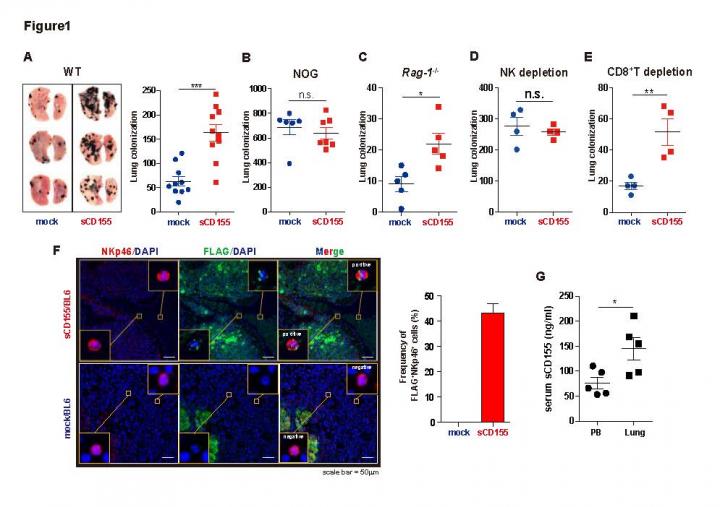
To function, proteins bind to other proteins. CD155 has been shown to bind to the proteins DNAM-1, TIGIT, and CD96, all of which are expressed by various types of immune cells. To achieve their goal, the researchers changed cancer cells, called B16/BL6 melanoma cells, to produce soluble CD155. When injected into normal mice or mice that are deficient in TIGIT or CD96, the soluble CD155-producing B16/BL6 cancer cells were able to settle and grow in their lungs, more so than compared with B16/BL6 cancer cells that had not been changed. Quite the opposite happened, however, when the same experiment was performed with mice deficient in DNAM-1–the researchers could not find a larger tumor in the lungs of the animals.

“Our results show that DNAM-1 was somehow involved in the tumor-promoting actions of soluble CD155,” says lead author of the study Genki Okumura. “Our next goal was to explore further how the two proteins interact to enable the growth of cancer”.

The researchers then depleted a certain type of immune cells, called natural killer (NK) cells, in the mice and found that all difference between the mice disappeared. In further experiments, they found that soluble CD155 prevented NK cells from releasing small proteins that are toxic to cancer cells by binding to DNAM-1.

“These are striking results that show how a single protein can drastically change the fate of a tumor. Targeting soluble CD155 could therefore be a new powerful strategy to treat cancer,” says Shibuya.

Given that tumor cells have to shield themselves from the immune system to grow, finding and disabling their ways to survive could mean defeating the growth and spread of cancer. Targeting soluble CD155 could mean an improved therapy for various types of cancer.

###

Media Contact
Naoko Yamashina
[email protected]
81-298-532-066

Related Journal Article

http://dx.doi.org/10.1084/jem.20191290

Tags: BiologyBiomedical/Environmental/Chemical EngineeringCell BiologyGeneticsImmunology/Allergies/AsthmaMolecular Biology
Share12Tweet8Share2ShareShareShare2

Related Posts

Simple Sugar Dextrose Emerges as Best Carbon Source for Zero-Exchange Shrimp Hatcheries

Simple Sugar Dextrose Emerges as Best Carbon Source for Zero-Exchange Shrimp Hatcheries

October 4, 2026
New Algorithm Simulates Gene Frequency Histories Exactly, Even as Populations Change Size

New Algorithm Simulates Gene Frequency Histories Exactly, Even as Populations Change Size

October 4, 2026

Touch-Sensing Piezo Channels Found to Steer the Cells That Build Our Teeth

October 4, 2026

Rumen Fluke Parasite Reveals Its Molecular Playbook Across Life Stages

October 4, 2026
Please login to join discussion

POPULAR NEWS

  • Alloys That Shrink Their Own Grains: New PIX Mechanism Refines Metals With Heat Alone

    Alloys That Shrink Their Own Grains: New PIX Mechanism Refines Metals With Heat Alone

    29 shares
    Share 12 Tweet 7
  • Endurance Exercise Reshapes the Liver in Males and Females Through Distinct Molecular Routes

    29 shares
    Share 12 Tweet 7
  • Single Transcription Factor PU.1 Rapidly Converts Fibroblasts into Macrophage-Lineage Cells

    29 shares
    Share 12 Tweet 7
  • New Scale Measures How Ready Nurse Educators Really Are for the AI Era

    29 shares
    Share 12 Tweet 7

About

We bring you the latest biotechnology news from best research centers and universities around the world. Check our website.

Follow us

Recent News

Alloys That Shrink Their Own Grains: New PIX Mechanism Refines Metals With Heat Alone

Endurance Exercise Reshapes the Liver in Males and Females Through Distinct Molecular Routes

Single Transcription Factor PU.1 Rapidly Converts Fibroblasts into Macrophage-Lineage Cells

Subscribe to Blog via Email

Enter your email address to subscribe to this blog and receive notifications of new posts by email.

Join 85 other subscribers
  • Contact Us

Bioengineer.org © Copyright 2023 All Rights Reserved.

Welcome Back!

Login to your account below

Forgotten Password?

Retrieve your password

Please enter your username or email address to reset your password.

Log In
No Result
View All Result
  • Homepages
    • Home Page 1
    • Home Page 2
  • News
  • National
  • Business
  • Health
  • Lifestyle
  • Science

Bioengineer.org © Copyright 2023 All Rights Reserved.