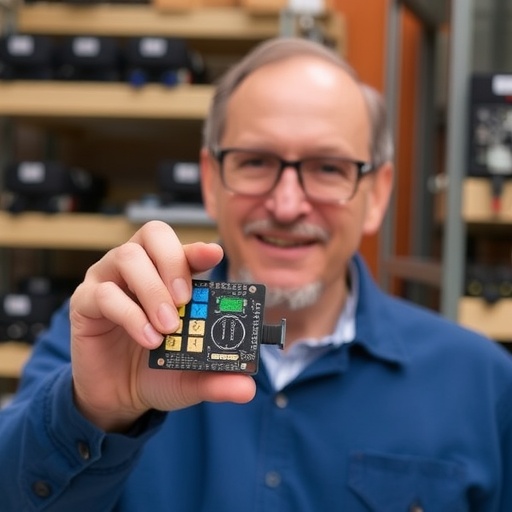
A groundbreaking innovation in environmental monitoring has emerged from the Institute of Experimental Physics at Graz University of Technology (TU Graz), where Birgitta Schultze-Bernhardt and her research team have engineered an advanced ultraviolet (UV) dual-comb spectrometer. This cutting-edge device offers unparalleled precision and sensitivity in detecting gaseous pollutants, including formaldehyde, a harmful chemical compound frequently found in urban and industrial atmospheres. Utilizing dual ultraviolet laser pulses, their spectrometer can measure pollutant concentrations within merely half a second, a feat that sets it apart from previous technologies that were slower and less accurate.
At the core of this spectrometer lies the generation of two ultra-short laser pulses in the ultraviolet spectral range, executed within fractions of a second. When these pulses interact with gas molecules, they trigger electronic excitation that causes the molecules to undergo rovibronic transitions—a complex interplay of rotational, vibrational, and electronic energy changes. Each molecule’s unique rovibronic fingerprint leads to the selective absorption of specific UV frequencies, allowing the spectrometer to unmistakably identify and quantify a vast variety of gaseous pollutants by their distinct spectral signatures.
The first prototype of this UV dual-comb spectrometer, developed over two years ago, marked a monumental milestone as the world’s inaugural instrument of its kind. However, it was originally confined to bulky laboratory setups that limited its practical application beyond research environments. The recent redesign has transformed the apparatus into a remarkably compact unit, approximately the size of a cardboard removal box, making it feasible for mobile use across different environments such as urban centers, industrial zones, and agricultural landscapes. Complementing this compactness, the innovation employs a single laser source that generates the dual laser pulses, which eliminates the need for intricate electronic stabilization and enhances the system’s robustness.
The spectrometer achieves a spectral resolution of 1 gigahertz in detecting UV light frequencies, a remarkable advancement over conventional UV spectrometers. This ultra-high resolution facilitates the capture of molecular absorption patterns at an unprecedented level of detail, allowing researchers to observe spectral features of formaldehyde never before documented experimentally. This development opens new frontiers in molecular spectroscopy, where previously inaccessible fine structures in the UV absorption spectra become accessible, enhancing the understanding of molecular dynamics and environmental chemistry.
One of the most striking outcomes of the spectrometer’s application involves revisiting the long-established rotational constants of formaldehyde. These constants, fundamental parameters that characterize the rotational energy levels of molecules, have been part of physics databases and textbooks since the 1960s. Through their high-resolution measurements, Schultze-Bernhardt’s team discovered discrepancies of up to 15% in these values. Collaborative work with the Harvard-Smithsonian Center for Astrophysics and the expertise of organic chemist Rolf Breinbauer from TU Graz—who provided high-purity formaldehyde samples—enabled the correction of these constants, substantially refining molecular data that underpin much of molecular physics and chemistry.
This advancement bears significant implications for both fundamental research and practical environmental monitoring. The UV dual-comb spectrometer’s capability to accurately identify and quantify semi-transparent gaseous substances holds immense promise for real-time, high-precision surveillance of air quality. Its design permits deployment in varied settings where air pollution and gas leaks pose health and safety risks. Ongoing research efforts aim to extend its functionality to estimate multiple pollutant concentrations simultaneously in a single measurement cycle, which would exponentially increase its utility for comprehensive environmental diagnostics.
The device’s portability and rapid measurement capabilities uniquely position it to revolutionize air quality monitoring in real-world environments. Unlike traditional bulky systems requiring extensive setup and calibration, this spectrometer is expected to empower environmental agencies, industrial operators, and even laypersons to perform reliable air quality assessments with minimal training. Funded in part by a Proof of Concept Grant from the European Research Council, ongoing development focuses on creating user-friendly versions of the UV spectrometer tailored for widespread adoption in companies and monitoring organizations.
The journey toward this technological leap has been supported by significant funding from prominent science funding bodies, reflecting its strategic importance. The Austrian Science Fund (FWF) and the European Research Council have both underpinned the foundational research projects led by Schultze-Bernhardt. Additionally, infrastructural support from NAWI Graz facilitated the creation of the novel laser source crucial to the device’s current compact configuration. Together, this support not only underscores the technology’s innovation but also its alignment with broader scientific and environmental priorities.
This novel UV dual-comb spectrometer stands as a testament to the fusion of sophisticated laser physics, molecular spectroscopy, and environmental science, promising to set a new standard in pollutant detection. By uncovering previously unknown molecular behaviors and enhancing the accuracy of atmospheric measurements, it elevates both academic knowledge and applied environmental monitoring technologies. Its swift response time and robust design suggest future integration in smart-city air quality networks and industrial safety systems, heralding a new era of precision environmental stewardship.
The technology’s fundamental mechanism—utilizing dual frequency combs in the ultraviolet range—enables the spectrometer to directly sample electronic transitions of molecules, a domain traditionally challenging due to the complexity of UV light generation and detection. The simplification achieved by employing a single laser source for dual-comb generation not only reduces device complexity but also improves spectral stability, making the instrument less susceptible to environmental perturbations—a critical factor for field deployment.
Moreover, this spectrometer’s ability to probe rovibronic transitions at such high resolution helps bridge the gap between conventional infrared spectrometry and electronic spectroscopy, providing detailed databases of UV absorption features that have implications beyond atmospheric science. Astrophysics, atmospheric chemistry, and even industrial process monitoring stand to benefit from the enhanced spectral data this instrument can deliver, enabling more accurate modeling and monitoring of molecular interactions in diverse environments.
In conclusion, the advancement of the UV dual-comb spectrometer by Schultze-Bernhardt and her team marks a seminal moment in molecular spectroscopy and environmental sensing. Its rapid, precise, and portable measurement of air pollutants ushers in a powerful tool for addressing urgent challenges related to air quality and human health. As the instrument transitions from laboratory innovation to widespread application, it embodies the promise of laser physics-driven solutions contributing tangibly to global environmental sustainability and scientific discovery.
Subject of Research: Not applicable
Article Title: Free-running ultraviolet dual comb spectroscopy enabling absolute electronic fingerprinting
News Publication Date: 21-May-2026
Web References:
DOI: 10.1186/s43074-026-00250-6
Image Credits: Oliver Wolf – TU Graz
Keywords
UV dual-comb spectrometer, ultraviolet spectroscopy, rovibronic transitions, formaldehyde detection, air pollutant monitoring, molecular spectroscopy, environmental sensing, laser physics, portable spectrometer, atmospheric chemistry, spectral resolution, innovation in spectroscopy
Tags: advanced laser-based spectrometrydual-comb spectroscopy for environmental gasesexperimental physics air sensor developmentformaldehyde detection in urban airhigh-precision ultraviolet dual-comb spectrometerindustrial air quality monitoring toolsmobile air pollutant measurement devicerapid gaseous pollutant sensing technologyreal-time atmospheric pollutant quantificationrovibronic transitions in gas analysisTU Graz environmental monitoring innovationultraviolet laser pulse spectroscopy