
• HOME
  • NEWS
  • EXPLORE
    • CAREER
      • Companies
      • Jobs
    • EVENTS
    • iGEM
      • News
      • Team
    • PHOTOS
    • VIDEO
    • WIKI
  • BLOG
  • COMMUNITY
    • FACEBOOK
    • INSTAGRAM
    • TWITTER
Sunday, May 17, 2026
BIOENGINEER.ORG
No Result
View All Result
  • Login
  • HOME
  • NEWS
  • EXPLORE
    • CAREER
      • Companies
      • Jobs
        • Lecturer
        • PhD Studentship
        • Postdoc
        • Research Assistant
    • EVENTS
    • iGEM
      • News
      • Team
    • PHOTOS
    • VIDEO
    • WIKI
  • BLOG
  • COMMUNITY
    • FACEBOOK
    • INSTAGRAM
    • TWITTER
  • HOME
  • NEWS
  • EXPLORE
    • CAREER
      • Companies
      • Jobs
        • Lecturer
        • PhD Studentship
        • Postdoc
        • Research Assistant
    • EVENTS
    • iGEM
      • News
      • Team
    • PHOTOS
    • VIDEO
    • WIKI
  • BLOG
  • COMMUNITY
    • FACEBOOK
    • INSTAGRAM
    • TWITTER
No Result
View All Result
Bioengineer.org
No Result
View All Result
Home NEWS Science News Biology

TSRI chemists awarded $2.1 million to create potential new therapies with click chemistry

Bioengineer by Bioengineer
February 12, 2018
in Biology
Reading Time: 2 mins read
0
Share on FacebookShare on TwitterShare on LinkedinShare on RedditShare on Telegram
IMAGE

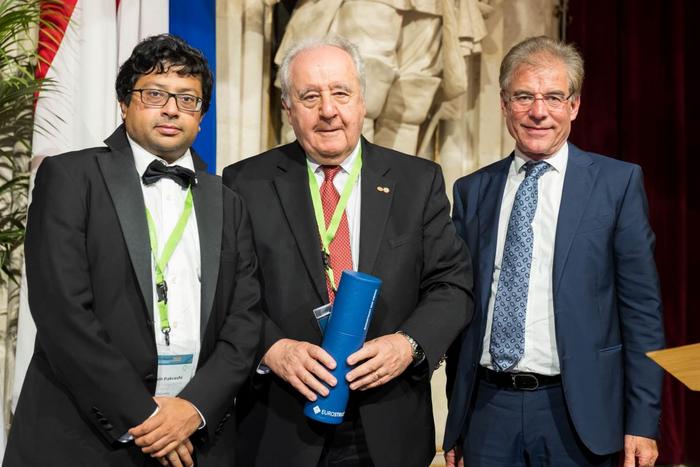
IMAGE: Scripps Research Institute Professor and Nobel laureate Barry Sharpless is principal investigator of the new grant.

Credit: Photo courtesy of The Scripps Research Institute.

LA JOLLA, CA – January 12, 2016 – Scientists at The Scripps Research Institute (TSRI) have received a grant of more than $2.1 million from the National Institutes of Health's National Institute of General Medical Sciences to create and screen a new library of drug candidates.

The researchers will use a branch of click chemistry–a method developed by TSRI Professor and Nobel laureate Barry Sharpless in the mid-1990s for quickly discovering new, or improving existing, chemical function. The new research could lead to novel therapeutics and improved positron emission tomography (PET) protocols for children with neurodevelopmental disorders.

"The idea is to make medicines that are more selective and more potent–letting us use a lower dose for the same effectiveness," said Sharpless, also W.M. Keck Professor of Chemistry and member of the Skaggs Institute for Chemical Biology at TSRI, who will be principal investigator on the four-year project.

TSRI Associate Professor Peng Wu, co-investigator on the new grant, added that the research will take advantage of powerful new gas-based click chemistry reactions developed by the Sharpless lab in 2014. The SuFEx–Sulfur Fluoride Exchange–reactions enable the team to link molecules of their choice together using derivatives of a common commercial chemical considered essentially inert.

"The molecules will only react when they find the right partner," said Wu.

The researchers will use these reactions to create potential "covalent drugs," a class of therapeutics that includes penicillin and aspirin. The team will then explore the molecules' reactivity in zebrafish to identify their potential as therapeutics.

###

The number of the grant is 1R01GM117145.

For more information on the investigators, see the Sharpless [http://www.scripps.edu/research/faculty/sharpless] and Wu [http://www.scripps.edu/research/faculty/pwu] faculty biosketch pages. For more information on SuFEX, see "Chemists Uncover Powerful New Click Chemistry Reactivity" [https://www.scripps.edu/newsandviews/e_20140825/sharpless.html].

Media Contact

Madeline McCurry-Schmidt
[email protected]
858-784-9254
@scrippsresearch

http://www.scripps.edu
Share12Tweet8Share2ShareShareShare2

Related Posts

Uncovering C. elegans Immunity via Genetic Screens — Biology

Uncovering C. elegans Immunity via Genetic Screens

May 16, 2026
Single mother must adapt swiftly — the survival of her colony depends on it — Biology

Single mother must adapt swiftly — the survival of her colony depends on it

May 15, 2026

Why Are Nearly Everyone Right-Handed? It Might Be Linked to How We Learned to Walk

May 15, 2026

Excessive Neuronal Activity Initiates Severe Autoimmune Brain Disorder

May 15, 2026
Please login to join discussion

POPULAR NEWS

  • Research Indicates Potential Connection Between Prenatal Medication Exposure and Elevated Autism Risk

    844 shares
    Share 338 Tweet 211
  • New Study Reveals Plants Can Detect the Sound of Rain

    730 shares
    Share 291 Tweet 182
  • Salmonella Haem Blocks Macrophages, Boosts Infection

    62 shares
    Share 25 Tweet 16
  • Breastmilk Balances E. coli and Beneficial Bacteria in Infant Gut Microbiomes

    58 shares
    Share 23 Tweet 15

About

We bring you the latest biotechnology news from best research centers and universities around the world. Check our website.

Follow us

Recent News

Noncanonical Sulfur Metabolism, Immunity Altered in Down Syndrome

Physical Resilience Linked to Aging Views in Chinese Elders

Tau T205 Phosphorylation Controls Memory and Engrams

Subscribe to Blog via Email

Enter your email address to subscribe to this blog and receive notifications of new posts by email.

Join 82 other subscribers
  • Contact Us

Bioengineer.org © Copyright 2023 All Rights Reserved.

Welcome Back!

Login to your account below

Forgotten Password?

Retrieve your password

Please enter your username or email address to reset your password.

Log In
No Result
View All Result
  • Homepages
    • Home Page 1
    • Home Page 2
  • News
  • National
  • Business
  • Health
  • Lifestyle
  • Science

Bioengineer.org © Copyright 2023 All Rights Reserved.