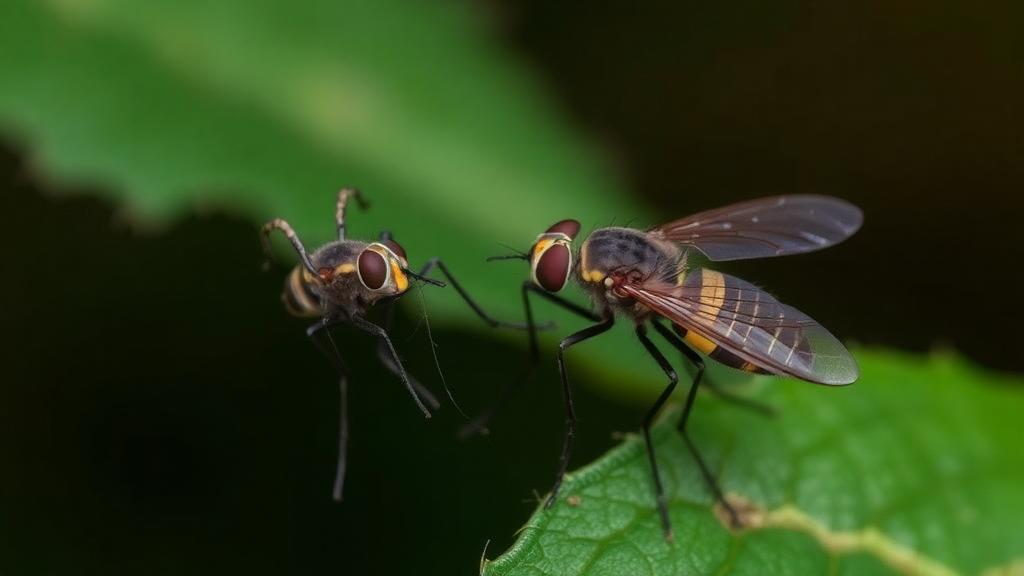
Deep inside two of Mozambique’s most celebrated national parks, and in the farmland that presses against their boundaries, tsetse flies are quietly carrying a burden of parasites that scientists have now mapped in unprecedented molecular detail. A research team led by Denise R. A. Brito of Eduardo Mondlane University’s Biotechnology Centre, working with collaborators in South Africa, Mexico, France and Côte d’Ivoire, has produced one of the most comprehensive snapshots to date of the vector–host–parasite network that drives African animal trypanosomoses at the fragile boundary between conservation land and agriculture. The study, published in the open-access journal Parasites & Vectors, sequenced DNA from hundreds of wild-caught flies to reveal which trypanosome species they harbour, which animals they feed on, and which bacteria share their bodies.
African animal trypanosomoses, caused by single-celled protozoan parasites of the genus Trypanosoma and transmitted exclusively through the bite of tsetse flies of the genus Glossina, remain one of the most formidable constraints on livestock productivity across sub-Saharan Africa. The disease devastates cattle herds, undermines plough-based agriculture, and imposes economic losses that ripple through rural communities already living at the edge of poverty. What makes the problem especially intractable is the ecology: tsetse flies feed on a wide range of vertebrate hosts, including wildlife that can carry trypanosomes without apparent illness, meaning that protected areas can act as reservoirs from which infection spills over into domestic animals and, occasionally, into people themselves.
Mozambique is a particularly instructive place to study this dynamic. The country harbours four main tsetse species, and pathogenic trypanosomes circulate widely in both wildlife and livestock. As human populations grow and agricultural activity intensifies around the edges of national parks, the interfaces where people, cattle, and wild animals meet have expanded, raising the risk of disease transmission in both directions. To understand exactly what is happening at these contact zones, the team concentrated its fieldwork on two contrasting landscapes: Maputo National Park in the south of the country and Gorongosa National Park in the centre, together with the agricultural buffer zones that surround each protected area.
The field effort was substantial. Using traps deployed inside the parks and in their buffer zones, the researchers collected 2,291 tsetse flies representing four species: Glossina austeni, Glossina brevipalpis, Glossina morsitans and Glossina pallidipes. Each specimen was identified using standard taxonomic keys, and a subsample of 200 flies was then selected for whole-body DNA extraction. From that genetic material, the team amplified and sequenced several molecular barcodes, targeting the internal transcribed spacer region to identify trypanosomes, mitochondrial markers to trace blood meal sources, and the 16S ribosomal RNA gene to profile the bacterial microbiome living inside each fly.
The trypanosome results were striking. Overall infection prevalence ranged from 65 to 90 percent depending on the fly species, an extraordinarily high parasite burden that underscores how intensively trypanosomes circulate in these landscapes. Seven distinct Trypanosoma species or subspecies were detected across the sampled flies. Trypanosoma brucei, the species group that includes the parasites responsible for human sleeping sickness, was the most abundant, found in 35 percent of flies, followed by Trypanosoma godfreyi at 20 percent. The team also identified Trypanosoma congolense Kilifi, Trypanosoma congolense Savannah, Trypanosoma simiae, Trypanosoma simiae Tsavo and Trypanosoma vivax, a roster that spans the full spectrum of parasites responsible for wasting diseases in cattle, pigs and other livestock.
Just as revealing was the blood meal analysis. By sequencing host DNA remaining in the flies’ guts, the researchers identified 17 different vertebrate host species, with wildlife predominating over domestic animals. Two hosts stood out at the top of the list: warthogs accounted for 26 percent of identified blood meals, and humans accounted for 25 percent. That human blood appears so frequently in the diet of these flies is a sobering finding, because it demonstrates that the ecological circuit connecting wild reservoirs, vectors and people is not hypothetical but an everyday occurrence. Cattle and other domestic animals also featured among the identified sources, confirming that livestock are woven into the same transmission network rather than standing apart from it.
The microbiome profiling added a third layer to the picture. Inside the flies, the dominant bacterial symbionts were Wigglesworthia and Wolbachia, two genera with well-known roles in tsetse biology. Wigglesworthia is an obligate mutualist housed in specialised bacteriomes that supplies nutrients the fly cannot obtain from its blood-only diet, and it has been implicated in vector competence and fertility. Wolbachia, by contrast, is a notorious reproductive manipulator that can bias host sex ratios and is being explored worldwide as a tool for controlling insect-borne diseases. Mapping which bacteria coexist with which parasites in which fly species provides raw material for future biocontrol strategies that might exploit these internal partnerships.
Perhaps the most important analytical finding concerns what actually shapes this entire system. When the researchers modelled the relationships among trypanosome diversity, host selection and microbiome composition, they found that the species of tsetse fly was the dominant explanatory factor, while location, meaning the difference between the parks and their surrounding buffer zones, played only a secondary role. In other words, the biology of the vector itself, rather than the immediate landscape it inhabits, is the strongest organising force in the transmission cycle. A constrained ordination analysis of blood meal variation showed that tsetse species together explained 96 percent of the total variance in community composition, a statistically significant association that highlights how tightly each fly species is bound to its own host preferences and parasite suite.
This species-level structure has practical consequences. Different Glossina species occupy different ecological niches, prefer different hosts, and harbour different combinations of trypanosomes, so a single blanket intervention is unlikely to succeed everywhere. Control programmes in the Gorongosa region, where G. morsitans and G. pallidipes dominate, may need different tactics from those around Maputo, where G. austeni and G. brevipalpis prevail. The finding that wildlife, particularly warthogs, sustain so many blood meals suggests that reservoir management and vector control must be designed together, and the prominence of humans in the blood meal record argues for surveillance of human African trypanosomosis even in areas where it is not currently considered a major clinical problem.
The study’s authors frame their results within a One Health perspective, the recognition that human, animal and environmental health are inseparable. By documenting the full diversity of vectors, parasites, hosts and microbes at the conservation–agriculture interface, the research provides the evidence base needed to design targeted, locally appropriate control strategies rather than generic ones. Funded by the European Union’s Horizon 2020 programme through the COMBAT project, which aims to control and progressively minimise the burden of animal trypanosomosis, the work demonstrates how molecular tools can transform our understanding of neglected tropical disease systems. As agricultural frontiers continue to press against Africa’s protected areas, studies like this one make clear that the fate of livestock, wildlife and people will be decided in the shared landscapes between them, one tsetse bite at a time.
Subject of Research: Tsetse fly-borne trypanosome transmission, blood meal hosts and microbiome diversity at wildlife–livestock–human interfaces in Mozambique
Article Title: Tsetse flies, trypanosomes, hosts and microbiome diversity at agricultural–conservation interfaces in Mozambique
Article References: Brito, D. R. A., Mulandane, F. C., Cossa, N. V., Mucache, H. N., Moo-Millan, J. I., Manzanilla, V., Boulangé, A., Waleckx, E., & Neves, L. (2026). Tsetse flies, trypanosomes, hosts and microbiome diversity at agricultural–conservation interfaces in Mozambique. Parasites & Vectors. https://doi.org/10.1186/s13071-026-07660-2
Image Credits: AI Generated
DOI: 10.1186/s13071-026-07660-2
Keywords: tsetse flies, trypanosomes, African animal trypanosomosis, Mozambique, Glossina, blood meals, microbiome, Wigglesworthia, Wolbachia, One Health, wildlife reservoirs, metabarcoding
News Source: Margaret Porter. (October 6, 2026). Tsetse flies in Mozambique reveal hidden web of parasites, hosts and microbes. Scienmag.