Urban trees have long been heralded as a vital tool in combating the escalating urban heat island (UHI) effect, a phenomenon where metropolitan areas experience significantly higher temperatures than their rural surroundings. A landmark study, recently published in Nature Communications by McDonald, Chakraborty, Endreny, and colleagues, has provided a comprehensive global assessment of urban forests’ dual role in mitigating heat stress while revealing the nuanced and unequal distribution of these benefits across different urban landscapes. Their work, groundbreaking in its scope and detail, illuminates both the promise and limitations of urban tree planting as a climate adaptation strategy in the era of global warming.
The study harnessed extensive multi-source datasets, including high-resolution satellite imagery, climate models, and urban vegetation inventories, to quantify the cooling effects of trees across hundreds of cities worldwide. The researchers implemented a robust analytical framework that juxtaposed observed urban temperature variances against modeled scenarios accounting for urban canopy cover. This scientific convergence allowed for an unprecedented precision in attributing temperature reductions directly to urban tree presence, thereby underscoring the tangible impact of urban greening initiatives on mitigating UHI intensity.
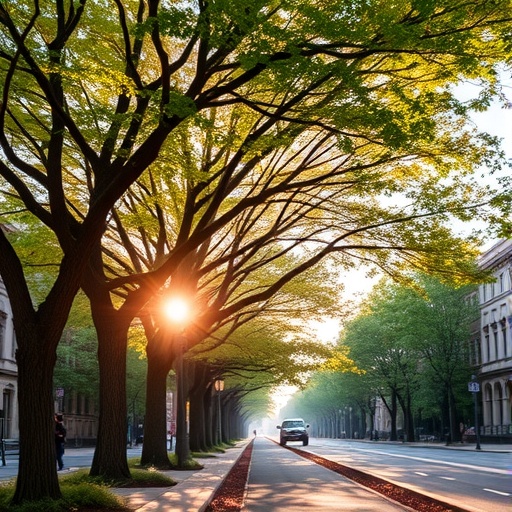
One of the study’s most striking revelations is that trees effectively halve the intensity of the urban heat island effect globally. This finding carries profound implications for urban planners and climate policy architects. In practical terms, where urban areas could experience temperature elevations of 4 to 6 degrees Celsius above neighboring rural zones, the presence of dense tree canopies can reduce this temperature spike by approximately 50 percent. This attenuation is not only a matter of comfort but crucially impacts human health, energy consumption, and air quality in dense population centers.
Despite these encouraging findings, the study highlights a critical disparity in how these benefits are distributed across global cities. In many urban centers, particularly in the Global South, urban forestry coverage remains sparse, and the cooling benefits are confined to wealthier districts or those already endowed with better green infrastructure. This unequal distribution exacerbates environmental injustices, accentuating heat vulnerability among marginalized and economically disadvantaged communities who suffer disproportionally from both heat stress and limited access to green spaces.
The researchers further integrated climate warming projections into their analysis, evaluating how the mitigating effects of urban trees interact with broader anthropogenic climate change. Here, the results were sobering. While trees provide substantial relief from localized heat amplification, their cooling capacity only modestly offsets the trajectory of global warming. This indicates that urban greening should be viewed as a complementary adaptation strategy, not a standalone solution, necessitating parallel aggressive reductions in greenhouse gas emissions to effectively confront climate warming.
Within the technical fabric of their methodology, the team employed advanced machine learning techniques to parse satellite-derived thermal imagery, isolating urban land cover types and quantifying vegetative fractions at granular scales. Such technical precision allowed the researchers to capture diurnal temperature variations and to dissect the underlying biophysical mechanisms by which trees modulate urban thermal dynamics, including shade provision and evapotranspiration.
The interplay between urban heat mitigation and energy savings was also a noteworthy focus. By cooling urban microclimates, trees reduce cooling demand in buildings, thereby lowering electricity consumption and concomitant carbon emissions from air conditioning. This feedback loop enhances the sustainability profile of urban forests, positioning them as multifaceted agents within urban climate resilience frameworks.
Moreover, the authors discuss species selection and tree placement as critical levers influencing the efficacy of urban greening programs. Not all trees provide equal cooling benefits; factors such as canopy density, leaf albedo, and water use efficiency critically modulate cooling potential. Consequently, urban forestry strategies oriented by ecological insights become indispensable for maximizing environmental dividends.
The study advances the discourse on social-ecological urban resilience by linking ecological data with socio-economic metrics. High-resolution mapping of tree cover juxtaposed with neighborhood income levels and public health indices revealed patterns of green space inequality that policymakers must urgently address. This integrative approach advances equitable urban planning by embedding environmental justice considerations into urban greening agendas.
Expanding beyond the typical city scale, the researchers employed global atmospheric circulation models refined to account for local land use, enabling them to extrapolate urban heat mitigation effects and their interaction with regional climate feedbacks. This multi-scalar analysis sets new standards for urban climate science, bridging the gap between localized interventions and global climate phenomena.
In synthesizing these findings, the authors articulate a nuanced narrative acknowledging the powerful cooling benefits of urban trees while cautioning against overreliance on tree planting to combat systemic climate challenges. They advocate for integrated urban policies that combine green infrastructure with other adaptive and mitigative strategies, including sustainable urban design, energy efficiency, and emission controls.
This study’s implications are vast and timely. As cities worldwide grapple with intensifying heat waves and their associated health, economic, and ecological impacts, the message is clear: investing in urban forests is essential but must be coupled with concerted efforts to address socio-economic disparities and global emission trajectories. The urban tree emerges as both a symbol and a practical instrument of climate adaptation, but its powers are bounded by complex socio-political and environmental realities.
Further research, the authors suggest, should focus on refining species-specific cooling models, exploring the integration of urban water management with greening, and expanding community engagement to foster stewardship and equitable access to tree-lined urban environments. Such interdisciplinary inquiries will be vital to harnessing the full potential of urban ecosystems in mitigating climate impacts.
As climate change accelerates, the synergy between urban nature and human systems assumes existential significance. McDonald and colleagues’ study provides an urgently needed scientific foundation that can inform policy, inspire community action, and guide the strategic deployment of urban trees worldwide. The notion that cities can “green” their way out of the climate crisis is nuanced but promising, hinging on equity, scientific rigor, and holistic planning.
The growing body of evidence from this study underscores the imperative to recognize urban forests not merely as amenities but as critical infrastructure within urban climate resilience strategies. Their cooling influence, pollutant filtration, carbon sequestration, and biodiversity support collectively enhance urban sustainability and livability, shaping the future of cities in a warming world.
In conclusion, while urban trees alone cannot stall climate warming, they halve the urban heat island effect globally, offering both measurable environmental and socio-economic benefits. Addressing the unequal distribution of these benefits and embedding urban greening within broader climate action agendas remains paramount for realizing their full potential. This research charts a hopeful yet realistic path forward, blending ecological science with social equity to confront the challenges of urban heat and climate change.
Article References:
McDonald, R.I., Chakraborty, T., Endreny, T.A. et al. Trees halve urban heat island effect globally but unequal benefits only modestly mitigate climate-change warming. Nat Commun 17, 3569 (2026). https://doi.org/10.1038/s41467-026-71825-x
Image Credits: AI Generated
DOI: https://doi.org/10.1038/s41467-026-71825-x
Tags: climate change urban strategiesclimate resilience urban forestsenvironmental justice urban greeningglobal urban heat studyheat stress reduction citiesmulti-source climate data analysissatellite imagery urban vegetationunequal climate adaptation benefitsurban canopy cover impacturban forest temperature reductionurban heat island mitigationurban tree cooling effects