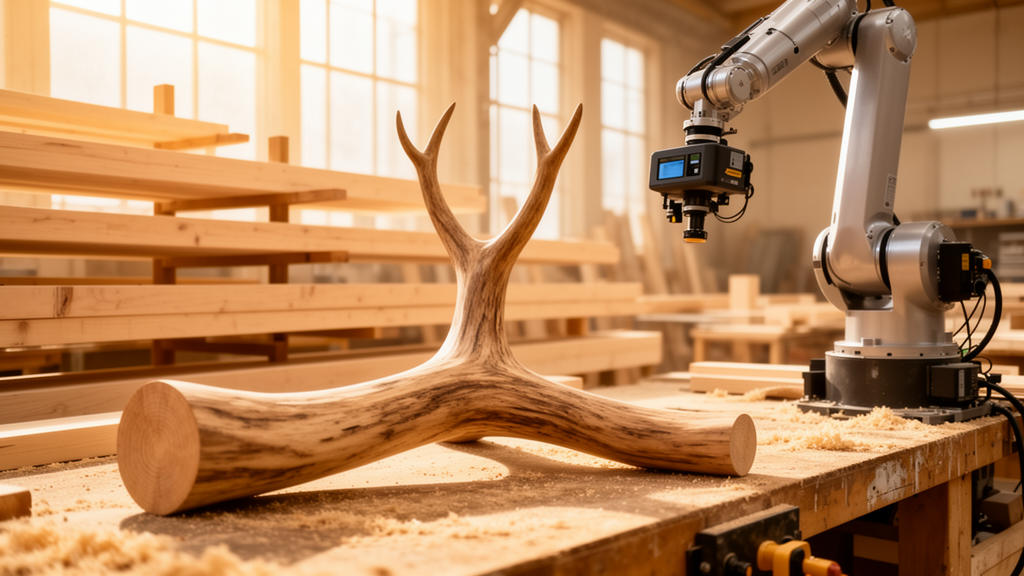
Tree forks, the irregular junctions that forests and city gardens usually discard or burn for energy, can be turned into load-bearing structural nodes through a computational workflow that matches scanned wood geometry to digitally generated structures. That is the central finding of a new open-access study published in the journal Architectural Intelligence, in which researchers Raman Suliman, Kevin Moreno Gata and Martin Trautz describe a parametric pipeline that takes raw, angular timber elements from a locally sourced inventory and drives the configuration, node geometry and element assignment of spatial frame structures directly from their measured fork angles.
The motivation is resource efficiency. The authors note that demand for timber in construction is rising while annual output remains limited, and that in 2022 Germany’s forests covered 29.9 percent of the land and produced 78.7 million cubic meters of wood annually. Harvested wood is sorted into categories such as stem wood, industrial wood, energy wood and non-utilizable material, with straight tree stems prioritized for construction. Irregularly shaped wood, including tree forks and curved branches, is typically left to decompose or used in thermal energy production. Rather than curating material to fit predefined geometric requirements, an approach the authors argue would systematically exclude large portions of the available resource, their method treats natural variability as a design input and addresses material efficiency at the scale of the whole resource pool.
The workflow, implemented in Rhinoceros 3D and Grasshopper 3D, comprises three main stages. First, timber elements were harvested directly from trees in a nearby forest or collected from offcuts at a city gardening center, with wood species, cross-section, crack patterns and moisture content recorded. Second, a digital material library was generated using 3D scanning with an LED structured-light scanner, producing meshes from which key features such as element angularity were extracted numerically. Third, the extracted features guided the formation of node configurations and spatial patterns, with a matching process based on the Hungarian algorithm pairing each node segment with a specific element, and fabrication data exported to a database with identifiers for tracking and production.
The geometric analysis treats bifurcations and curved branches as two separate typologies. For bifurcations, mesh models are imported, smoothed, and their centerlines extracted for each branch; the centerlines of paired branches are joined to produce a representative curve for the grain flow, capturing at least three potential use cases per fork. Cross-sections are estimated along each centerline path, and the angle between branch ends is calculated with reference to the bifurcation point. For curved branches, a continuous centerline is divided into one-millimeter sub-segments, curvature radii are extracted at each point, and averaged over overlapping regions to damp outliers before angles are documented. The resulting library entries are sorted by angular size into 5-degree intervals spanning 0 to 180 degrees, an interval chosen as the tolerance for how far wood grain may deviate from an ideal structural path within a node segment, and plotted as a histogram of the inventory.
On the design side, the researchers define structures as assemblies of nodes and webs, with node layouts oriented to wood orthotropy so that bending actions are carried primarily along the grain. A Grasshopper algorithm starts from randomly distributed points, selects one as a primary node center, connects neighbors with webs, and generates a convex hull whose triangulated mesh edges define reference curves and, from these, the polyline geometry of each node segment. The angle between primary and secondary vectors at each segment defines the angular characteristic required of the raw timber piece. Because node geometry depends on relative node position, the researchers made node positioning itself a driver in a subsequent multi-objective optimization, alongside load-bearing behavior and angular compatibility.
That optimization compares the angle distribution of the material library with that of the generated structure, both grouped in 5-degree increments, and minimizes the sum of absolute differences between corresponding groups. A second criterion extracts maximum deformation values from global simulations across multiple load scenarios. Applied across wall-, tower-, ceiling- and bridge-like typologies, the process showed that asymmetrical structural forms often improved compatibility in later stages; the second iteration produced a notable reduction in incompatibility, and the third delivered subtler further refinement. A hybrid triangular-and-square strategy led to a rectangular base pattern balancing stability against segmentation complexity, later adjusted into parallelogram grids with 45- and 135-degree angle pairings and stacked into multi-layer interlocking grids connected by diagonal cross-webs.
Three prototypes were fabricated from 16 bifurcations selected from the library of 60 samples. The first, a single element, benchmarked the available tools and tested how timber deforms and cracks after milling. The second proved three concepts: joining node segments with double-threaded screws, tilting bond surfaces so segments conform to curved surfaces, and using corrugated bond surfaces to improve assembly and stability. The third implemented full node pairing and exposed real shortcomings: forks with small angular values caused alignment and balance issues because shallow angles displace more wood mass farther from the node center, and the two-step milling workflow scaled poorly, producing significant misalignments in 4 of the 16 elements. The matching process, the authors conclude, also needs to consider dimensional consistency between elements assigned to the same node.
Fabrication relied on standard 3-axis CNC equipment, a deliberate choice to broaden applicability compared with robotic multi-axis strategies. Because the 16-millimeter end mill allows only 60 millimeters of milling depth, elements are processed in two steps and limited to a maximum thickness of 12 centimeters. Adhesive bonding was not prioritized as the primary connection because irregular three-dimensional fork geometries make controlled tolerances and pressure distribution during curing difficult; traditional joinery was rejected for excessive subtraction of structural cross-section. The final solution combines mechanical fastening with double-threaded screws, whose double threads generate pressure between bonding surfaces, and tailored corrugated bonded surfaces that mainly support geometric registration, since the corrugation direction runs perpendicular to the grain and locally interrupts fibers. Node-to-web connections are completed on site with perforated metal bands tensioned by threaded rods. Elements with diameters between 15 and 20 centimeters proved optimal: larger ones exceeded equipment capacity, smaller ones lacked sufficient cross-section for the screw connections.
The authors are careful about scope. A full quantitative structural validation lies beyond this initial investigation, and the prototypes offer a preliminary assessment under real material and fabrication constraints; fabrication speed, connection precision and the scalability of the two-step milling remain the primary constraints to resolve, with testing planned on a substantially larger sample set. Still, the study demonstrates the feasibility of combining computational design with the variability of raw timber to reduce waste. In the longer term, the authors argue, material availability described through statistical distributions of key characteristics allows substitution within neighboring material categories, and recurring fork-angle patterns can become generative inputs that shape architectural and structural strategies over time rather than merely evaluative metrics.
Subject of Research: A parametric design and fabrication workflow that converts scanned tree bifurcations into structural nodes for timber construction
Article Title: From branch to fabrication: investigating natural tree bifurcation for structural node design
Article References: Suliman, R., Moreno Gata, K., & Trautz, M. (2026). From branch to fabrication: investigating natural tree bifurcation for structural node design. Architectural Intelligence, 5(1), Article 18. https://doi.org/10.1007/s44223-026-00130-w
Image Credits: AI Generated
DOI: 10.1007/s44223-026-00130-w
Keywords: timber construction, tree bifurcations, parametric design, digital fabrication, structural nodes, 3D scanning, multi-objective optimization, sustainable materials, CNC milling, Hungarian algorithm, wood geometry, prototyping
News Source: Denise Maddox. (October 29, 2026). Tree Forks Become Structural Nodes in Parametric Timber Construction Workflow. Scienmag.