• HOME
  • NEWS
  • EXPLORE
    • CAREER
      • Companies
      • Jobs
    • EVENTS
    • iGEM
      • News
      • Team
    • PHOTOS
    • VIDEO
    • WIKI
  • BLOG
  • COMMUNITY
    • FACEBOOK
    • INSTAGRAM
    • TWITTER
Monday, May 11, 2026
BIOENGINEER.ORG
No Result
View All Result
  • Login
  • HOME
  • NEWS
  • EXPLORE
    • CAREER
      • Companies
      • Jobs
        • Lecturer
        • PhD Studentship
        • Postdoc
        • Research Assistant
    • EVENTS
    • iGEM
      • News
      • Team
    • PHOTOS
    • VIDEO
    • WIKI
  • BLOG
  • COMMUNITY
    • FACEBOOK
    • INSTAGRAM
    • TWITTER
  • HOME
  • NEWS
  • EXPLORE
    • CAREER
      • Companies
      • Jobs
        • Lecturer
        • PhD Studentship
        • Postdoc
        • Research Assistant
    • EVENTS
    • iGEM
      • News
      • Team
    • PHOTOS
    • VIDEO
    • WIKI
  • BLOG
  • COMMUNITY
    • FACEBOOK
    • INSTAGRAM
    • TWITTER
No Result
View All Result
Bioengineer.org
No Result
View All Result
Home NEWS Science News Chemistry

Treasure hunt in hot springs?

Bioengineer by Bioengineer
April 14, 2023
in Chemistry
Reading Time: 2 mins read
0
Overview of rare earth recovery using P-yeast
Share on FacebookShare on TwitterShare on LinkedinShare on RedditShare on Telegram

The demand for precious metals and rare earths is expected to continue increasing in the future. Due to limited production areas, recycling from precision equipment and recovering from seawater and hot spring water are needed to ensure a stable supply.
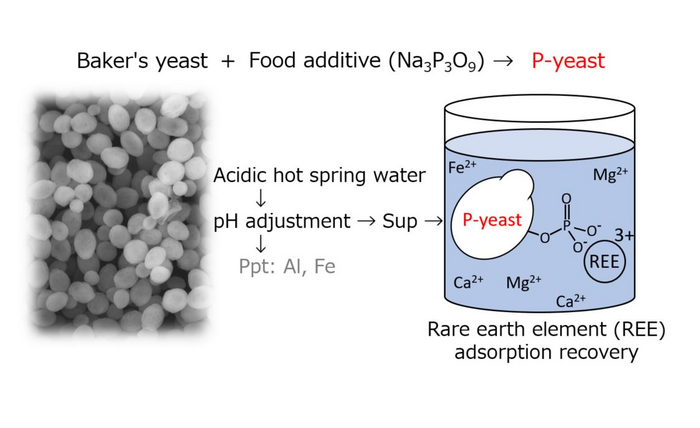
Overview of rare earth recovery using P-yeast

Credit: Masayuki Azuma, Osaka Metropolitan University

The demand for precious metals and rare earths is expected to continue increasing in the future. Due to limited production areas, recycling from precision equipment and recovering from seawater and hot spring water are needed to ensure a stable supply.

A research group led by Professor Masayuki Azuma and Associate Professor Yoshihiro Ojima of the Osaka Metropolitan University Graduate School of Engineering has successfully developed an adsorbent material that can selectively recover rare earth elements (REEs) using environmentally friendly and inexpensive baker’s yeast and trimetaphosphate, which is used as a food additive.

The research group conducted experiments using synthetic seawater and hot spring water to evaluate the performance of this material in a real environment. As a result, it was confirmed that the material can selectively adsorb REEs even when using hot spring water with an REE concentration of several to several tens of ppb (μg/L) and a very high content of other components.

“This new technology is expected to contribute to the realization of a metal resource-circulating society and a safe society through environmental purification. In the future, we will continue to conduct experiments on a variety of environmental water with the aim of establishing a system capable of treating large quantities of metal resources through continuous operation,” said Professor Azuma.

The results were published in the Environmental Technology & Innovation.

###

About OMU 

Osaka Metropolitan University is a new public university established in April 2022, formed by merger between Osaka City University and Osaka Prefecture University. For more research news visit https://www.omu.ac.jp/en/ or follow @OsakaMetUniv_en and #OMUScience.


Journal

Environmental Technology & Innovation

DOI

10.1016/j.eti.2023.103093

Method of Research

Experimental study

Subject of Research

Not applicable

Article Title

Adsorption of rare earth ions from synthetic seawater and hot spring water using phosphorylated yeast

Article Publication Date

2-Mar-2023

Share12Tweet8Share2ShareShareShare2

Related Posts

Miniature Sensor Uses Light to Detect Touch — Chemistry

Miniature Sensor Uses Light to Detect Touch

May 8, 2026
Iron Minerals Determine Whether Dissolved Organic Matter Fuels Microbes or Becomes Long-Term Carbon Storage — Chemistry

Iron Minerals Determine Whether Dissolved Organic Matter Fuels Microbes or Becomes Long-Term Carbon Storage

May 8, 2026

Kate Evans Appointed Associate Lab Director for Biological and Environmental Systems Science at ORNL

May 8, 2026

Advancing Multiscale Modeling and Overcoming Operational Challenges in Autothermal CO₂-to-Methanol Reactors

May 8, 2026

POPULAR NEWS

  • Research Indicates Potential Connection Between Prenatal Medication Exposure and Elevated Autism Risk

    840 shares
    Share 336 Tweet 210
  • New Study Reveals Plants Can Detect the Sound of Rain

    727 shares
    Share 290 Tweet 181
  • Salmonella Haem Blocks Macrophages, Boosts Infection

    61 shares
    Share 24 Tweet 15
  • Breastmilk Balances E. coli and Beneficial Bacteria in Infant Gut Microbiomes

    57 shares
    Share 23 Tweet 14

About

We bring you the latest biotechnology news from best research centers and universities around the world. Check our website.

Follow us

Recent News

New Post-Hoc Analysis Explores Daily Oral Orforglipron Use in Adults Over 65 with Obesity, Regardless of Diabetes Status

Evaluating Digoxin Use in Patients with Symptomatic Rheumatic Heart Disease

Evaluating the Effectiveness and Safety of Digitalis Glycosides in Treating Heart Failure

Subscribe to Blog via Email

Enter your email address to subscribe to this blog and receive notifications of new posts by email.

Join 82 other subscribers
  • Contact Us

Bioengineer.org © Copyright 2023 All Rights Reserved.

Welcome Back!

Login to your account below

Forgotten Password?

Retrieve your password

Please enter your username or email address to reset your password.

Log In
No Result
View All Result
  • Homepages
    • Home Page 1
    • Home Page 2
  • News
  • National
  • Business
  • Health
  • Lifestyle
  • Science

Bioengineer.org © Copyright 2023 All Rights Reserved.