Credit: Wolfgang Rutkies
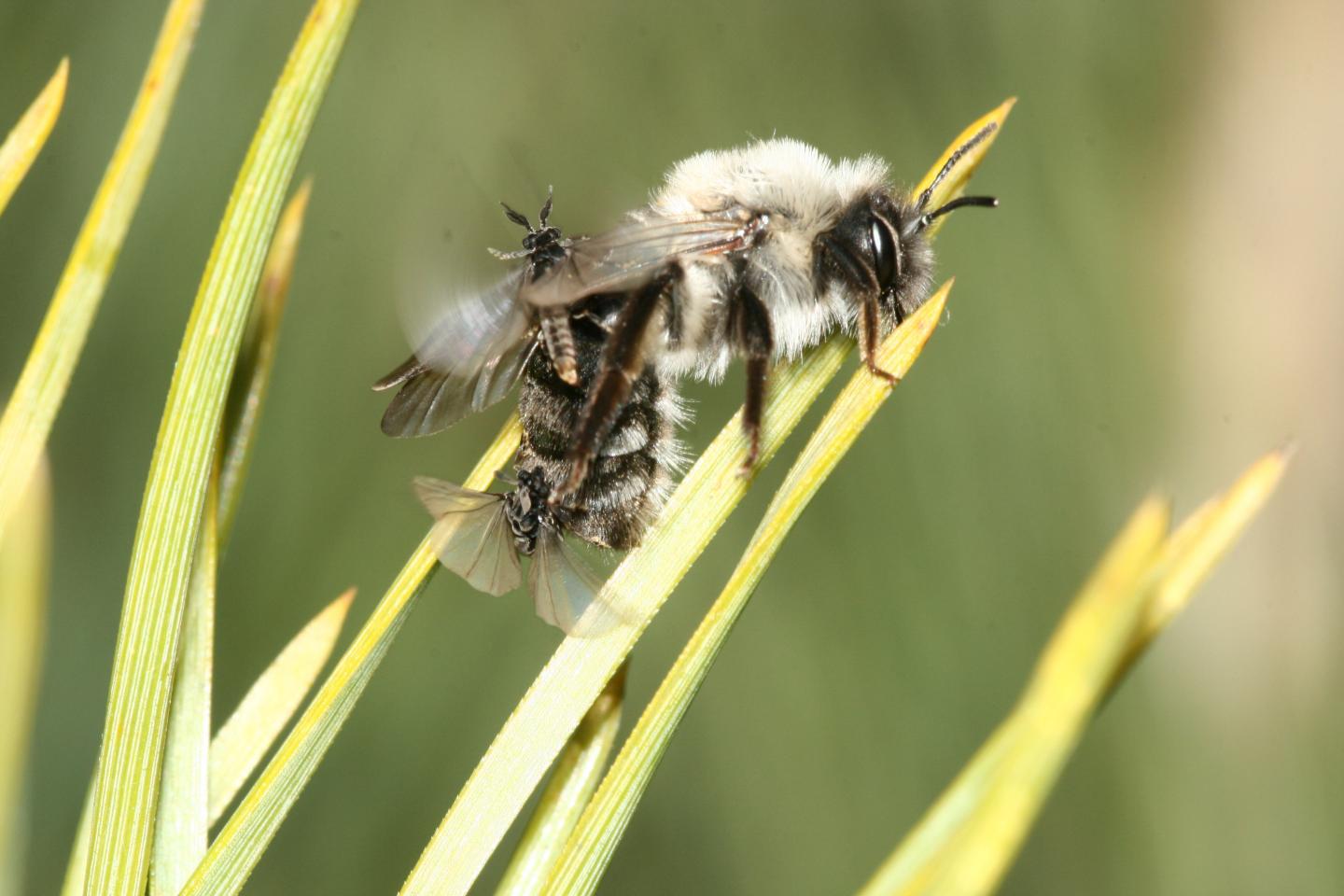
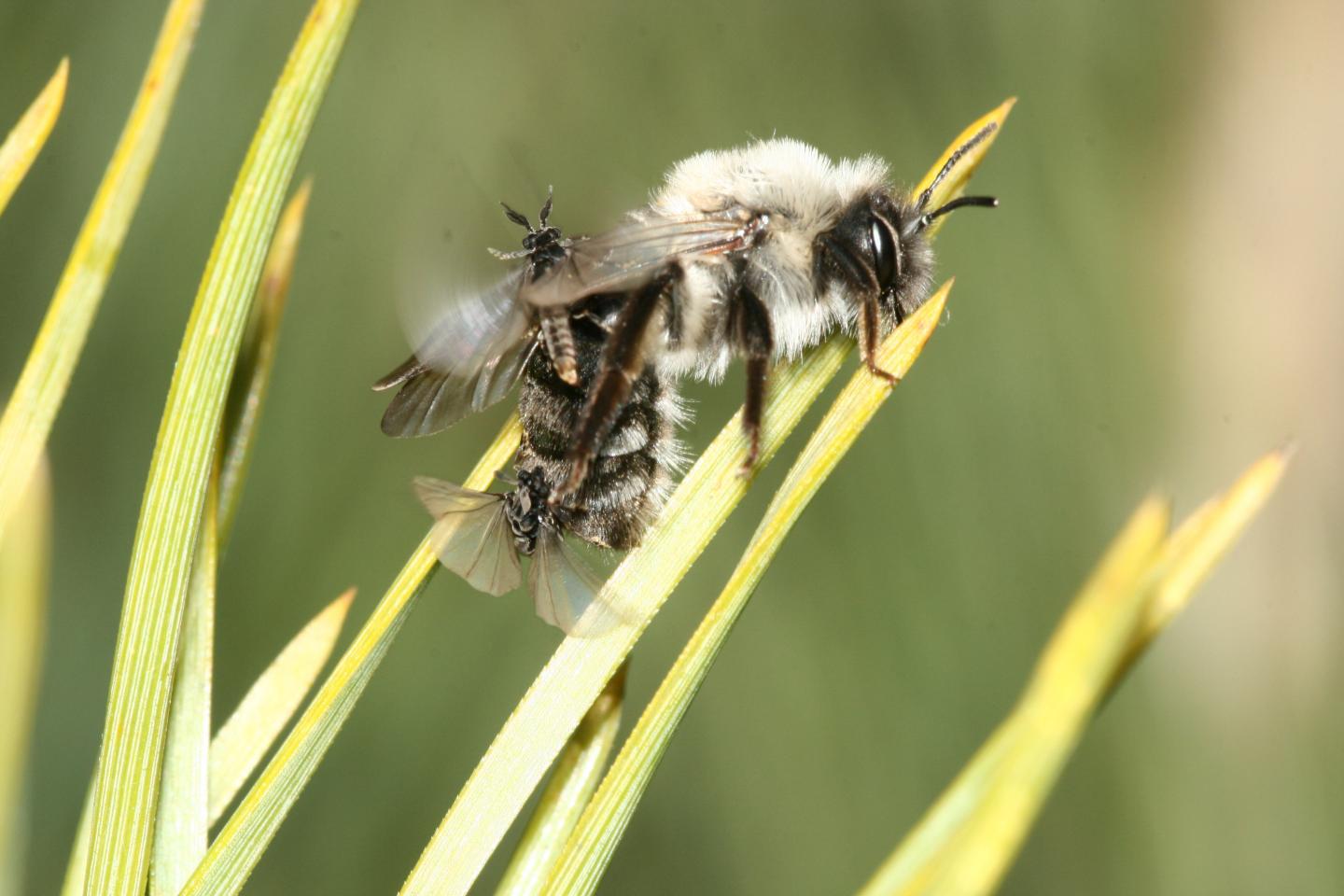
Jena (Germany) With the arrival of spring many insects leave their winter quarters. Presently swarms of the mining bee (Andrena vaga) emerge along sandy river valleys. These whitish-grey haired wild bees live in galleries and cavities in the ground. They feed on nectar and pollen mostly collected from willow trees. "Sometimes the first bees come out very early, weeks before it would actually be their time," says PD Dr Hans Pohl of the Friedrich Schiller University Jena (Germany). This usually indicates that the insects are infested by specific parasites, explains the entomologist. The native twisted-winged parasites (Strepsiptera) use the wild bees as 'incubators' for their own offspring – in a quite ruthless manner. Hans Pohl and his scientific collaborators from Jena and Kiel describe the bizarre mating act of the strepsipteran species Stylops ovinae in the newly published online edition of the Scientific Reports (DOI: 10.1038/srep25052). It is the first time that this process has been described and examined in detail by scientists.
The females of these insects, measuring only a few millimetres, live as parasites in the abdomen of the mining bee. Almost their entire body is hidden inside of the host, with only the pinhead-sized sclerotized fore body protruding from the bee's body wall. "To inseminate the female, the twisted-winged parasite attaches to the bee's abdomen and pushes its hook-shaped penis into the females neck region," as Miriam Peinert explains the brutal procedure. "After this the sperm fertilize many thousand egg cells in the body cavity of the female which then develop into extremely small larvae." The MSc candidate of the Entomology Group at the Phyletic Museum Jena is the first author of the study, which was the topic of her bachelor thesis at Jena University.
Some weeks after that the larvae leave the female which does not survive the birth. The "mother" is virtually eaten alive, providing her body as an investment in her offspring. Generally the adults of the twisted-winged parasites serve only one purpose: to reproduce – and in the case of the males as fast as possible. They are free living, very active, with excellent flying abilities, and they live only for few hours. Within this very limited life span they have to find a female and mate. Surprisingly, once the contact is established, Stylops ovinae couples invest an unusually protracted time span with the act. It lasts up to 30 minutes, probably to reduce the sperm competition with other males.
In their new study the Jena entomologists have analyzed the mating act for the first time using high resolution scanning electron microscopy and micro- computed tomography. As pointed out by Dr Pohl "the detail images show clearly that we are dealing with a traumatic insemination directly into the body cavity". Until now it was assumed that the fertilization takes place via the birth canal – without any injury. The new interpretation is also clearly confirmed by histological sections of high quality. A specialized invagination or fertilizing pocket with a modified integument was identified on the fore body of the female, where the males inject the semen. This probably reduces the cost of traumatic insemination for the female, as it was also observed in the ectoparasitic bedbugs.
###
Original Publication: Miriam Peinert et al. Traumatic insemination and female counter-adaptation in Strepsiptera (Insecta). Scientific Reports (2016), DOI: 10.1038/srep25052 http://www.nature.com/articles/srep25052
Contact:
PD Dr Hans Pohl, Miriam Peinert
Institute of Systematic Zoology and Evolutionary Biology with Phyletic Museum
Friedrich Schiller University Jena
Erbertstr. 1, 07743 Jena
Germany
Phone: ++49 3641 949156
Email: [email protected]
Media Contact
Ute Schoenfelder
[email protected]
http://www.uni-jena.de