


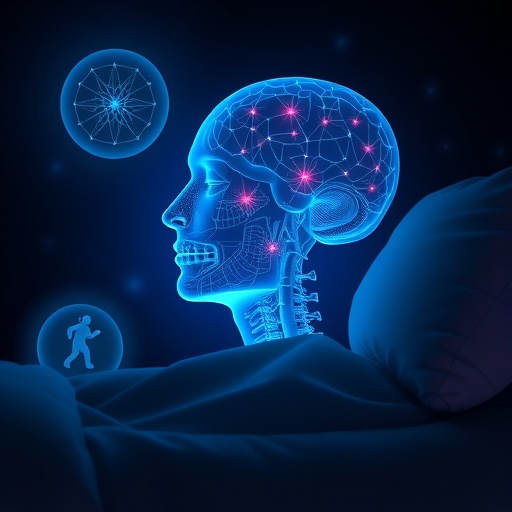
A new artificial intelligence model has found that a routine overnight sleep study may contain far more information about a patient’s future health than clinicians currently use. In a study published in Nature Communications on August 3, researchers reported that AI could analyze the complex physiological signals recorded during sleep and identify hidden patterns associated with heart disease, cognitive decline and mortality. The model divided patients into distinct risk groups, revealing differences that were not apparent through conventional sleep medicine measures.
The most striking result involved survival. Patients classified by the model as belonging to the highest-risk group faced twice the risk of dying within five years compared with those in the lowest-risk category. This separation was not captured by the apnea-hypopnea index, or AHI, the standard clinical measure used to assess obstructive sleep apnea. AHI primarily counts pauses in breathing and reductions in airflow during sleep, but the new findings suggest that this single number may overlook important information about how the brain, heart, lungs and muscles respond throughout the night.
An in-lab sleep study, known as polysomnography, produces a continuous record of multiple biological systems. Sensors can track brain waves, eye movements, muscle activity, breathing, blood oxygen levels, heart rhythms and body position, often across several hours. Although these signals are extremely detailed, clinical reports typically reduce them to a limited collection of summary measurements, such as the number of breathing interruptions per hour. The new AI system was designed to preserve and interpret more of the physiological complexity contained in the original recordings.
Researchers trained the model using data from the Cleveland Clinic Sleep Signals, Testing, and Reports Linked to Patient Traits registry, known as STARLIT. Rather than relying only on predetermined variables, the system learned latent physiological features directly from overnight sleep data. In technical terms, these latent features are patterns that may not correspond to a single visible measurement but emerge from relationships among many signals over time. Changes in heart rhythm, brain activity, oxygenation, breathing effort and sleep-stage transitions, for example, may combine to reveal a health profile that is invisible when each measurement is analyzed separately.
The model grouped patients into five risk categories and demonstrated that these groups had meaningfully different long-term outcomes. It also performed well in both men and women, an important finding because AHI has historically been more reliable for assessing risk in men. Sleep apnea can present differently across sexes, and women may experience symptoms or physiological disturbances that are less likely to be fully represented by traditional diagnostic thresholds. By analyzing the broader physiological record, the AI approach may help reduce some of the blind spots created by one-size-fits-all measures.
The findings were independently confirmed in a nationwide patient cohort, strengthening the evidence that the model’s signals were not limited to a single medical center or local patient population. However, the researchers emphasized that further validation is needed in more diverse groups before the technology can be used routinely in clinical care. Differences in age, ethnicity, socioeconomic conditions, medical history, equipment and recording practices can influence sleep-study data, making broad external testing essential for determining whether the model performs consistently in real-world settings.
The work was produced by a multidisciplinary team of sleep physicians, neuroscientists, data scientists and artificial intelligence researchers through the Discovery Accelerator, a 10-year research partnership between Cleveland Clinic and IBM focused on applying AI and quantum computing to life sciences. The researchers describe the system as a foundation-model approach, meaning it is designed to learn general representations from complex biological signals rather than being trained exclusively to answer one narrowly defined clinical question. Such models could eventually be adapted to predict cardiovascular events, neurological decline or other outcomes from the same underlying sleep recordings.
The potential impact is significant because sleep studies are already performed on a large scale. An estimated 1 million to 4 million polysomnograms are conducted each year in the United States, primarily to investigate sleep apnea. If existing recordings can be reanalyzed without requiring additional tests, AI could create a new layer of risk assessment from data that hospitals have already collected. That could support earlier referrals, closer monitoring and more personalized treatment, although the model is not yet a substitute for medical judgment and does not prove that sleep abnormalities directly cause the outcomes it predicts.
The researchers say the broader message extends beyond sleep medicine. Routine medical tests may contain hidden physiological information that current clinical workflows discard when complex signals are compressed into a few summary values. Because everyone sleeps and sleep affects nearly every major biological system, overnight monitoring could provide a powerful window into overall health. The team’s next steps include testing the model in more diverse populations, determining which physiological patterns drive its predictions and assessing whether AI-guided risk information can improve patient outcomes. For now, the study offers a provocative possibility: a test traditionally used to diagnose disordered breathing may also hold an AI-readable map of long-term human health.
Subject of Research: Artificial intelligence analysis of polysomnography and the prediction of long-term health risks.
News Publication Date: August 3, 2026.
Web References: https://doi.org/10.1038/s41467-026-75326-9; https://my.clevelandclinic.org/research/computational-life-sciences/discovery-accelerator/education-outreach
References: Nature Communications, DOI: 10.1038/s41467-026-75326-9.
Keywords: Artificial intelligence, sleep studies, polysomnography, sleep apnea, apnea-hypopnea index, cardiovascular disease, cognitive decline, mortality, sleep physiology, foundation models.
Tags: AI detection of heart disease and cognitive declineAI-driven personalized health risk groupsartificial intelligence in sleep medicinehidden health insights from sleep studieslimitations of apnea-hypopnea indexmortality risk assessment through AInovel sleep biomarkers for health prognosisphysiological responses during sleeppolysomnography data analysispredictive health risk modelingsleep study analysissleep study signals and physiological patterns


