• HOME
  • NEWS
  • EXPLORE
    • CAREER
      • Companies
      • Jobs
    • EVENTS
    • iGEM
      • News
      • Team
    • PHOTOS
    • VIDEO
    • WIKI
  • BLOG
  • COMMUNITY
    • FACEBOOK
    • INSTAGRAM
    • TWITTER
Thursday, June 25, 2026
BIOENGINEER.ORG
No Result
View All Result
  • Login
  • HOME
  • NEWS
  • EXPLORE
    • CAREER
      • Companies
      • Jobs
        • Lecturer
        • PhD Studentship
        • Postdoc
        • Research Assistant
    • EVENTS
    • iGEM
      • News
      • Team
    • PHOTOS
    • VIDEO
    • WIKI
  • BLOG
  • COMMUNITY
    • FACEBOOK
    • INSTAGRAM
    • TWITTER
  • HOME
  • NEWS
  • EXPLORE
    • CAREER
      • Companies
      • Jobs
        • Lecturer
        • PhD Studentship
        • Postdoc
        • Research Assistant
    • EVENTS
    • iGEM
      • News
      • Team
    • PHOTOS
    • VIDEO
    • WIKI
  • BLOG
  • COMMUNITY
    • FACEBOOK
    • INSTAGRAM
    • TWITTER
No Result
View All Result
Bioengineer.org
No Result
View All Result
Home NEWS Science News Chemistry

Transportation of water into the deep Earth by Al-phase D

Bioengineer by Bioengineer
December 1, 2020
in Chemistry
Reading Time: 2 mins read
0
IMAGE
Share on FacebookShare on TwitterShare on LinkedinShare on RedditShare on Telegram

IMAGE

Credit: Ehime University

Since the discovery of a water-bearing ringwoodite specimen trapped in a superdeep diamond from Brazil by Pearson et al., in 2014 (published in Nature), there is a regained interest for finding and characterizing the potential carrier and host minerals of water in the deep Earth’s interior. Among the candidate minerals, Dense Hydrous Magnesium Silicates (DHMSs) are considered as primary water carriers from the shallow lithosphere to the deep mantle transition zone (MTZ; 410-660 km in depth), but because of their relative instability against pressure (P) and temperature (T), DHMSs were generally associated with the presence of water up to the middle-part of the MTZ.

An experimental study published also in 2014, in the journal Nature Geoscience however showed that when aluminum incorporates DHMSs, their stability against P and T is drastically improved, allowing those minerals to transport and host water up to depths of 1200 km in the lower mantle (Pamato et al., 2014). Their experiments indeed showed that the aluminum-bearing DHMS mineral called Al-phase D is likely to form at the uppermost lower mantle P and T conditions, from the recrystallization of hydrous melt at the boundary of the mantle and the subducted slab. Although this reaction was justified by laboratory experiments, there were no direct measurement of the sound velocities of Al-phase D and therefore it was difficult to associate the presence of Al-rich hydrated rocks to the seismic observations at the bottom of the MTZ and in the uppermost lower mantle.

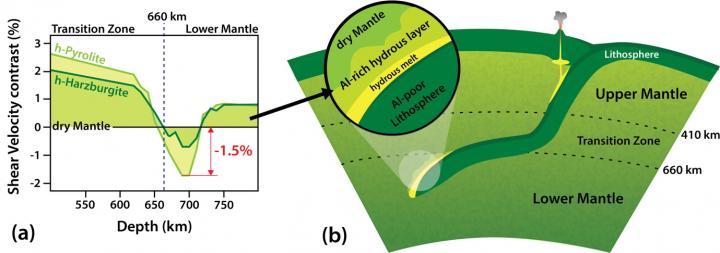
The researchers at Ehime successfully measured the longitudinal (VP) and shear (VS) velocities, as well as the density of Al-phase D, up to 22 GPa and 1300 K by mean of synchrotron X-ray techniques combined with ultrasonic measurements in situ at high P and and T, in the multi-anvil apparatus located at the beamline BL04B1 in SPring-8 (Hyogo, Japan). The results of their experiments provided a clear understanding of the sound velocities of Al-phase D under a wide P and T range, allowing for modelling the seismic velocities of hydrous rocks in the inner and outer parts of the subducted slab (Image 1). From these models they showed that the presence of an Al-rich hydrous layer including Al-phase D, in the uppermost lower mantle, would be associated with negative VS perturbations (-1.5%) while the corresponding VP variations (-0.5%) would remain below the detection limit of seismological techniques. These new data should greatly contribute to tracing the existence and recycling of the former subducted lithospheric crust and eventually the presence of water in the Earth’s lower mantle.

###

Media Contact
Public Relations Division
[email protected]

Related Journal Article

http://dx.doi.org/10.1029/2020GL088877

Tags: Earth ScienceGeophysics/Gravity
Share12Tweet8Share2ShareShareShare2

Related Posts

AI and Physics Collaborate to Design Advanced Hydrogen Storage Materials

June 25, 2026

International Team Including Dresden Scientists Develops Novel Designer Proteins for Advanced Study of Living Tissue

June 25, 2026

New Study Uncovers Key Factors Driving Water Chemistry in Nanoscale Environments

June 25, 2026

Plasma Technology Extends Catalyst Lifespan in Hydrogen Production

June 24, 2026
Please login to join discussion

POPULAR NEWS

  • Saying Goodbye to PGY-6: Pediatric Fellowship Realities

    103 shares
    Share 41 Tweet 26
  • Multi-Hospital Study Reveals Long Covid Burden Is Twice as High as Current Estimates

    92 shares
    Share 36 Tweet 23
  • Detection of EDCs in Breast Milk and Infant Urine Up to Six Months Highlights Early Exposure Risks

    77 shares
    Share 31 Tweet 19
  • New Drug Candidate Developed at McMaster Shows Potential for Treating Brain Cancer

    58 shares
    Share 23 Tweet 15

About

We bring you the latest biotechnology news from best research centers and universities around the world. Check our website.

Follow us

Recent News

Tracking Lanthanide-Labeled Microplastics in Plants

POSTECH Researchers Slash Cost of Reconstituted Cell-Free Systems by 95%

AI and Physics Collaborate to Design Advanced Hydrogen Storage Materials

Subscribe to Blog via Email

Success! An email was just sent to confirm your subscription. Please find the email now and click 'Confirm' to start subscribing.

Join 82 other subscribers
  • Contact Us

Bioengineer.org © Copyright 2023 All Rights Reserved.

Welcome Back!

Login to your account below

Forgotten Password?

Retrieve your password

Please enter your username or email address to reset your password.

Log In
No Result
View All Result
  • Homepages
    • Home Page 1
    • Home Page 2
  • News
  • National
  • Business
  • Health
  • Lifestyle
  • Science

Bioengineer.org © Copyright 2023 All Rights Reserved.